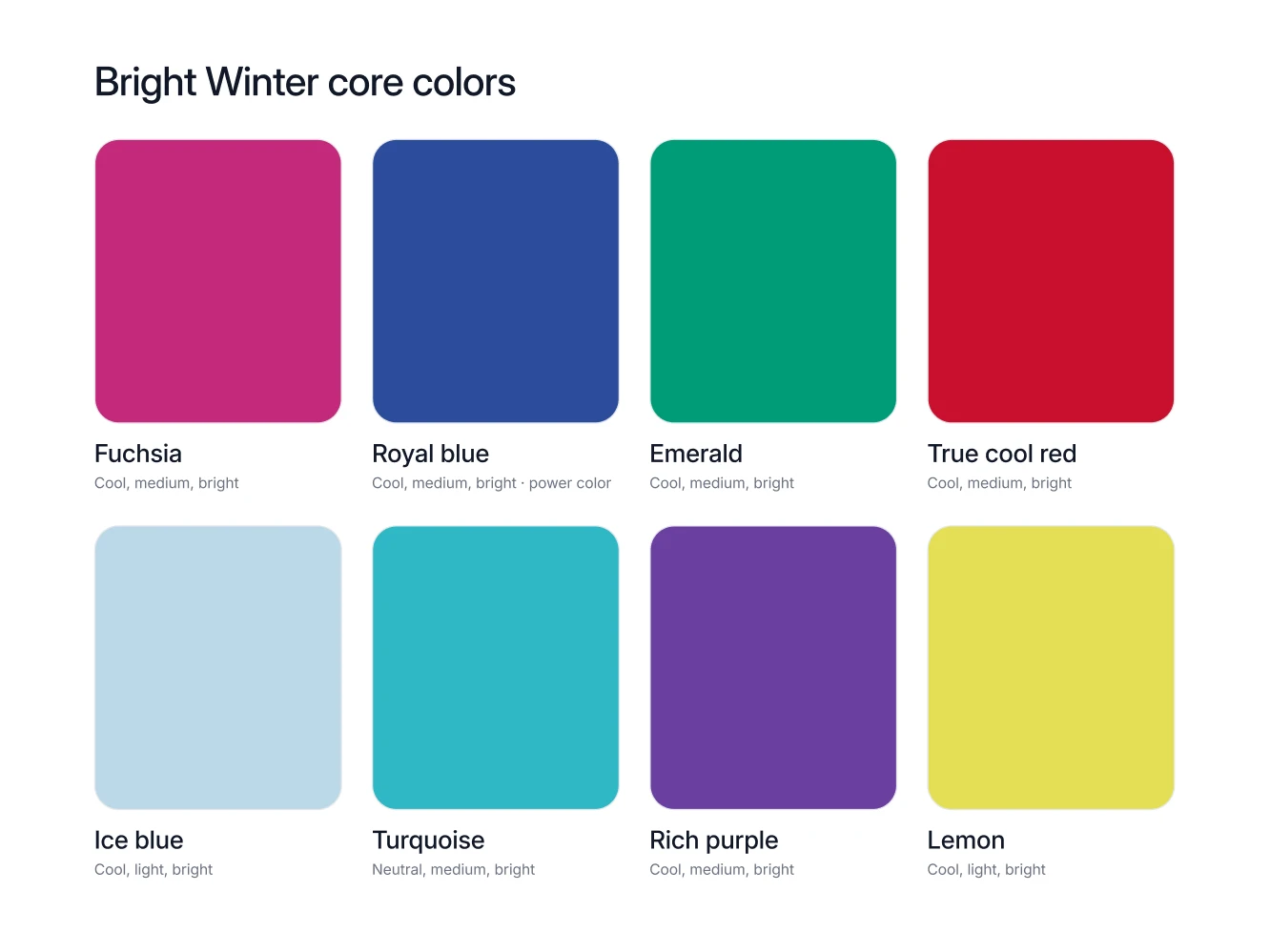
Bright Winter is the brightest season in the 12 season system. The undertone is cool-neutral, the value is medium, the chroma is very bright, and the contrast is very high. The palette runs on fuchsia, royal blue, emerald and lemon, held together by black, pure white and charcoal, with nothing earthy anywhere in it.
Am I a Bright Winter?
Bright Winter coloring is defined by brightness rather than darkness. The eyes are saturated and clear, often a striking blue, green or a bright cool brown. The usual pairing is dark hair with light skin, and the giveaway is photographs: your contrast reads as very high on camera, sharper than the people standing next to you.
The shop test is a fuchsia top against a camel one. Fuchsia should make your eyes look brighter and your skin look cleaner. Camel should make you look faded and slightly dusty. If bright wins that comparison by a distance, Bright Winter is the season to test first.
What Bright Winter actually means
Cool-neutral undertone. Cool, with a small tolerance for near neutral shades. Anything with a golden cast is still out.
Medium value. Bright Winter is not the dark end of the Winter family. Your colors sit in the middle and get their power from saturation, not depth.
Very bright chroma. This is the defining quality. Bright Winter needs color at maximum purity. Turn the saturation down and the palette stops working.
Very high contrast. Black next to pure white is not a bold choice for you, it is the baseline. Softly blended outfits look underpowered.
Your core colors
Fuchsia. One of the two power colors. Near the face, a fuchsia top or scarf does more than any neutral you own.
Royal blue. The most wearable of your brights. Royal blue knitwear and royal blue tailoring both work.
Emerald. Bright Winter green, clean and saturated. Good as a shirt, a knit or a dress.
True cool red. Blue based red, not an orange one. This is the coat and the lipstick color.
Ice blue. Bright Winter's light. It works as a color and as a pale neutral, which makes it unusually useful in shirts and summer pieces.
Turquoise on its cool edge. The bluer turquoise, not the warm green one. Best in one clear piece against black or charcoal.
Rich purple. Deep and saturated rather than soft. Rich purple holds its own against black without looking heavy.
Lemon. The surprise on the list. Clean cool lemon works on Bright Winter where a golden yellow would not. Wear it as a single accent.
Your neutrals, your white, your metal
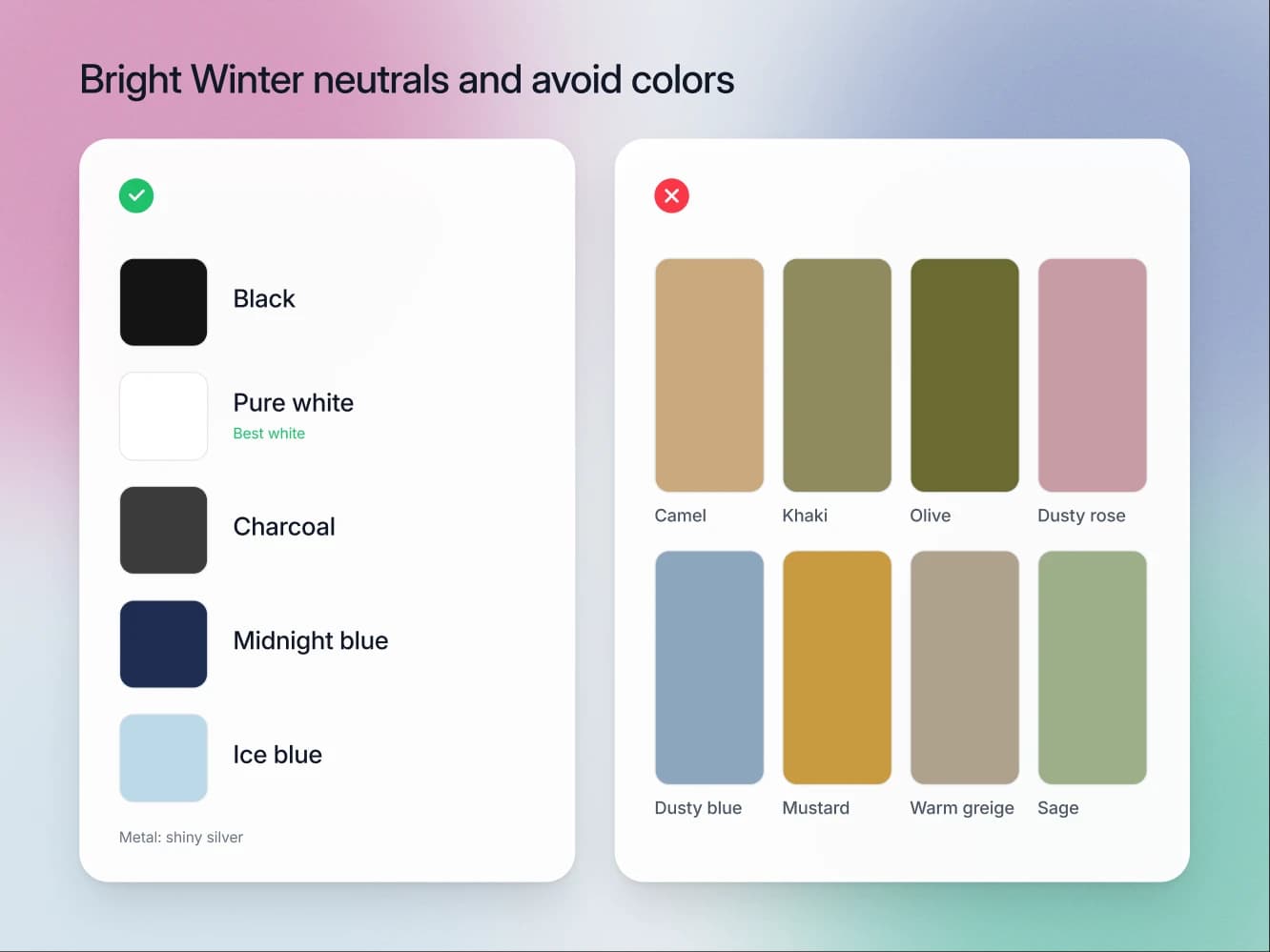
Bright Winter neutrals are black, pure white, charcoal, midnight blue and ice blue used as a light neutral. Ice blue is the interesting one. It gives you a pale option that stays cool and clean, which is something beige and camel could never do for this season.
Your white is pure white, and ivory is the white that fails you. Ivory is warmer and softer than pure white on both counts, so it lowers the top end of an outfit that needs its full range: the light half stops reading as properly light, the look goes underpowered, and the saturated eyes that make this season recognizable stop registering as bright. Next to pure white a Bright Winter face goes clear again. One shirt, and the whole light half of the wardrobe starts working.
Your metal is silver, and it should be shiny rather than brushed or antiqued. Polished steel, white gold, a high shine chain. A matte or aged finish takes the sharpness out of an outfit whose whole logic is sharpness.
Your power color is electric blue or bright fuchsia. Both are loud on purpose. On Bright Winter coloring they read as clarity rather than as noise.
The colors that fight you
Earthy muted tones. Anything that belongs to soil, wood or stone. Camel, khaki and olive all sit at low saturation, and low saturation is the exact quality Bright Winter has none of. The garment goes flat and your face goes flat with it.
Anything dusty. Dusty rose, dusty blue and their relatives have had gray mixed into them. Bright Winter reads that gray as fog. The outfit looks tired within an hour of putting it on.
Anything with a golden cast. Mustard, gold, warm beige and warm whites. A golden cast fights the cool-neutral undertone directly, and it is the most common reason a Bright Winter outfit looks slightly wrong with no obvious cause.
The pattern is simple enough to shop by. If a color looks soft, dusty or sunbaked on the rail, it is not yours, regardless of how good it looks on the hanger.
How to combine them
The Bright Winter formula is a neutral plus one sharply bright accent. Black trousers with a fuchsia knit. A charcoal suit with an electric blue shirt. Pure white with royal blue.
Black and white together is welcome here, which is not true for most of the 12 seasons. Use it as the base and add one bright thing on top. What does not work is spreading the brightness across three or four pieces at once, or letting an earthy accessory into the outfit. A camel bag will quietly undo a good Bright Winter outfit while the clothes themselves are still right.
Seasons this one gets confused with
True Winter. Both are cool, bright and high contrast, and both wear pure white and silver. The tell is lemon and turquoise. Both are Bright Winter core colors and neither belongs to True Winter, so if a clean lemon yellow works on you, you are on the Bright side. Bright Winter also sits at a medium value, where True Winter runs medium to deep.
Bright Spring. The same level of brightness with the opposite undertone. Bright Spring is the warm side of bright, Bright Winter the cool-neutral side. The tell is the golden cast. If warm brights with gold in them look better on you than fuchsia and ice blue do, look at Bright Spring instead. The metal settles it too, because Bright Winter wants shiny silver.
FAQ
Yes. Bright Winter and Clear Winter are two names for the same season.
Yes. Black with pure white is a welcome Bright Winter combination and one of the few palettes where it needs no softening at all.
No. Both are earthy and muted, which is the one thing this palette cannot carry. Charcoal, midnight blue and ice blue cover the same ground without going flat.
Yes. Lemon is a Bright Winter core color, as long as it stays clean and cool rather than golden. Wear it as one accent against black or charcoal.
Silver, and shiny. Gold brings a golden cast, and brushed or antiqued silver loses the brightness this season runs on.