Soft Summer: the most muted palette, and why black is the hardest rule in it
By Wearly Labs · Published · 7 min read
Soft Summer is the most muted season in the Summer family. Undertone runs cool-neutral, value sits medium, chroma is markedly grayed, and contrast is low. Sage, dusty rose, mauve, periwinkle. Every color looks like it has been left in soft daylight for a season. Clear color overwhelms this coloring, and so, quietly, does black.
Am I a Soft Summer?
Three signals, checked in daylight without makeup.
Eye clarity first, and it is the strongest tell here. A Soft Summer eye looks smoky rather than sharp, and the iris pattern blurs at conversation distance instead of resolving into clean lines. Contrast second. Squint at yourself in a mirror. If your hair, skin, and eyes blend into one soft band rather than separating into light and dark, your contrast is low, which is the Soft Summer default. Veins third. Soft Summer veins read blue, or mixed blue and green, which is what cool-neutral looks like at the wrist.
One more check. Put any pure saturated color near your face. If the color arrives before your face does, you are almost certainly a Soft Summer.
What Soft Summer actually means
Undertone: cool-neutral. Cool leaning, but not absolutely cool. That small neutral tolerance is why warm greige belongs in this palette and why a fully cool season like True Summer has no use for it.
Value: medium. Your coloring sits in the middle of the range. Nothing about a Soft Summer is pale, and nothing about it is deep.
Chroma: markedly muted. This is the defining trait. Every Soft Summer color is a grayed version of itself. Not dull, grayed. There is a real difference, and your mirror shows it in about four seconds.
Contrast: low. The gap between your hair, your skin, and your eyes is small, so outfits built on a large light to dark jump will always look like the outfit won.
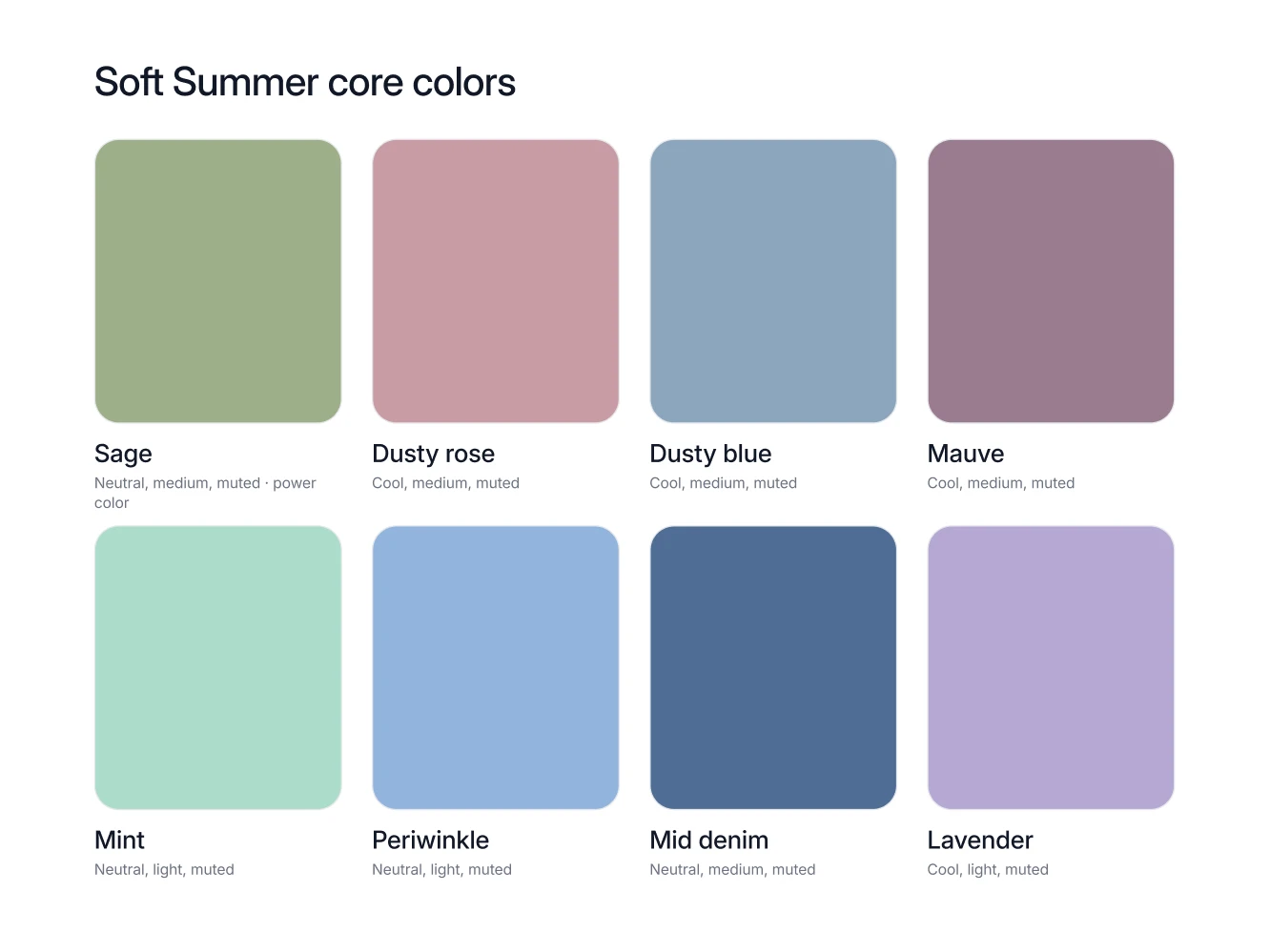
Your core colors
Sage. Your most versatile piece of color. A sage knit, a sage shirt, a sage coat, all of it works with mid gray and soft navy without a second thought.
Dusty rose. The near-the-face color. A dusty rose top or scarf gives your skin warmth without pulling anything golden into it.
Dusty blue. The shirt. Wear it with mid denim for a low contrast look that is far more flattering on you than a white shirt with black trousers.
Mauve. A knit, a dress, a blouse. Mauve is dusty rose with more depth, so use it when the outfit needs a little weight.
Mint. Your lightest green, best in warm weather and best in matte fabric. Shine adds the clarity Soft Summer is trying to avoid.
Periwinkle. Shirts, scarves, light knits. Periwinkle is the one blue in the palette that reads as color rather than as neutral.
Mid denim. A neutral, not an accident. Mid denim jeans, a mid denim shirt, a chambray dress. It is the exact value your face wants beside it.
Lavender. The lightest thing that should sit at your collar. Lavender over mid gray is a quiet, correct outfit.
Your neutrals, your white, your metal
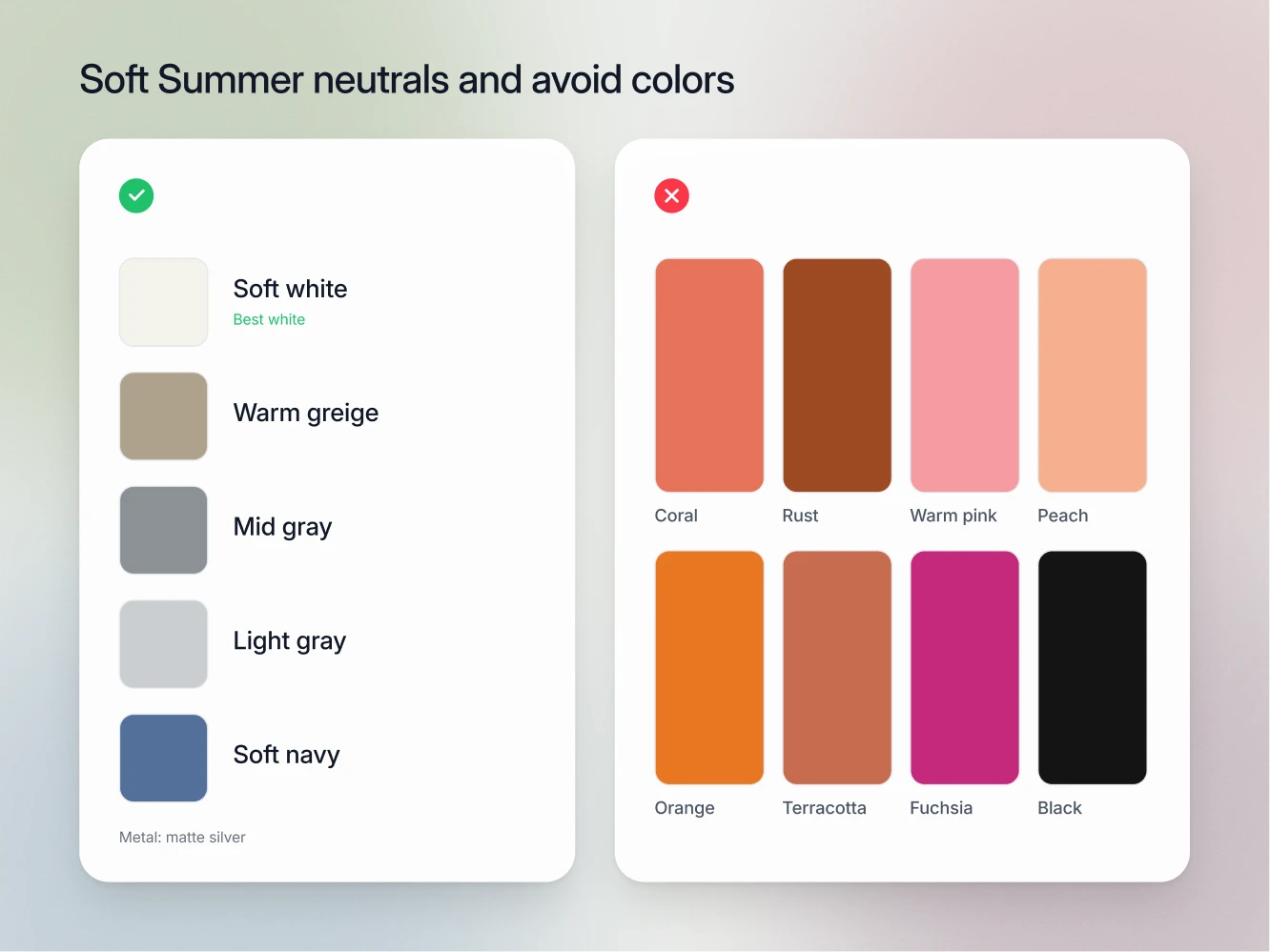
Soft Summer neutrals are soft white, warm greige, mid gray, light gray, and soft navy. Warm greige is the interesting one. It is the neutral cool-neutral coloring can carry that a fully cool season cannot, and it is why a Soft Summer can shop the greige end of a rail without hesitating.
Your white is soft white, and optic white is the white that fails you. Optic white arrives with a clarity that markedly muted coloring has no answer for, so the shirt reads sharp and the face above it loses its edges, features blurring into one another instead of resolving. Ivory brings in a warmth your cool-neutral undertone cannot absorb, so it reads slightly grubby. Soft white sits in between, muted enough to belong to you. One correct white shirt fixes more outfits than any accent purchase.
Your metal is matte silver. Matte, specifically. Polished silver adds a shine that behaves like clarity, and clarity is the one thing this season does not want. Brushed steel, matte silver, and white gold with a soft finish all work.
The colors that fight you
The Soft Summer avoid list is long, and it splits into three reasons.
Too warm. Coral, rust, warm pink, peach, orange, terracotta, mustard, golden yellow, light gold, and lemon. All of these push warmth at a cool-neutral undertone, which pulls yellow into the skin and deepens under-eye shadow.
Too saturated. Tomato red, true cool red, fuchsia, turquoise, royal blue, rich purple, and forest green. The problem here is not temperature, it is strength. Markedly muted coloring cannot hold its own beside a pure color, so the garment ends up wearing you.
Too dark. Black. This is the hard truth of the season, so here it is plainly: black is on the Soft Summer avoid list. It creates exactly the light to dark jump your low contrast face cannot answer, and beside it your features lose definition rather than gain it. Soft navy does the same anchoring job and does it kindly. Mid gray does it too. Between those two there is no job left that black was needed for, in trousers, a coat or a suit.
How to combine them
The rule is grayed adjacent tones, never pure saturated, always low contrast.
Adjacent means colors that sit near each other on the wheel and near each other in depth. Sage with mint. Mauve with dusty rose. Dusty blue with periwinkle with mid denim. Those combinations look expensive on a Soft Summer for the same reason they look bland on a high contrast season: nothing in them competes.
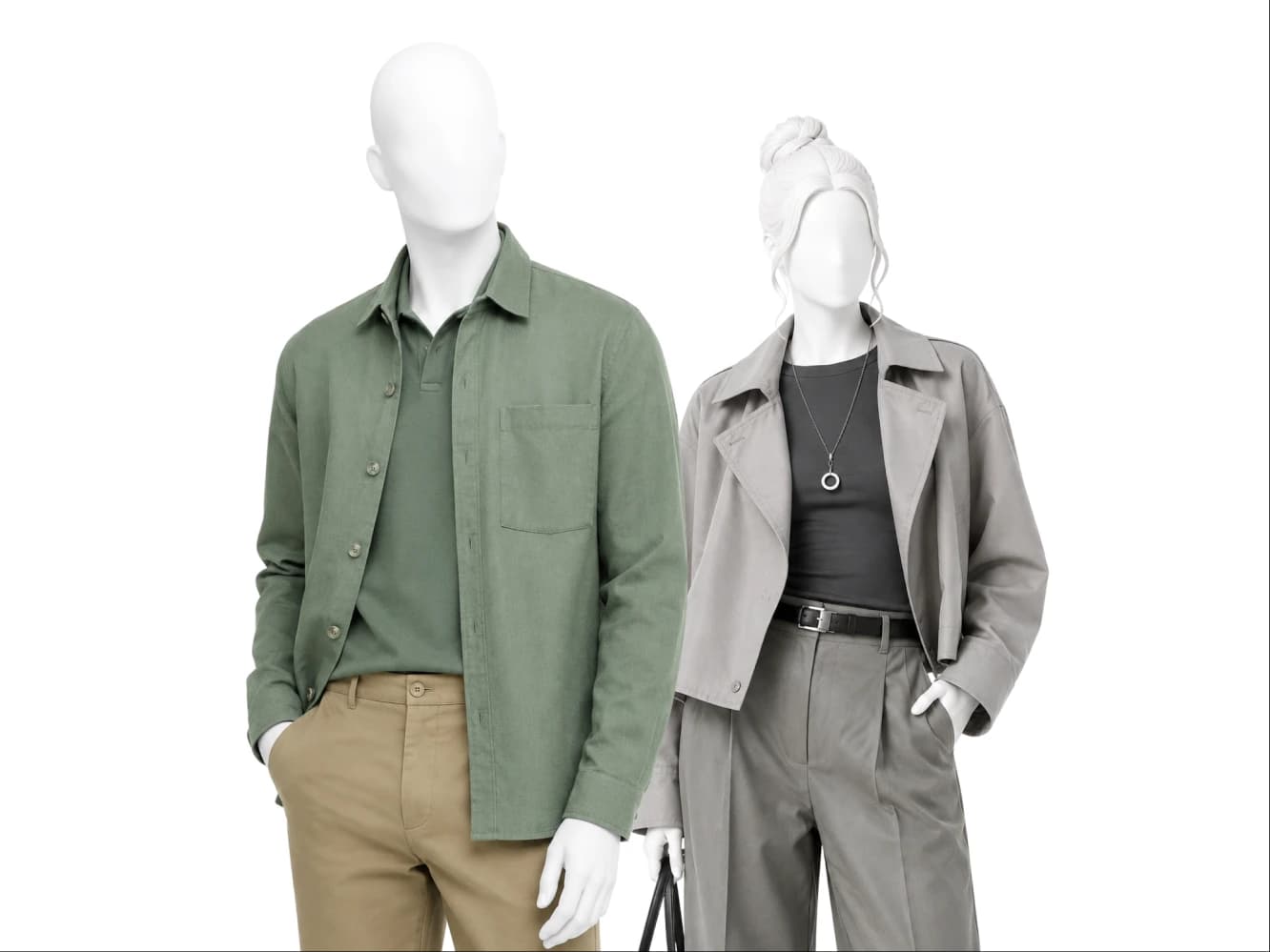
Then keep the value range narrow. Soft white top, mid gray trousers, warm greige coat is a full outfit with three neutrals and no jump. When you want a color moment, use muted raspberry as your power color, and mute it with the rest of the outfit. Muted raspberry with mid gray and soft white reads as intention. Muted raspberry with black and optic white reads as a color you borrowed.
Seasons this one gets confused with
Soft Autumn. Both are muted, both are low contrast, and both sit at medium value, which makes this the most common mix-up in the twelve season system. The tell is peach. Peach is a Soft Autumn core color and it is on the Soft Summer avoid list. Hold peach at your jaw. If it warms you, you are Soft Autumn. If it makes your skin look slightly sallow, you are Soft Summer. The white test agrees: Soft Summer wants soft white, Soft Autumn wants ivory.
Light Summer. Both are cool leaning and both are low contrast, so this one takes a second look. The tell is depth. Soft Summer sits squarely at medium value and needs its colors grayed, while Light Summer lives lighter and holds more clarity. Put mid denim and mid gray beside your face. If those mid tones give you definition rather than swamping your features, you are Soft Summer.
FAQ
Can a Soft Summer really not wear black?
Correct, black is on the avoid list, and it is the hardest rule in this season. Soft navy and mid gray give you the same grounded, serious effect without flattening your face.
What is the Soft Summer power color?
Muted raspberry. Wear it near the face and mute it with the rest of the outfit, so mid gray, soft white, and soft navy rather than anything clear.
Why matte silver and not regular silver?
Because shine reads as clarity, and Soft Summer is defined by the absence of clarity. Matte silver, brushed steel, and soft finish white gold all keep the surface quiet.
Is warm greige a mistake in a cool season?
No. Soft Summer is cool-neutral, not fully cool, and warm greige is exactly what that neutral tolerance buys you. It is a genuine Soft Summer neutral.
My favorite dress is royal blue. Do I give it up?
Royal blue is on the Soft Summer avoid list, and the reason is strength rather than temperature: at that saturation the blue arrives before your face does. The palette's answer is periwinkle, which gives you the same clean blue at a strength your coloring can hold, or muted raspberry if what you loved was the color moment rather than the blue itself.