A professional draping session gives you physical fabric against your skin in daylight, a person watching your face react, and answers to questions you did not know to ask. An AI color analysis usually gives you a result within ten minutes, for a fraction of the price, the same result every time if it decides by fixed rules, and something you can keep and search. They are not the same product, and the honest comparison is not which is better but which failure mode you can live with.
On this page
Side by side, with every price checked in October 2026 on the seller's own site:
| In person draping | Virtual consultation | AI color analysis | |
|---|---|---|---|
| Who reads your coloring | An analyst, by eye, with fabric at your face | An analyst, from your photos | AI, from your photos, and in some tools your answers too |
| The light | Daylight in the studio, makeup off | Whatever light your photos were taken in | Whatever light your photos were taken in, unless the tool corrects it against a white reference |
| A borderline case | Two drapes held up side by side, and a conversation | A judgment from the photos | Settled by the tool's rules or model |
| How long it takes | About 90 minutes in the studio | Results within 30 business days at the studio we checked | Minutes |
| What you keep | A swatch card or a color fan | Your results by email | A result screen, a chat thread, or a page of your own |
| Price | $240 for 90 minutes in Santa Clara, $645 with a franchise stylist in Brooklyn | $275 with Carol Brailey | Free in an AI chat, $29 once at Wearly Labs |
The four-way comparison gives selfie apps and AI chats columns of their own, with what each one includes beyond color.
What a professional does that software cannot
Real fabric under real light. No screen reproduces the way a fabric bounces color up into your jaw. A drape is a physical test. A photograph of a drape is a recording of one, and recordings lose information.
Reacting to you in the room. A good analyst notices that a particular green did something to your eyes and follows it. Software runs the same path every time, which is a strength when the case is clear and a weakness when it is not.
Handling ambiguity. Borderline cases are where the money is. If you sit between two neighboring seasons, a human can hold two drapes up in sequence, ask you which one you prefer, and factor that in. Software has to pick.
Answering the question behind the question. Many people who book an analysis are not really asking about color. They are asking why they feel invisible in photographs. That conversation is worth paying for and it is not a data problem.
What software does that a professional cannot
Repeat itself. Draping is judged by eye, so two analysts can read the same borderline face into two different seasons, and two schools can give the same face two different names: one draping franchise sorts people into four seasons, while analysts trained in the 12 tone method use twelve. A scoring system with fixed rules gives the same answer to the same inputs every time, which means when it is wrong, it is wrong in a traceable way. The sample analysis is a Deep Autumn, and its page names the sister season too: True Autumn, which is what the photos alone suggested before the answers decided it. A general AI chat is the exception: it writes a new answer every time you ask.
Give you something searchable. A session ends. You go home with a color fan and a memory. A page of your own is something you can open in a shop, with a verdict and its reason on every color, and a machine readable profile is one an AI assistant can read while you are deciding on a jacket.
Cost a fraction of a session. Which matters, because the people who most need this advice are usually the people who cannot spend a week of groceries on it.
Cover cuts as well as color. Many studios sell color and style as two separate appointments, each at full price: a franchise stylist in Brooklyn lists $645 for color and $810 for style, as of October 2026. Software has no reason to split them.
Not be in a city. Draping studios cluster in large cities, and some do not work online at all. Where you live should not decide what you know about your own face.
Where a virtual consultation fits
A virtual consultation is a trained analyst working from your photos instead of your face. It keeps the person and loses the fabric and the light: the analyst looks at the same kind of phone photo an app does, taken in whatever light you had. Carol Brailey's virtual analysis costs $275, with results by email within 30 business days (checked October 2026). Some studios will not do it at all: the four-season franchise above says its analysis is performed "in person in a studio with natural daylight, never online".
So a virtual session has the person's strengths and the photo's weakness. If you go that way, the section on light below applies to you as much as to any app.
What decides the accuracy, in every case
Light. That is most of the answer.
A professional session controls it. The same franchise drapes in natural daylight and asks you to arrive makeup-free, and the routine the Christian Science Monitor described in 1984 went further: hair bound up in a white cloth, makeup removed, a white smock over the clothes. Software reads a phone photo, often taken under a warm bulb, after the camera already guessed at white balance and the phone may already have adjusted the face or warmed the tone. Even a dedicated camera does not always remove a bulb's warmth: one of Canon's auto white balance modes keeps some of it on purpose.
This is fixable. Put a known reference in the frame, a plain sheet of white printer paper, and the correction becomes arithmetic. Any tool that does not ask for a reference is estimating your skin from an image whose colors have already been altered twice. How to take photos for an accurate color analysis has the full setup.
The rest is what sits on your face: makeup, a fresh tan, dyed hair. A draper and software are both asked to see past them, and both do better when they are not there.
How to settle two results that disagree
If a draper and an app, or two apps, gave you two different seasons, you can test the difference yourself.
- Pick the colors that differ. Take one color only the first season marks as Wear and one only the second does. Pure white against ivory is the quickest pair for undertone: in the sample analysis, ivory is a Wear at the collar, while pure white is a Depends, kept below the waist because it has "none of the warmth your face needs".
- Face a window in daylight, makeup off, hair pulled back, in a plain white or gray top.
- Wait a minute before you judge. Your eyes adjust to a change of light, and in a 1995 study that adjustment was about 90% complete after roughly 60 seconds.
- Hold each color under your chin and look at your skin, not the fabric. The right one leaves your skin looking even and clear. The wrong one makes it look gray, flushed or tired.
If both colors pass, your coloring sits near the border, and anything both seasons accept is a safe buy. If neither passes, retake the photos before you trust either result.
So which should I choose?
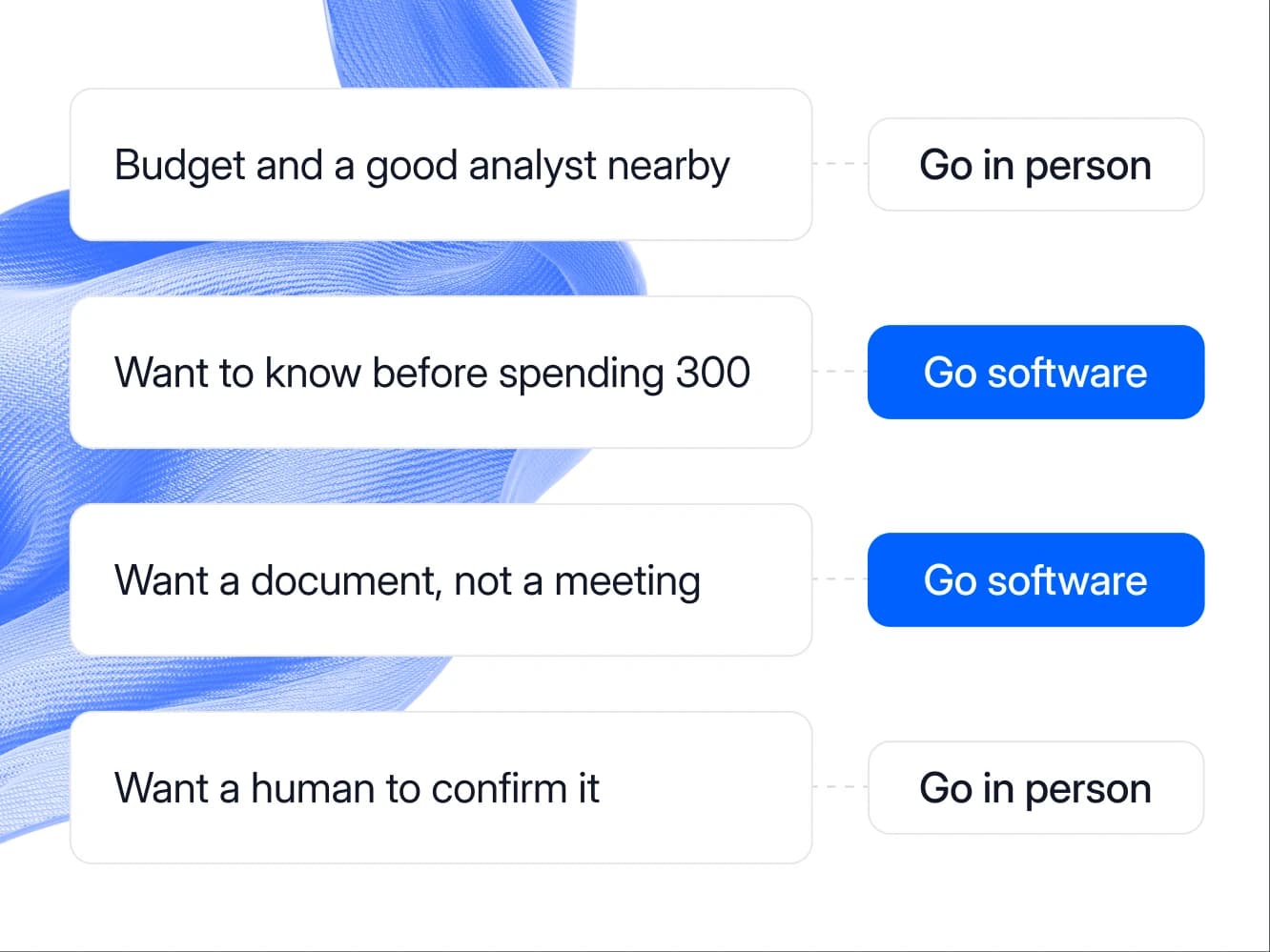
Choose a professional if you have the budget, you live near a good one, you know you are a borderline case, or the conversation is part of what you want.
Choose a virtual consultation if you want a person's eye, there is no studio within reach, and you can take your photos in good daylight.
Choose software if you want to know before you spend three hundred dollars, you want a page you can come back to rather than an appointment, you want cuts alongside color, or the nearest studio is two countries away.
And there is a fourth answer that people rarely say out loud: do both, in that order. A software read tells you roughly where you sit. If the answer surprises you, or you land on a boundary, that is when a session is worth the money, and you will walk in able to ask a much better question. Our method page says the same about our own results: the verdicts closest to a border between two seasons are where a daylight test with real fabric is worth your time.
The AI profile: common questions
It is as accurate as the photo it reads. From a photo with a known white in it, software can read undertone (warm or cool), value (light or deep) and chroma (clear or muted), the three traits a season is built on. From an uncalibrated one, it is guessing at the input, and no amount of model quality fixes a wrong input.
Not always, and the size of the gap tells you why. Neighboring seasons share their main trait and differ in one other, so a split between neighbors comes down to that one trait, and that is the one to test. In one published test, a writer whose professional analysis said Soft Summer got Soft Autumn from ChatGPT: both muted and medium in depth, with the undertone read as warm instead of cool. A split between opposites, such as Bright Spring against Soft Summer, is too wide for a borderline case: check the photos first.
Yes, if you spend meaningfully on clothes and a chunk of it goes unworn: one session can pay for itself in a year. If you buy four things a year, it will not.
Not all of them. A draping franchise with studios in the US and the UK works with four seasons refined into sub-seasons, the same four as Carole Jackson's bestseller Color Me Beautiful (1980), while other analysts use the 12 tone method. Wearly Labs places you in one of 12 seasons. Ask before booking, because a season name from one system does not translate cleanly into another.
It is the same seasonal idea, with makeup in the room. Korea's Doosan Encyclopedia describes the diagnosis in natural daylight between 10 am and 3 pm, with the hair under a white cover and a white cape over the clothes: a pink-based and a yellow-based foundation on either cheek, gold and silver fabric held to the hands, and a look at the veins on the wrist. It sorts people into four seasons by undertone and depth: Spring is warm and light, Summer cool and light, Autumn warm and dark, Winter cool and dark. What a session in Seoul costs is in our guide to color analysis prices.