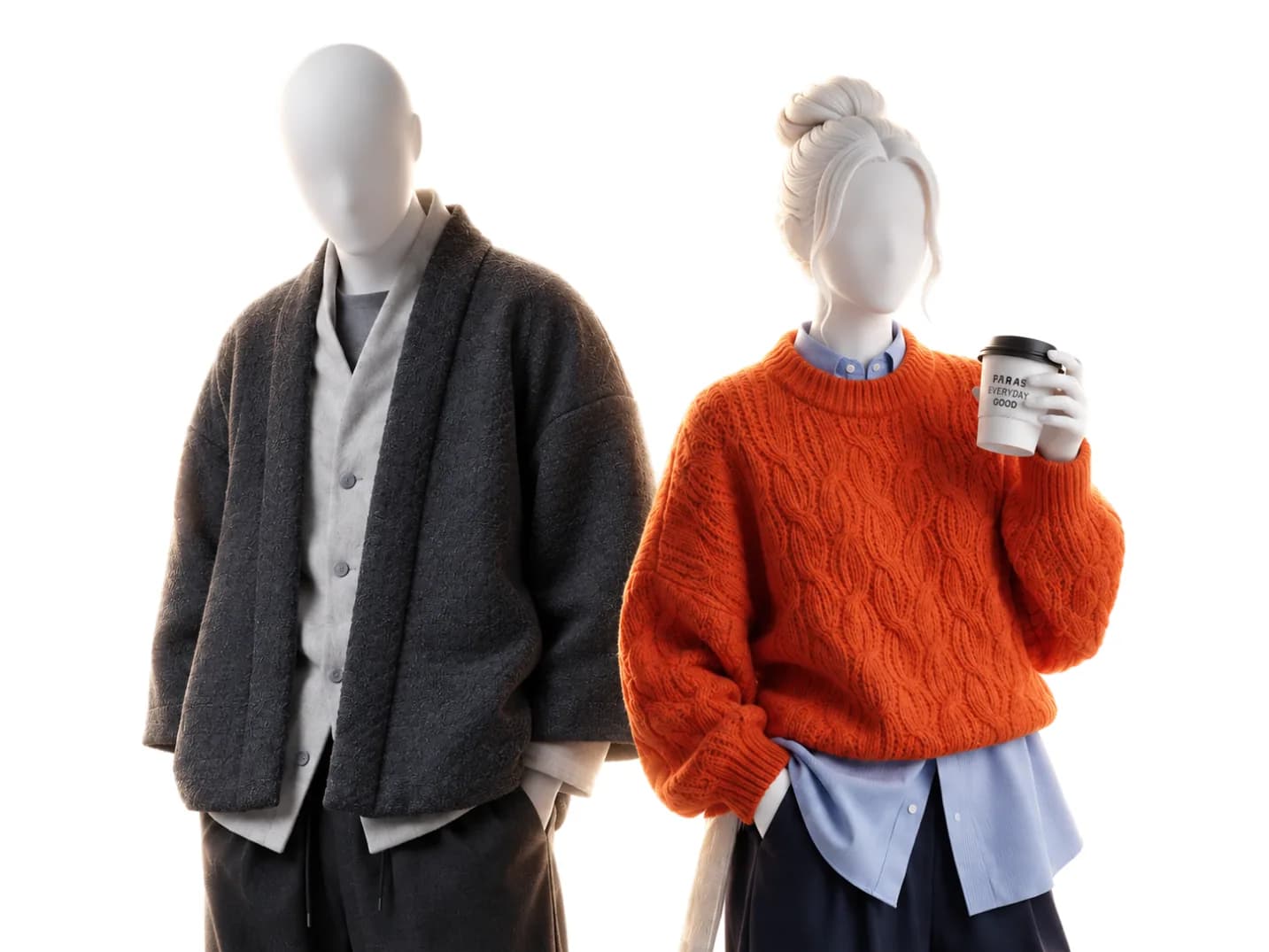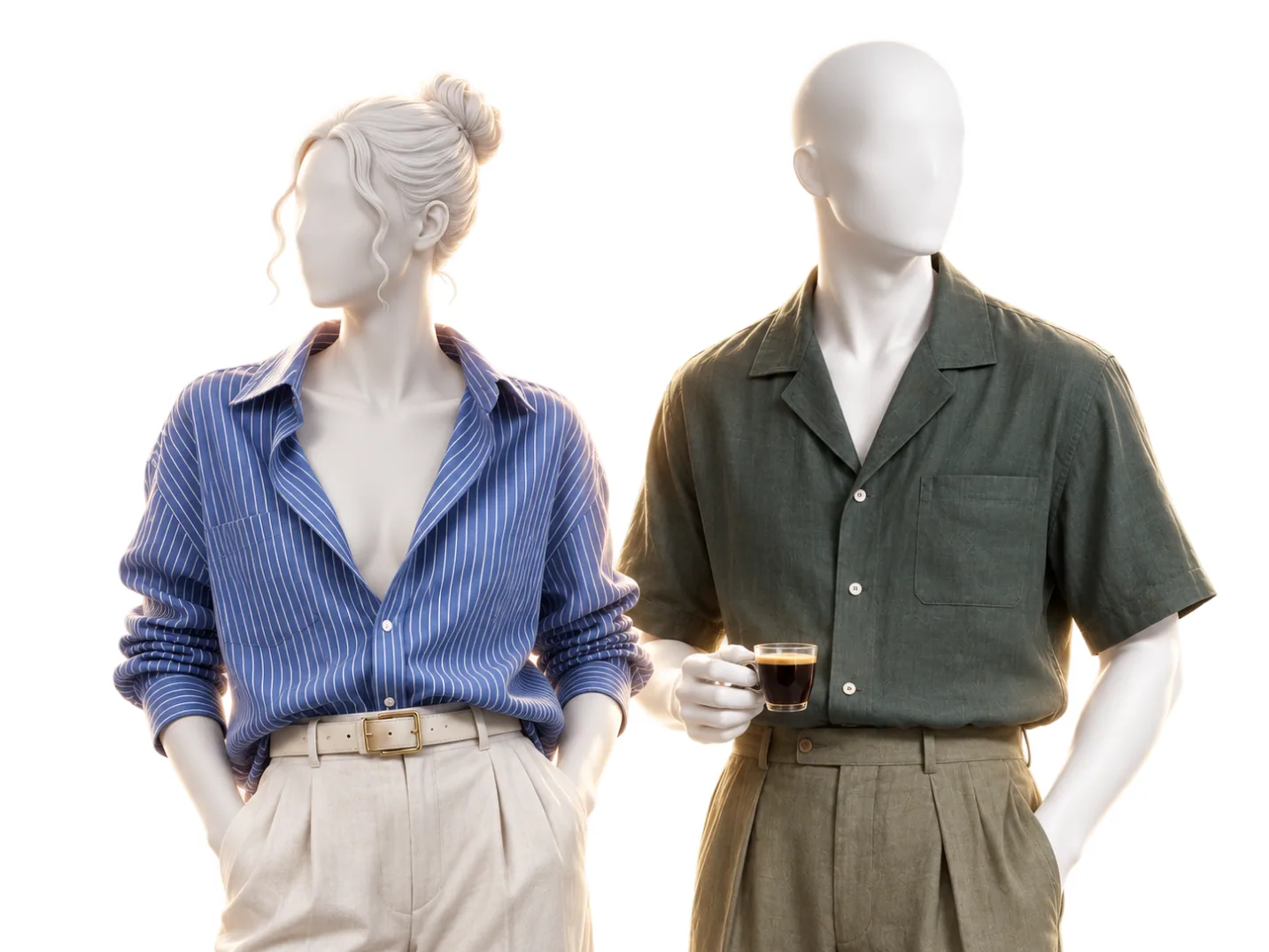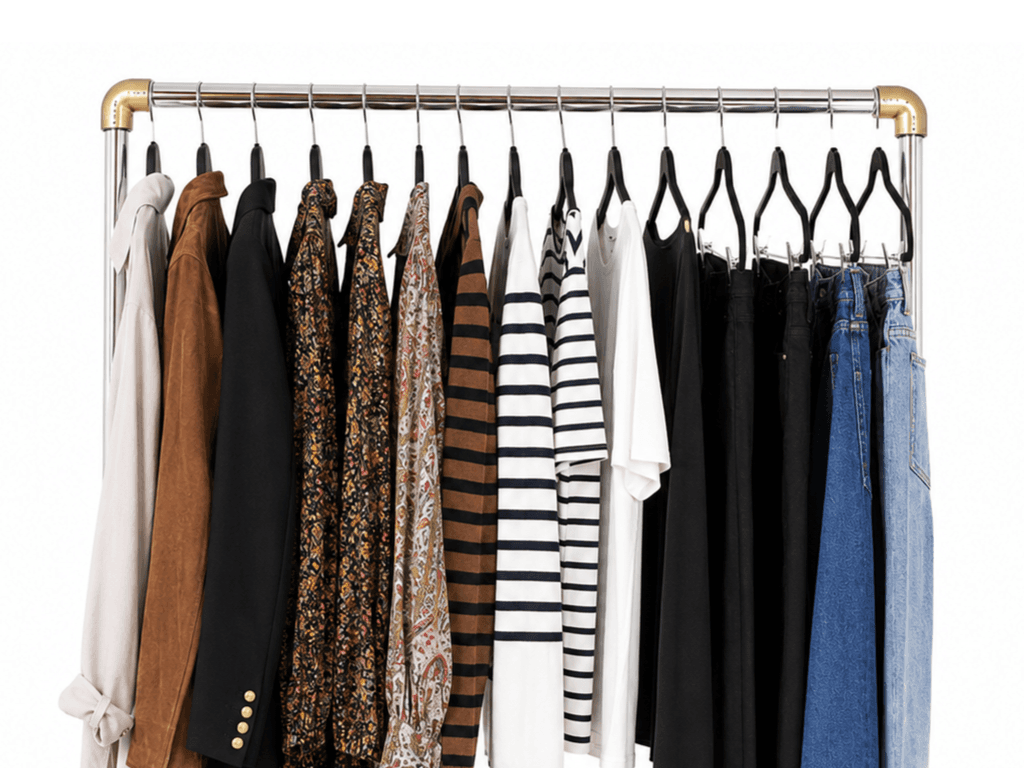
To choose colors for a capsule wardrobe, take seven from your color season: three neutrals, your best white, one dark anchor and two accents. Colors from one season share an undertone, a range of depth and a level of saturation, so every top in the capsule goes with every bottom.
On this page
The capsule wardrobe is a great idea that usually dies the same death: you buy twelve "versatile" pieces, and half of them refuse to be seen together. The navy fights the black. The beige argues with the white. Your capsule turns out to be three outfits and a pile.
The fix is to stop choosing pieces first. Choose colors first. When every color comes from one palette, combination stops being a skill and starts being automatic.
Why palettes make capsules work
A color season is not a list of pretty colors. It is a set of colors that share the same undertone, sit in a compatible range of depth, and match in saturation. Depth and saturation are what Albert Munsell called value and chroma in A Color Notation: value is "the quality by which we distinguish a light color from a dark one", chroma "the quality by which we distinguish a strong color from a weak one". When all three agree, nothing in an outfit is louder, paler, warmer or cooler than the rest, so a capsule built inside one season comes pre-mixed: any top with any bottom, no supervision needed.
That is the whole trick. Everything below is just applying it.
The formula: 3 + 1 + 1 + 2
Three anchor neutrals. The backbone: trousers, coats, knitwear, the pieces you buy again. A True Autumn takes camel, chocolate and olive; a True Summer takes light gray, medium gray and dusty blue. They carry most of your outfits.
One best white. Not "white." Your white. Ivory for Light Spring, True Spring and the three Autumns, soft white for Bright Spring and the three Summers, pure white for the three Winters. It goes under everything.
One dark anchor. Your version of black: the deepest color that grounds outfits without deadening your face. It is espresso or chocolate for True Spring, Bright Spring and the Autumns, soft navy for Light Spring and the Summers, and black for the three Winters, the only seasons that give black a Wear at the face.
Two accents. Your power color plus one more from your top verdicts. Accents live in knits, tees, and accessories, where they meet your face.
Seven colors. That is a complete system.
The formula for all 12 seasons
Each of the 12 season pages on this site lists five neutrals, and they fill five of the formula's seven slots: one white, one dark anchor, three neutrals. Deep Autumn and Deep Winter, which Wearly Labs calls Dark Autumn and Dark Winter, are listed under the Dark names. The two accents are the personal part: take them from your season's eight core colors.
| Season | Best white | Dark anchor | Three neutrals |
|---|---|---|---|
| Light Spring | Ivory | Soft navy | Latte, camel, warm greige |
| True Spring | Ivory | Chocolate | Camel, latte, khaki |
| Bright Spring | Soft white | Espresso | Camel, medium denim, soft navy |
| Light Summer | Soft white | Soft navy | Light gray, warm greige, dusty blue |
| True Summer | Soft white | Soft navy | Light gray, medium gray, dusty blue |
| Soft Summer | Soft white | Soft navy | Warm greige, medium gray, light gray |
| Soft Autumn | Ivory | Chocolate | Latte, warm greige, khaki |
| True Autumn | Ivory | Espresso | Camel, chocolate, olive |
| Dark Autumn | Ivory | Espresso | Chocolate, camel, midnight blue |
| Dark Winter | Pure white | Black | Charcoal, midnight blue, medium gray |
| True Winter | Pure white | Black | Charcoal, medium gray, midnight blue |
| Bright Winter | Pure white | Black | Charcoal, midnight blue, ice blue |
Read down the white column and you see why a capsule copied from someone else goes wrong at the collar. Ivory is a Wear for five of the twelve seasons, soft white for five, pure white for three, so whichever white you pick, it is not a Wear at the collar in at least seven of them.
A worked example: the 12-piece Light Spring capsule
To make it concrete, here is the formula filled in for one season, Light Spring (light, warm and low in contrast): ivory, soft navy, camel, latte, coral and warm aquamarine, with light denim standing in for the table's warm greige, since the Light Spring page gives denim a Wear as well.
- Ivory tee
- Ivory shirt
- Coral fine knit (power color, worn near the face)
- Warm aquamarine knit polo (second accent)
- Latte trousers
- Soft navy trousers
- Light-wash jeans
- Camel skirt or chinos
- Latte overshirt or soft blazer
- Camel coat
- Ivory sneakers
- Suede loafers in warm tan
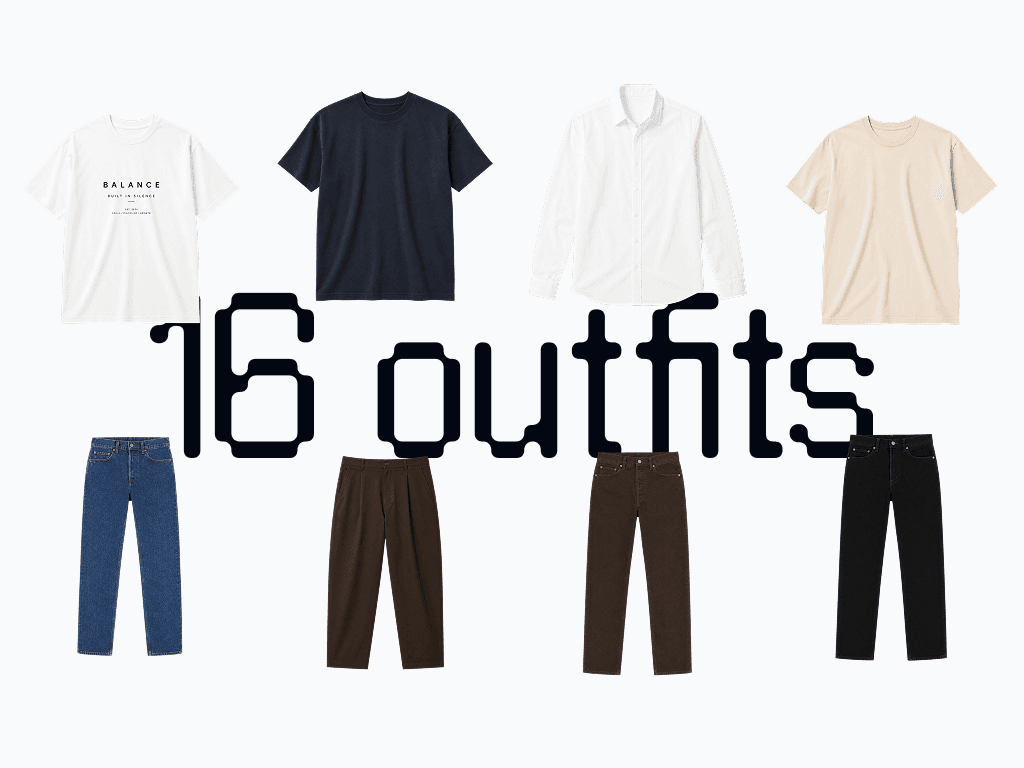
Run the math: 4 tops × 4 bottoms is 16 base outfits before you touch the layers. Add the overshirt and coat and you are past 30 combinations from 12 pieces, and every single one is in palette.
Different season? Same skeleton, different fill. A Dark Winter swaps ivory for pure white, soft navy for black, camel for charcoal and coral for a cool burgundy. The formula holds.
Where Wear, Depends and Skip go in a capsule
A Wearly Labs analysis gives each of its 50 colors a verdict and the reason for it. Each verdict has its own place in a capsule.
| Verdict | What it means on your page | Where it goes in a capsule |
|---|---|---|
| Wear | Anywhere, the face included | Tops and knits first, then anything else |
| Depends | Below the waist, or as an accent only | Below the waist: trousers, shorts, shoes. Accent only: a scarf, a belt, a bag |
| Skip | Not yours: it grays your skin or outshouts you | Nowhere, whatever the discount |
The middle row is the one that saves a capsule. A color that fails at your collar often works in your trousers, so your old neutrals rarely have to go. On the 12 season pages of this site, black, charcoal, espresso, chocolate, khaki and soft white are never a Skip, and each of the six works as trousers in every season. Black is a Wear at the face for the three Winters and a Depends, below the waist, for the other nine.
The collar test. In a shop, hold the piece under your chin in daylight. If your face looks clearer, it can be a top. If the color looks fine but your face looks tired or gray beside it, it can still be trousers: a Depends color only costs you something near the face.
The formula on a real analysis
The sample analysis is the real result of co-founder Filip Poláček: Dark Autumn, men's library. Of his 50 colors, 11 are a Wear, 22 a Depends and 17 a Skip, and 15 of the Depends are marked below the waist only. Here is the formula filled in from his verdicts, with wine and olive as the two accents, the colors his page says to lead with and to try.
| Slot | His color | Why, in his page's words |
|---|---|---|
| Best white | Ivory (Wear) | "A warm, soft neutral that gives your darker colors somewhere to rest." |
| Dark anchor | Espresso (Wear) | "Warm, deep and soft, this shade mirrors your coloring closely." |
| Neutral | Chocolate (Wear) | "Its warm, understated depth sits comfortably alongside your own." |
| Neutral | Camel (Wear) | "A dependable neutral that sits easily against your depth and warmth." |
| Neutral | Midnight blue (Wear) | "Its weight and quiet tone match the depth you carry." |
| Accent | Wine (Wear) | "Lead with it: knit or coat." |
| Accent | Olive (Wear) | "Muted and warm, it never fights the depth in your skin." |
| Trousers | Charcoal (Depends, below the waist) | "A steady neutral that anchors the lower half rather than the face." |
| Trousers | Black (Depends, below the waist) | "Clear and deep, but its coolness sits wrong close to your skin." |
His page puts the rule in one sentence: "Gray and lighter neutrals are too light to hold your depth at the collar, so send charcoal, medium gray and black to the trousers and shoes instead." Two of his six outfits pair a Wear shirt, midnight blue or wine, with charcoal trousers, and his Evening combination keeps black in the trousers.
Copy the Light Spring capsule above onto him and only two of its seven colors survive. Ivory and camel are a Wear for him. Coral and warm aquamarine are a Skip, soft navy is an accent only, and latte and light denim go below the waist.
Cuts get the same verdicts. For his trapezoid shape and medium line, the sample analysis starts with a heavy tee, a hoodie, straight denim and a structured classic suit. Of straight denim it says: "Its waistband and seat are cut for this frame, so the leg falls straight without pulling." It skips the boxy overshirt: "So much spare cloth in the chest pockets and body that your own shape vanishes." In a capsule, choose the color first, then check each piece's cut against your shape and line.
Three rules that keep it working
- Accents near the face, workhorses below. Your accent colors do the most good in tops and knits. Neutrals can live anywhere your page allows, and a neutral marked Depends stays below the waist.
- Buy inside the palette or don't buy. The capsule dies by exceptions. That mustard sweater at 60 percent off is only a bargain if mustard is on your list.
- Texture replaces print. With seven colors, variety comes from fabric: ribbed knit, suede, denim, crisp poplin. Texture mixes; loud prints negotiate.
FAQ
There is no standard number: three well-known systems run from 7 to 37 pieces. Donna Karan built her first collection on Seven Easy Pieces: a bodysuit, a tailored jacket, a skirt, pants, a cashmere sweater, a leather jacket and an evening look. Courtney Carver's Project 333 allows 33 items for three months, counting clothing, accessories, jewelry, outerwear and shoes. Un-fancy's capsule is 37 pieces: tops, bottoms, dresses, outerwear and shoes. The 12 pieces here are the core the color formula needs, and anything added later comes from the same seven colors.
More than about ten. Seven works for a 12-piece capsule: your white and your dark anchor each take a slot, and the accents get two. Other guides count the palette lower, The Capsulist at 3 to 4 core neutrals and 1 optional accent and The Elegance Edit at 4 to 6 colors. Past ten colors you are no longer building a capsule, you are building a regular wardrobe with extra steps.
Sort what you own against your palette before you buy anything. Wear colors keep the tops and knits, Depends colors move to trousers, shoes and bags, and Skip colors leave the rotation. What is left shows which of the seven slots is empty, and that is your shopping list. Your analysis gives you the verdicts; your season's page above gives you the white, the anchor, the neutrals and the colors to skip.
Usually yes, below the waist. Black is a Wear at the face only for the three Winters, and every other season page on this site gives it Depends, below the waist, which keeps black trousers, jeans and shoes in the capsule. Above the waist your dark anchor does black's job: espresso, chocolate or soft navy.
Treat leather goods as neutrals in your palette's temperature: camel, brown and espresso for the warm seasons, black, charcoal or soft navy for the cool ones. Shoes and bags sit below the waist, so a color your page marks Depends works there too. Two pairs of shoes cover a capsule.
No. Same colors, different fabrics. The palette does not change with the weather; linen and wool do.
Find it first, because the formula has nothing to plug into without it, and guessing your palette and building 12 pieces on the guess is the expensive way to find out. Two checks narrow it at home. Read your undertone (here is how). Then hold ivory, soft white and pure white under your chin in daylight, and pick the white that makes your face look clearer rather than the fabric look brighter. Ivory points to Light Spring, True Spring and the Autumns, soft white to Light Spring, Bright Spring and the Summers, pure white to the Winters. It narrows the table above to a family, and your analysis settles the season.