Last updated: October 11, 2026. Every price comes from the seller's own page, an app store listing or a booking platform, read without buying anything and last checked on October 11, 2026, in US dollars. Won are converted at 1,350 won to the dollar and pounds at 1.32 dollars to the pound, from the ECB reference rates of October 2, 2026.
On this page
- Why the same service costs 6 dollars and 645 dollars
- What each price band buys you
- Is Korea really that much cheaper?
- Why do prices vary so much within one country?
- What does the cheap end actually miss?
- What should a result contain, whatever you pay?
- Is a color analysis worth it at any price?
- Color seasons: common questions
- Related reading
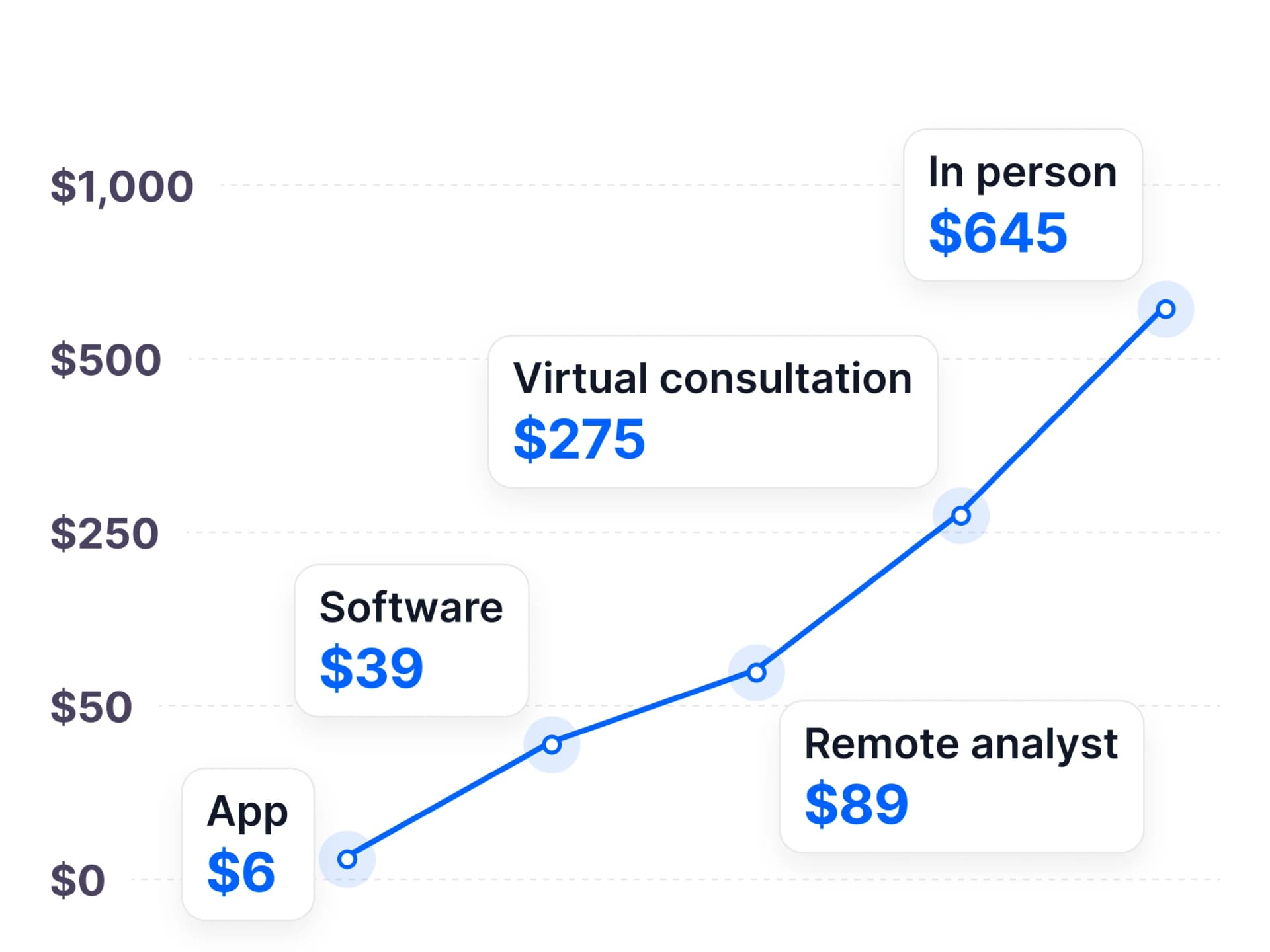
A color analysis costs 6 to 59 dollars as software you buy once, 4 to 20 dollars a month as an app subscription, and 240 to 645 dollars per person for a session in person at the US sellers we read, as of October 2026. At the three UK franchise stylists we read, a session costs 265 to 295 pounds, about 350 to 390 dollars. In between are a remote analysis by a person at 50 to 100 dollars and a virtual consultation at 275 to 400. The spread is enormous, and the price alone does not tell you what separates the bands. This article does, and every price links to the page it came from.
Why the same service costs 6 dollars and 645 dollars
Three things drive the price, and only one of them is the analysis itself.
Whether a human looks at you. A trained analyst holding fabric next to your face in daylight is labor, and labor is most of the price. A session runs 90 minutes at The Color Studio in Santa Clara, two hours at US franchise stylists and about two and a half hours at UK ones. Software costs very little for each extra client, which is why it can charge single digits.
Whether you are paying for a brand. One franchise (houseofcolour.com/color) calls itself the world's number one personal styling franchise, with more than 400 franchise owners. Its franchise page lists a franchise fee of 30,000 dollars, a royalty of 4 percent or 175 dollars a month and a technology fee of 125 dollars a month. That system sits behind the session price, along with the take-home fan of swatches.
Whether it is a session or a file. A session includes conversation, questions, and someone talking you through your own face. A file is a file.
What each price band buys you
Prices as of October 2026, each linked to its source.
| Band | Price and sellers, October 2026 |
|---|---|
| Selfie app, one time | 6 to 15 USD. MySeason 5.99, What Colors Suit Me 9, Colorwise 14.99 for lifetime premium |
| Selfie app, subscription | 4 to 20 USD a month. Style DNA 7.99 to 19.99 a month, 14.99 to 24.99 for three months or 29.99 to 39.99 a year. Dressika is free to download, from 4.49 a month, with in-app purchases up to 40 |
| Full software analysis | 19 to 59 USD, one time, depending on the country. Palette Hunt 29, 39 or 59 in the US, from 19 when opened from Europe, ColorAnalysisTech 39, Wearly Labs $29 |
| Remote analysis by a person | 50 to 100 USD. InMyTone 89, Sterling Style Academy 49.97, or 97.97 with a video call |
| Virtual consultation | 275 to 400 USD. Carol Brailey 275 or 350, My Authentic Colors 397 |
| In person, Seoul | 60 to 140 USD. COCORY 140,000 won for 60 minutes or 80,000 for a 30 minute mini session at one branch, Color Signal 150,000 won, or 190,000 on Creatrip with interpretation. Won at 1,350 to the dollar |
| In person, US and UK | 240 to 645 USD. The Color Studio 240, The Outfit Curator from 299, franchise stylists 295 to 645 in the US and 265 to 295 pounds in the UK |
What each band gets you for that price:
| Band | What you get |
|---|---|
| Selfie app, one time | A season and a palette from one to three selfies. |
| Selfie app, subscription | A season plus extras that need an ongoing plan, such as a body type guide and daily outfits from clothes you own. |
| Full software analysis | Season, palette, sometimes body shape and generated outfit images, in minutes. |
| Remote analysis by a person | A person reviews your photos and sends a written analysis, sometimes with a video call. 72 hours on average at InMyTone. |
| Virtual consultation | An analyst works from your photos. Results take up to 30 business days at Carol Brailey, a 30 minute video call is 125 dollars extra and swatch kits are sold separately. |
| In person, Seoul | 30 to 60 minutes with a colorimeter, fabric draping and a palette. |
| In person, US and UK | 90 minutes to two and a half hours of draping in daylight, take-home swatches or tools, and a person answering your questions. |
Sellers on Fiverr and Etsy also sell a color season from photos. Both sites block automated reading, so we could not check a live price and left them out of the table. For the software band in detail, see the best AI color analysis tools, compared. For a consultant, an AI chat, a selfie app and Wearly Labs side by side, see the four-way comparison.
Is Korea really that much cheaper?
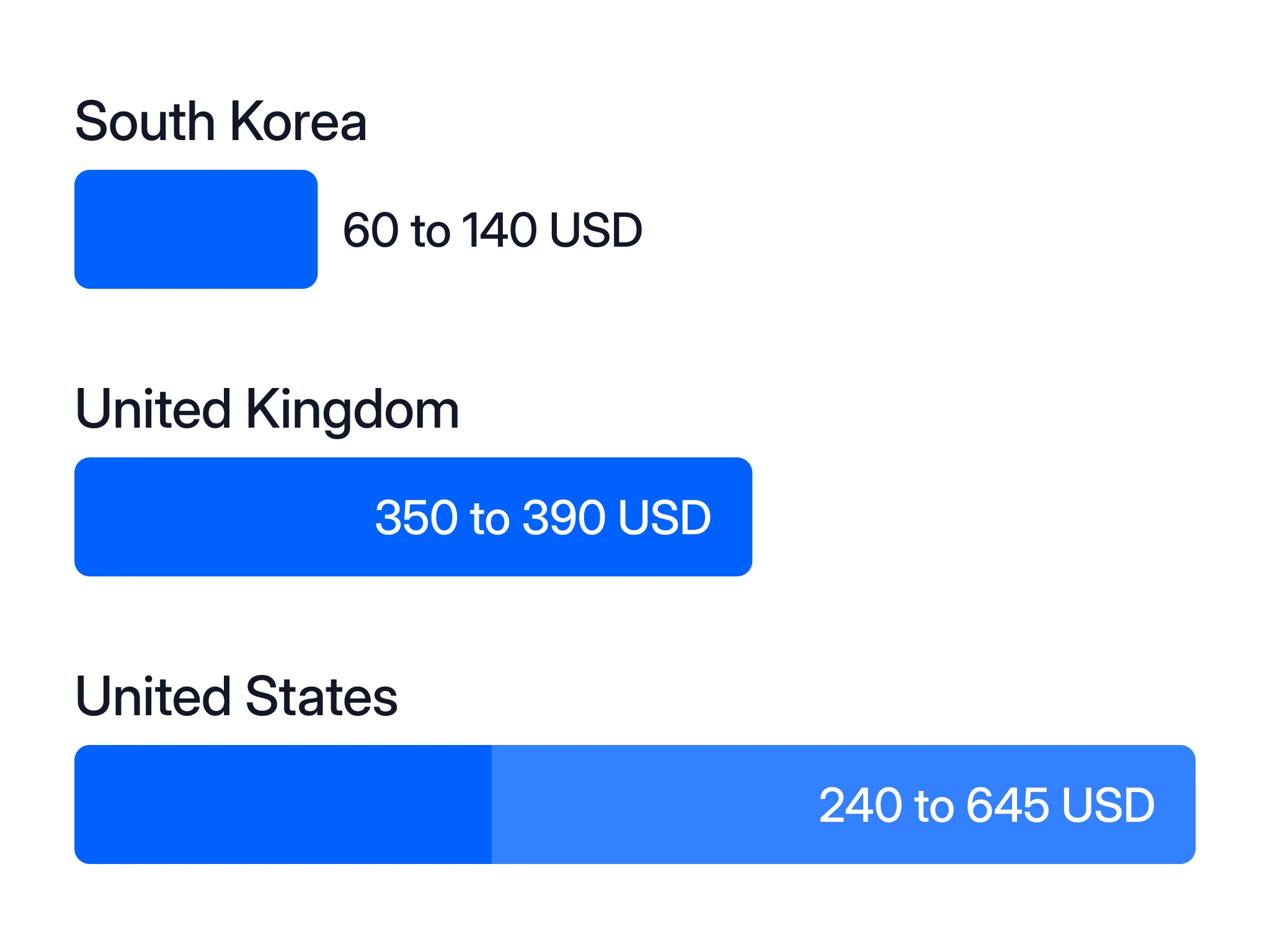
Per session, yes. Per hour, only partly. COCORY charges 140,000 won for a 60 minute session and Color Signal 150,000 won, about 104 and 111 dollars, under half of the US prices in the table. But Korean sessions are shorter: at COCORY that is about 104 dollars an hour, against about 160 at The Color Studio and 140 to 156 at UK franchise stylists. Color Signal's one person session lists at 190,000 won, about 141 dollars, on Creatrip, a travel booking platform, with interpretation included. That brings the hourly price to the UK level.
Groups lower the price per person. At Color Signal two people pay 240,000 won in total, 20 percent less each than a single booking, and four pay 380,000, 37 percent less each. Longer sessions cost more: The Korea Times reported in September 2026 that personal color has grown from a niche trend into a mainstream industry in Korea, and quoted one Seoul lab at roughly 200 dollars for a three hour session.
Why do prices vary so much within one country?
Even one franchise has no single price. Inside it, the booking pages we read show 295 dollars on one stylist's page, 395 on another's and 645 in Brooklyn on a weekend, with 10 percent off on weekdays. The UK is tighter, 265 to 295 pounds, and one stylist charges 265 on weekdays and 280 on Saturdays. Independent studios can sit lower: The Color Studio charges 240 dollars for one person, 215 each for two and 185 each for three. If you are price shopping, compare two or three booking pages, and check the session length and what is included before the price.
What does the cheap end actually miss?
Two things.
Calibration. A phone camera decides what white is before any app sees the photo, and a bathroom light shifts your skin before the camera does, so a tool that reads a selfie inherits both. Good light helps: Palette Hunt asks for a selfie in natural daylight facing a window, and the developer of Dressika tells an App Store reviewer that results reflect varying lighting conditions. Light is not a reference, though. Wearly Labs asks for a sheet of white paper in the frame and uses it to correct the light, so the correction starts from a white we know is white.
Cuts. Most sellers in the table stop at color or sell body shape separately. The Outfit Curator sells its body, face and style analysis for 299 on top of its color session, and Style DNA sells its body type guide as an extra, together with a palette, for 12.99. Your palette tells you which navy to buy. It does not tell you whether that jacket should be structured or unstructured, or where your trousers should sit, and a wrong cut looks wrong in the right color. Wearly Labs reads your shape and line in the same analysis as your colors.
What should a result contain, whatever you pay?
A season name is a label. A result you can shop with has a verdict for every color and the reason next to it, including for the colors you love that are not yours.
The sample analysis shows what that looks like. It is the real result of our co-founder Filip, published with his consent, and all 50 colors get a verdict: 11 are Wear, 22 are Depends (below the waist or as an accent only) and 17 are Skip. Khaki is a Depends: "Too soft in depth for your face, it settles fine on the lower body." Emerald is a Skip: "Its undertone runs the opposite way from yours, so it fights your skin." Cuts get the same treatment. The heavy tee is a Wear: "Straight seams follow your frame, so it hangs clean without pulling anywhere."
One test costs nothing, and it comes from the same page. In a shop, hold the piece against your skin in daylight. If it still looks rich and warm rather than washed out, take it home. The words change with your coloring, the test does not.
Is a color analysis worth it at any price?
It depends on how much you spend on clothes. The break-even is arithmetic: a 300 dollar session pays for itself when it stops you buying three 100 dollar pieces you would not have worn. If you buy four or five pieces a year, a 645 dollar session will not pay for itself. If you spend two thousand a year and a third of it hangs unworn, almost any of these bands is cheap. The honest framing is not what a color analysis costs. It is what buying the wrong things costs, repeated for a decade. If you are weighing a person against software, AI color analysis vs a professional consultation goes through what each one does better.
Color seasons: common questions
It costs 6 to 59 dollars as software you buy once, 4 to 20 a month as an app subscription, 50 to 100 dollars when a person reviews your photos, 275 to 400 as a virtual consultation, and 240 to 645 per person for a session in person at the US sellers we read, as of October 2026. The table above links every price to its source.
A session with a UK franchise stylist costs 265 to 295 pounds at the three we read, about 350 to 390 dollars, for roughly two and a half hours, as of October 2026. Prices differ by stylist: one charges 265 pounds on weekdays and 280 on Saturdays, another 295. Bringing a friend lowers the price per person to 230 to 260 pounds.
A virtual consultation costs 275 to 397 dollars at the two sellers we read, and a person reviewing your photos costs 50 to 100. Carol Brailey charges 275 or 350 dollars and delivers within 30 business days. On the 350 dollar package, a 30 minute video call is a 125 dollar add-on. My Authentic Colors charges 397. For a faster and cheaper version, InMyTone charges 89 dollars with results in 72 hours on average.
Not reliably. Price mostly tracks labor and brand, and the systems behind the prices differ: Carol Brailey's method sorts you into one of 35 results, Palette Hunt uses 16 seasons, and apps such as MySeason, Dressika and Colorwise's My Best Colors use 12. Two sellers can name the same face differently at any price. What a higher price does buy is a person handling ambiguous cases, and physical fabric, which no screen reproduces exactly.
Because an analysis is a one-time result, a subscription is usually paying for something else. Style DNA's 7.99 to 19.99 a month, for example, bundles the color analysis with a body type guide, a style type and five outfit ideas a day from clothes you already own. If you only want the analysis, a one-time price is the cleaner structure: MySeason, Colorwise's lifetime premium, Palette Hunt on its website, ColorAnalysisTech and Wearly Labs all charge once.
Usually not for your season, but sometimes for your shades. Kettlewell says going gray will not turn a Spring into a Winter, but the best colors inside your palette may shift, and the most common shift for Winters is that black and white stop working so well. Methods differ, though: Sterling Style Academy treats hair color as a major factor in your coloring. Where a re-analysis is sold it costs less than the first one: one UK stylist charges 140 pounds, or 190 with a new fan and booklet.
As a first sort into warm or cool, often. As a final season, less often. What Colors Suit Me gives a season estimate and a 12-color palette for free from one to three daylight selfies, and sells a handbook for 9 dollars. A quiz that asks you to judge your own vein color or tan is asking about things you cannot see well on yourself, which is the exact problem an analysis is supposed to solve.
Software takes minutes. A person reviewing your photos takes 72 hours on average at InMyTone, and a virtual consultation takes up to 30 business days at Carol Brailey. In person, you walk out with it after 90 minutes to two and a half hours.