Deep Winter and True Winter are both cool, high contrast Winters, and the difference is which quality leads: True Winter is cool first, Deep Winter is deep first, and both are fully cool. Four colors show it: wine, plum and forest green suit a Deep Winter and not a True Winter, while ice blue is a whole-shirt color for True Winter but only an accent for Deep Winter. Forest green under your chin is the quickest test.
On this page
- Deep Winter vs True Winter at a glance
- The short answer: the forest green test
- Where the two seasons agree
- Where Deep Winter and True Winter split
- The four colors that change verdict
- The forest green swap, step by step
- What you lose if you pick the wrong season
- If the forest green test does not settle it
- Deep Winter vs True Winter: common questions
Deep Winter vs True Winter at a glance
- What leads: depth in Deep Winter, coolness in True Winter, on a fully cool undertone in both.
- What they share: pure white, silver, black at the face, and the same verdict on 46 of the 50 colors.
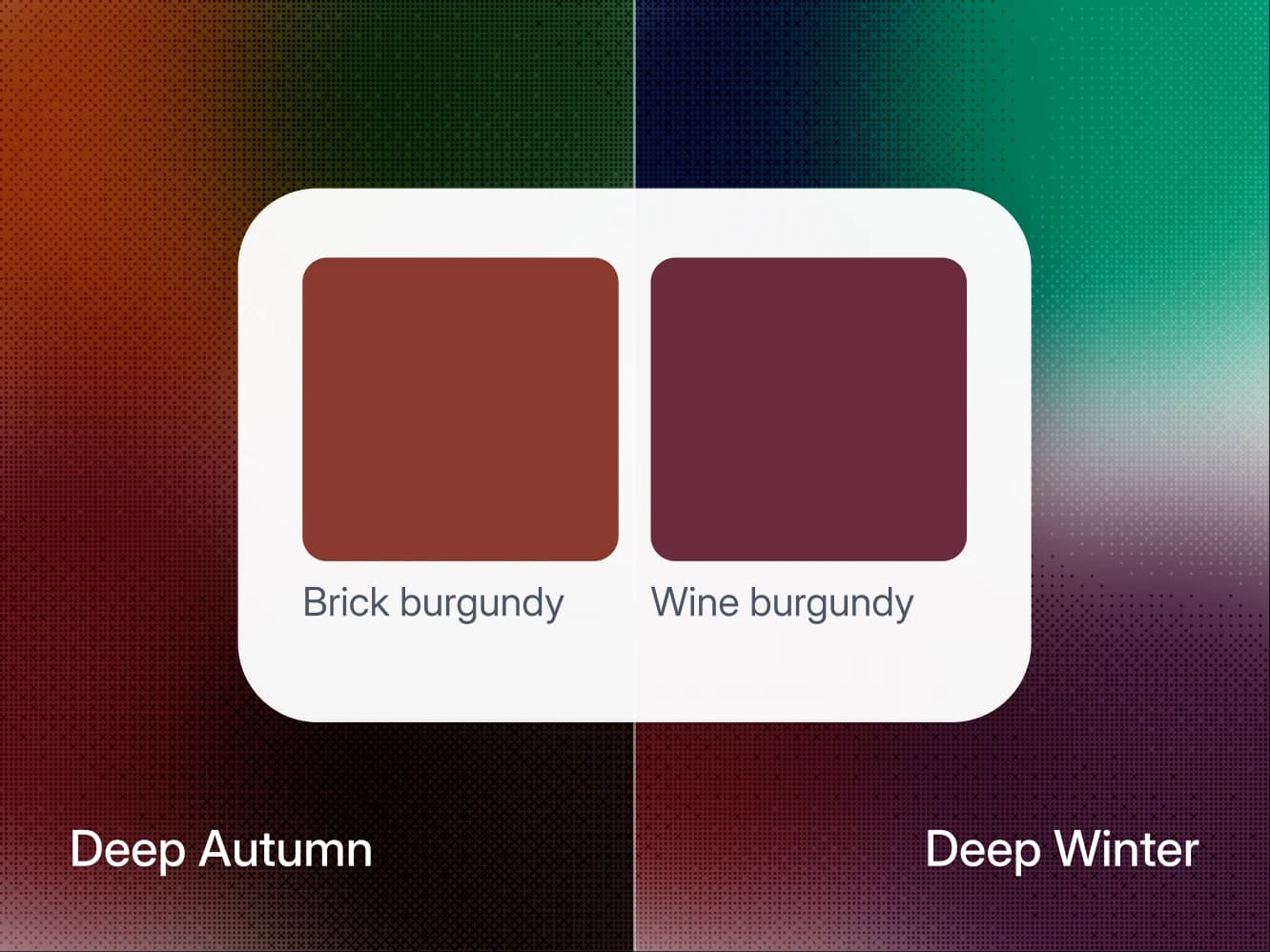
- Deep Winter only: wine, plum and forest green are Wear for Deep Winter and Skip for True Winter.
- Ice blue: Wear for True Winter, Depends for Deep Winter, as an accent only.
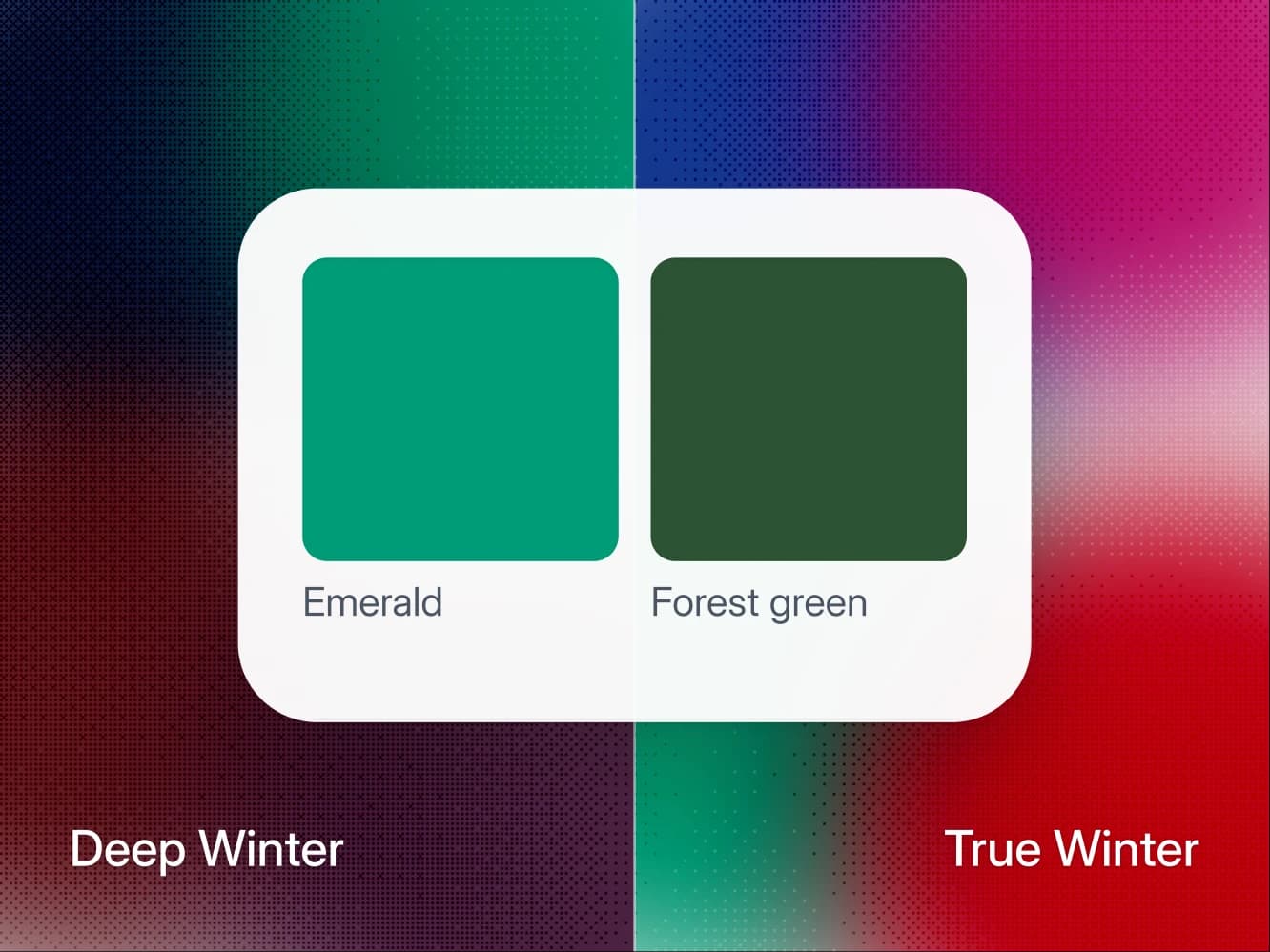
- The quickest test: forest green under your chin, with emerald as the control. If it sits comfortably, you are Deep Winter.
The short answer: the forest green test
Put forest green under your chin: if it is comfortable on you, you are Deep Winter. True Winter runs on clear color, and forest green is deep and slightly muted, so it dulls a True Winter face. Deep Winter carries forest green on its cool edge, so nothing much happens except that the green looks good.
Use the bluer forest green, closer to pine than to olive. Olive is Skip for both seasons, so an olive-leaning green dulls either of you and proves nothing.
Where the two seasons agree
In the rules behind a Wearly Labs analysis, the two seasons get the same verdict on 46 of the 50 colors, pure white and black included. That is more agreement than almost any other pair in the system. Three qualities of your coloring overlap:
- Contrast: the gap in depth between your hair, your skin and your eyes is high on both.
- Value: how light or deep your coloring sits overall overlaps heavily. Deep Winter is deep and True Winter runs medium to deep, so both can sit at the deep end without difficulty.
- Chroma: how much saturation you can carry before a color starts wearing you is only one step apart, with Deep Winter at rich and True Winter at bright.
The practical anchors match exactly:
- White: both take pure white, not soft white and not ivory.
- Metal: both take silver.
- Black: both wear it at the face. It is one of Deep Winter's eight core colors and one of True Winter's neutrals.
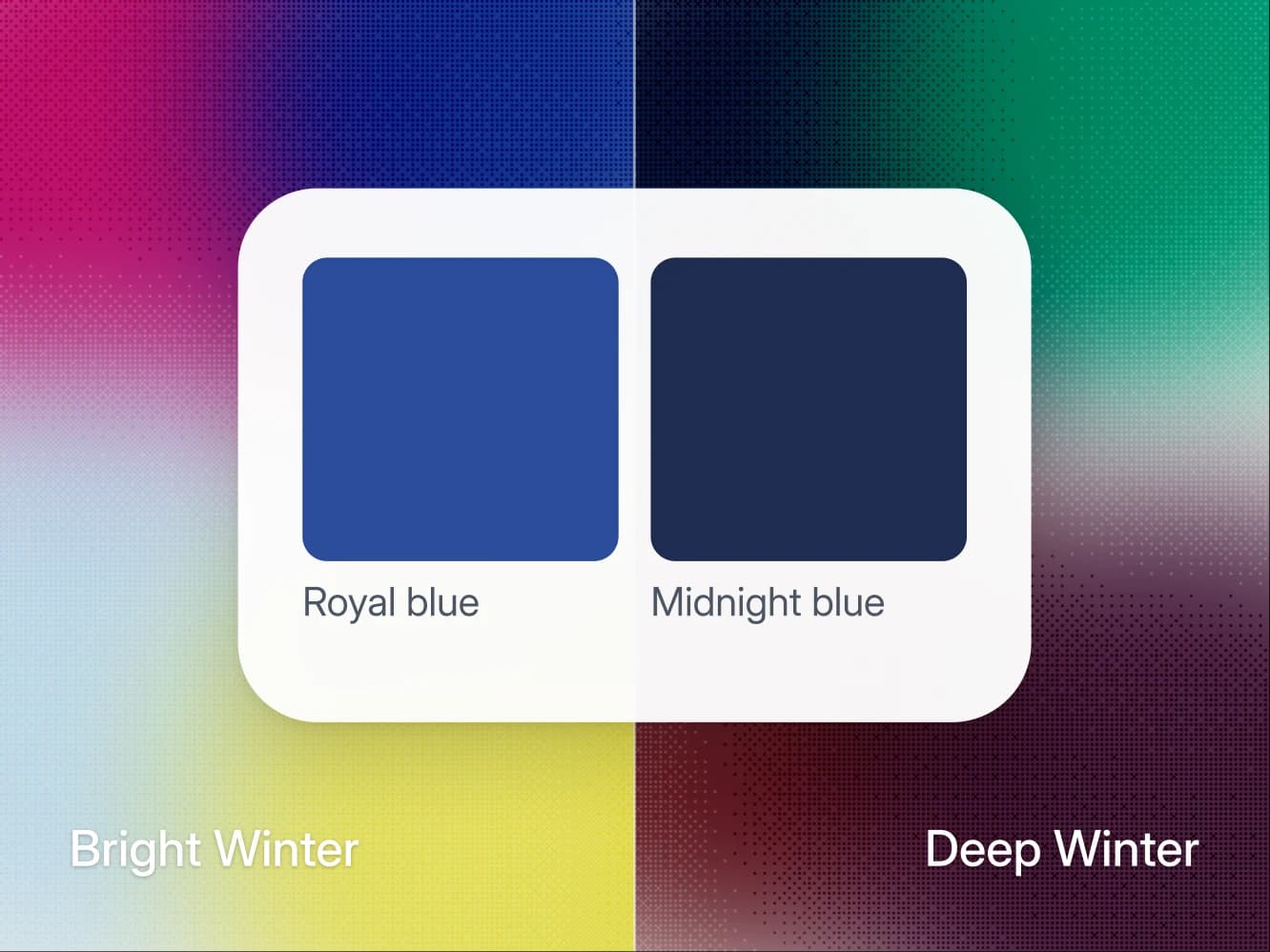
- Core colors: four are shared outright, emerald, royal blue, raspberry and midnight blue.
- More True Winter core colors: fuchsia, sharp red and deep purple are Wear for a Deep Winter too.
If your wardrobe is built on those in pure white and silver, you have been dressing correctly for either season without knowing which one you are.
Where Deep Winter and True Winter split
The 12-season system describes the pair by what leads. The Concept Wardrobe's Dark Winter guide puts depth first and coolness second, on skin that is neutral or neutral-cool, and its True Winter guide puts coolness first, with no warm quality in any feature. Curate Your Style, which also uses the name Cool Winter for True Winter, calls it the coolest of the three Winters.
| Axis | Deep Winter | True Winter |
|---|---|---|
| Leads with | Depth | Coolness |
| Undertone | Fully cool | Fully cool |
| Value | Deep | Medium to deep |
| Chroma | Rich | Bright |
| Contrast | High | High |
| Best white | Pure white | Pure white |
| Metal | Silver | Silver |
| Power color | Cool burgundy | Fuchsia or royal blue |
Read the table from the first row, which names the quality that leads in each season. Undertone, contrast, best white and metal are the same in both, and value, chroma and power color are the rows that differ. Depth separates the two only at the lighter end, because True Winter can sit at medium and Deep Winter cannot, so where both run deep, chroma is the quickest axis to test: how much of a deep, slightly muted color your face can carry.
The four colors that change verdict
Every color in a Wearly Labs analysis gets Wear, Depends or Skip, with its reason, and Depends means below the waist or as an accent only. Run the 50 colors against both seasons and these four are the only ones that come out differently.
| Color | Deep Winter | True Winter | Why |
|---|---|---|---|
| Wine (cool burgundy) | Wear | Skip | Deep, a step below bright |
| Plum | Wear | Skip | Deep, a step below bright |
| Forest green | Wear | Skip | Deep, slightly muted |
| Ice blue | Depends | Wear | Light and clear |
Read the Why column as the price a True Winter pays. All three cost it clarity, and a True Winter page gives each the same reason: "too dusty for your clarity". Ice blue runs the other way: it is Depends for a Deep Winter, as an accent only, a small area beside something dark.
Forest green is the hinge because it is the green the two Deep seasons share. The sample analysis, the real result of co-founder Filip Poláček, is a Deep Autumn, the season on Deep Winter's warm side, and his page marks forest green Wear: "Deep and understated, it holds its own against your coloring." Emerald, the green both Winters wear, is Skip on the same page: "Its undertone runs the opposite way from yours, so it fights your skin." A green that a warm Deep season and a cool Deep season both wear is the one that finds out whether your coloring asks for depth or for clarity.
The forest green swap, step by step
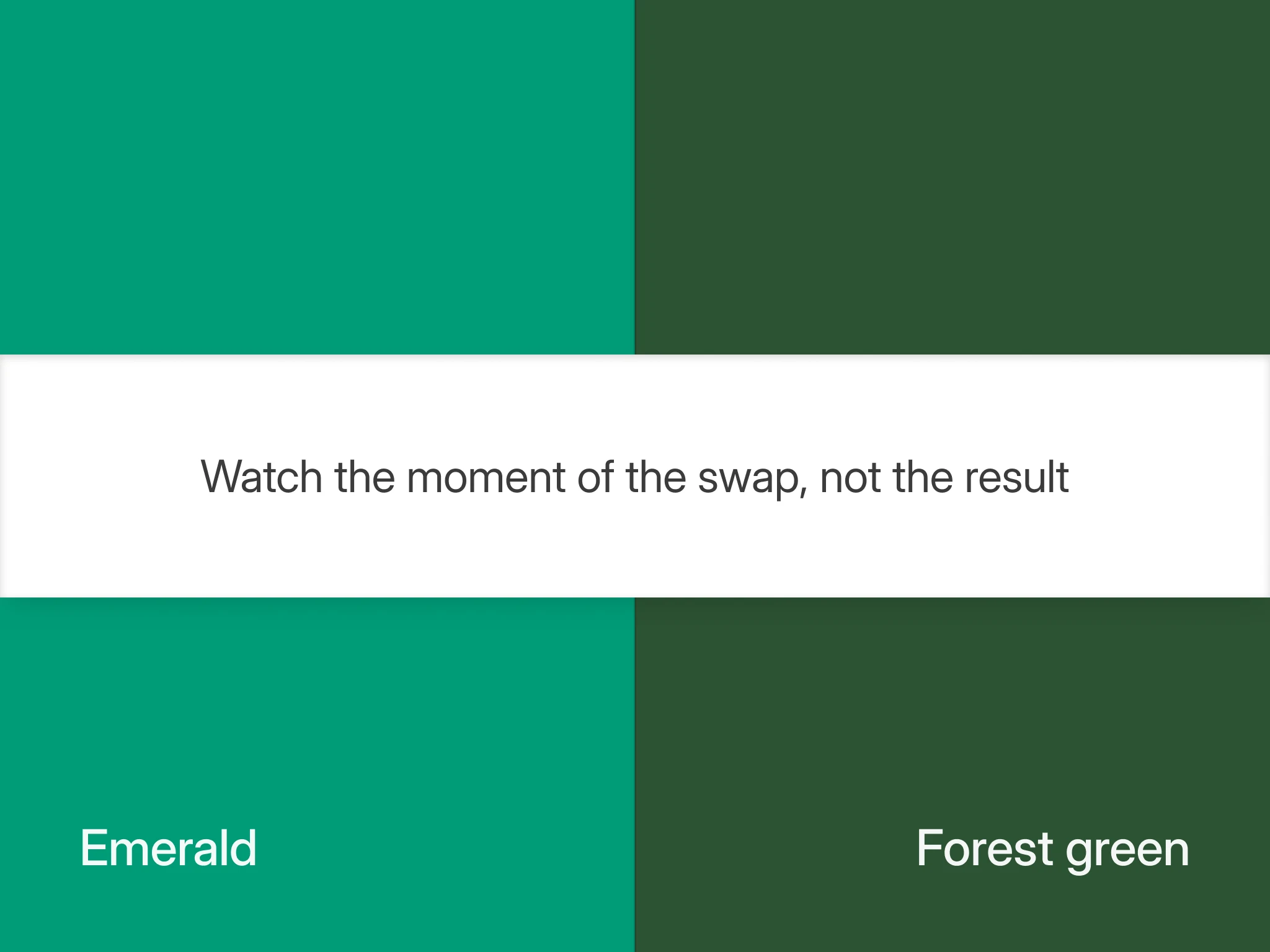
The test is a green swap run against a control. Both seasons wear emerald, so emerald is the reference point rather than the question.
- Set up. Lay out an emerald garment, core for both seasons, and a forest green one, core for Deep Winter on its cool edge and too muted for True Winter's clarity. Keep both within arm's reach, because you need to bring up the second one inside a second or two. Stand side-on to a window with no direct sun on your face, hair back, face clean.
- Settle your eye. Hold emerald under your chin for a slow ten count. It is the easy step to skip, and your eye needs a moment to settle on a color you know is right before it can register a change.
- Swap to forest green without moving your head or leaving the window. Watch the shadow under your jaw at the instant of the swap, and compare its weight with the weight of the garment.
- Read the result. On a Deep Winter, nothing shifts: the shadow stays as dark as the green and the two hold each other in balance. On a True Winter, the green gains and the shadow loses: forest green comes forward as the heaviest thing in the picture, the jaw shadow thins out underneath it, and the skin directly above goes dull.
The change is small, but it happens in the first second, which is why you swap instead of comparing two photographs later.
To check the result from the other side, put on a plain ice blue shirt with nothing dark near your face. On a True Winter it reads clean and the face stays the sharpest thing in the mirror. On a Deep Winter the shirt tends to look better than the face, because a look built at that lightness gives your depth nothing to push against.
What you lose if you pick the wrong season
A True Winter in Deep Winter colors
A True Winter dressed as a Deep Winter loses clarity rather than gaining depth. Forest green carries a step of muting, and a season that runs on clear color has nowhere to put it. Wine and plum get there through depth: their temperature is correct, but they sit deep and one step below bright, so they cost a True Winter clarity too. Either way the skin dulls slightly and the eyes read less crisp, like a slightly worse day rather than a visible mistake.
A Deep Winter in True Winter colors
A Deep Winter dressed as a True Winter goes the other direction. Bright color at every point and nothing dark near the face, such as an ice blue shirt worn on its own, gives the palette no deep note to sit on, and it can read as clinical rather than striking. The larger cost is what you give up: wine, plum and forest green are three of Deep Winter's eight core colors, and a True Winter palette skips all three.
If the forest green test does not settle it
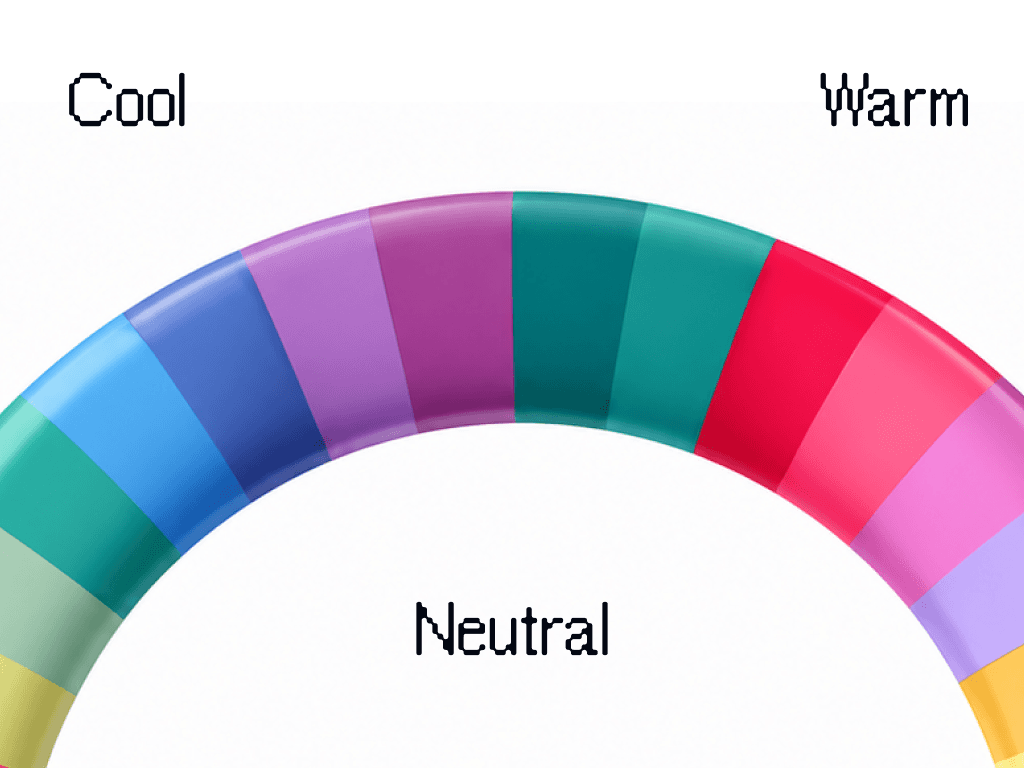
Undertone tests will not settle this pair, because both seasons are fully cool and look obviously cool next to anything warm. What separates them is depth against clarity, and that is hard to hold in your head between two mirror trips. If you have not settled warm against cool at all yet, start with the three undertone tests you can do at home.
If the green swap came back split, do not reach for a third green. Test depth instead: Bright Winter is cool like Deep Winter and sits at medium value, so a Winter who cannot place forest green may be deciding between two value levels, and Bright Winter is the season to test against.
- Hold lemon at your collar. Lemon suits a Bright Winter and outruns a Deep Winter face.
- Hold cool burgundy at your collar. Cool burgundy does the reverse: it suits a Deep Winter and outruns a Bright Winter face.
The Bright Winter and Deep Winter comparison walks through that test step by step.
A consultant settles it with drapes under controlled light. A Wearly Labs color analysis does it from five photos and your answers: AI reads the photos, with a white sheet of paper in frame to correct the light, and fixed rules make the call. When a photo contradicts a clear answer, the answer decides. Photos fill in what the questionnaire doesn't ask. Your page then marks wine, plum, forest green, and ice blue Wear, Depends, or Skip for you, each with its reason, and names your sister season, the neighbor you sit closest to.
Deep Winter vs True Winter: common questions
Both. Black is Wear for both seasons, at the face included. Deep Winter lists it among its eight core colors, and True Winter lists it as a neutral, with black and pure white as its easiest pairing. A black and white wardrobe tells you nothing about which of the two you are.
Yes. Fuchsia is Wear for both seasons, near the face included, because it is cool and clear. It is core for True Winter and not for Deep Winter, so wine, your power color, does more for you, and raspberry is already on your core list if you want pink.
No. Wine, the cool burgundy that is Deep Winter's power color, and plum are both Skip for True Winter: their temperature is right, but they sit deep and a step below bright, and True Winter runs on clear color. For a deep red take sharp red, and for berry take raspberry. Both are Wear for either season.
Because Deep Winter is built on depth. Ice blue is fully cool and bright, which suits True Winter exactly, but on its own it gives a deep season nothing to sit against. For a Deep Winter it is Depends, as an accent only: a scarf over black, a small area against midnight blue. It is not a color for a whole outfit there.
No, they behave the same in both seasons, so none of them helps you choose. Soft navy is Skip for both, because both seasons have midnight blue in its clean form. Mint is Depends for both, as an accent only, and lavender and soft white are Depends for both, below the waist. All four are softened or pale versions of colors these seasons wear clean, which is why they stay away from the face.
Shop from the 46 colors the two agree on and test the four that differ. Everyone gets one season in the 12-season system, but neighboring seasons share much of a palette. In a Wearly Labs analysis your page names your season and your sister season, the neighbor you sit closest to, and anything both accept is a safe buy. A Deep Winter's neighbors are True Winter and Deep Autumn; a True Winter's are Deep Winter and Bright Winter.