To dress well, get eight things right, and none of them is a trend: fit, undertone, proportions, fabric, one statement per outfit, contrast, a wardrobe for the life you actually have, and repeating what works. Start with fit, the one you can improve this week on clothes you already own.
On this page
- The eight basics at a glance
- 1. Fit beats everything, including price
- 2. Know your undertone before you buy another thing
- 3. Dress your proportions, not the mannequin's
- 4. Fabric is the real luxury
- 5. One statement per outfit
- 6. Match your contrast
- 7. Buy for the life you have
- 8. Repeat what works
- The pattern behind all eight
- FAQ
- Related reading
Dressing well is a skill with surprisingly few moving parts. None of them are on this season's mood board, which is why they still work. Each basic below has a do, a don't and a test you can run in a minute, and the table has all eight in one place.
The eight basics at a glance
| # | Basic | One-minute test | You pass when |
|---|---|---|---|
| 1 | Fit | Check the shoulder seam, the sleeve and the hem in a mirror | The shoulder seam sits at the edge of your shoulder and nothing pulls or hangs |
| 2 | Undertone | Wrist veins, gold against silver, white paper, in daylight | Two of the three tests agree |
| 3 | Proportions | Sit down in the trousers, raise your arms in the jacket | Rise, shoulders and hem land where your body does |
| 4 | Fabric | Read the label, crush the cloth in your fist | The first fiber listed is one you chose, and the creases fall out |
| 5 | One statement | Count the ideas in the outfit | One loud thing, everything else quiet |
| 6 | Contrast | Photograph your face in daylight, turn it black and white | Your outfit's contrast sits close to your face's |
| 7 | Your real life | Count the occasions on this month's calendar | Most of what you buy is for occasions you actually have |
| 8 | Repeat what works | Photograph the outfits that worked | You rebuy a proven piece before it is gone |
1. Fit beats everything, including price
A cheap shirt that fits beats an expensive one that doesn't. A suit cut to the wearer is fit at its limit, and people notice fast: in a 2013 study, Ben Fletcher and Karen Pine showed 274 people a faceless man in either a bespoke or an off-the-peg suit, the two differing only in minor details, for at most five seconds. They rated him significantly higher in the bespoke suit on four of the five traits, success and salary among them. The difference in trustworthiness was not significant. It was one man in two suits, so take it as a sign, not a law.
Fit is also a basic you can improve on clothes you already own. A tailor changes more than most people expect and less than they hope, because fabric can be taken away and not added (Gentleman's Gazette, on jackets and trousers). Buy for the parts that cannot move and let the tailor handle the rest:
| Alteration | How hard | Why |
|---|---|---|
| Hem trousers, taper the leg, narrow jacket sleeves | Easy | Fabric is only taken away |
| Shorten or lengthen jacket sleeves by about half an inch | Routine | A small change |
| Adjust the trouser waist by 2 to 3 inches | Possible, within limits | Makers typically leave at least that much at the center-back seam; beyond it the pockets move |
| Change the trouser rise | The hardest trouser job | The waistband comes off and the zipper is replaced |
| Change a jacket's shoulders | Not recommended | The structure is built around them, and widening them is impossible |
| Lengthen a jacket | Not possible | There is no fabric to add |
The same source gives a sizing rule of thumb: you can take a garment in by two sizes at most, and a jacket by one.
Do: find an alterations tailor and use them like a subscription.
Don't: buy the wrong size because the label says your usual number.
Test: in daylight, in front of a mirror, run the jacket checklist from Put This On: the shoulders end where your own shoulders end, the sleeves hang without divots or wrinkles, and nothing pulls at the button. Then sit, reach forward and raise your arms. If the garment pulls anywhere, it is the wrong size or the wrong cut.
In the sample analysis, the real result of Wearly Labs co-founder Filip Poláček, published with his consent, fit is a verdict too, and it cuts both ways. A structured classic suit is a Wear for his Trapezoid shape, because "shoulder and body are cut the way you are built, so it closes without strain." Slim cropped suit trousers are a Skip, "tighter than your frame wants," and so is a boxy oversized t-shirt, whose "dropped shoulders and a boxy body bury your own outline under loose fabric." Every color and cut in a Wearly Labs analysis gets one of three verdicts with a reason: Wear, Depends or Skip. Depends means it works under a condition the analysis names, such as below the waist for a color or with a hip-length top for a cut.
2. Know your undertone before you buy another thing
Warm, cool, or neutral decides your best white, your metals, and whether black is your friend or your enemy. It stays put while your tan comes and goes, so learn it once.
Treat the vein test as a lean, not a verdict. Veins carry red blood, and the color you see depends on how your skin scatters and absorbs light, how much oxygen the blood carries, how deep and wide the vein runs and how your eye reads the result (Kienle and colleagues, Applied Optics, 1996). Only the first of those is your skin. Run a second test, and trust the answer when two of three agree.
Do: the wrist vein test in daylight (green leans warm, blue-purple leans cool), then a second test.
Don't: trust colors tried on under warm store lighting.
Test: by a window, out of direct sun, hold gold and then silver against bare skin, then a sheet of white paper and then something cream next to your face. Warm skin looks best next to gold and cream, cool skin next to silver and pure white. If both work, you are probably neutral. Find your undertone at home has all three tests and what a neutral result means.
What undertone decides is concrete. Filip's coloring is Deep Autumn, which Wearly Labs calls Dark Autumn: warm, dark and saturated. Here is how his analysis sorts the whites, the blacks and one color that fails the test:
| Color | Verdict | Reason in the sample analysis |
|---|---|---|
| Ivory | Wear | "A warm, soft neutral that gives your darker colors somewhere to rest." His best white, at the collar. |
| Pure white | Depends, below the waist | "Clean and bright, but with none of the warmth your face needs." |
| Espresso | Wear | "Warm, deep and soft, this shade mirrors your coloring closely." His black. |
| Black | Depends, below the waist | "Clear and deep, but its coolness sits wrong close to your skin." |
| Fuchsia | Skip | "Its icy pink base clashes with the warmth under your skin." |
His metal is gold, and bronze, copper, brass and burnished gold work as well. Mirror-bright silver stays away from his face. Depends is not a ban: pure white and black stay on his palette, for the trousers and the shoes.
3. Dress your proportions, not the mannequin's
Every cut is designed around a reference body that probably is not yours. Sizing tables are reference bodies too: the ASTM size table for US women, D5585-11, is built around a woman 65.5 inches tall, and a 2016 comparison with SizeUSA body measurements found its waist sizes smaller than actual American women's. Where your shoulders, waist, and legs actually sit decides what a garment does on you.
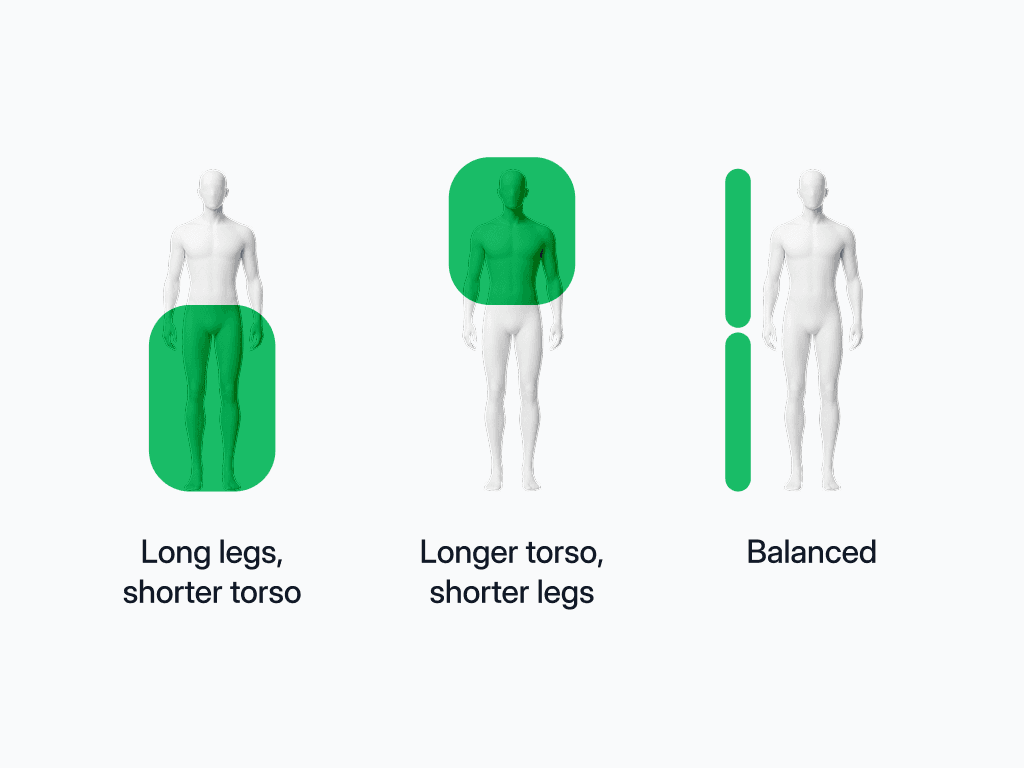
Do: learn your two or three non-negotiables (rise height, shoulder construction, where hems hit).
Don't: conclude a whole category "doesn't suit you" after one wrong cut.
Test: sit down in the trousers and raise your arms in the jacket, then check three things: where the waistband lands against your navel, where the shoulder seam lands, and where the hem ends against your hip bone or your ankle.
Filip's non-negotiables are written out in the sample analysis: a mid rise that sits just below the navel in every trouser, tops and knits that end past the hip bone, and jackets that cover the hip. His shape is Trapezoid: shoulders lead gently, and the body narrows evenly to the hip. One wrong cut does not condemn a category, and trousers carry all three verdicts in his analysis:
| Trousers cut | Verdict | Reason in the sample analysis |
|---|---|---|
| Straight denim | Wear | "Its waistband and seat are cut for this frame, so the leg falls straight without pulling." |
| Tapered | Wear | "Cut for your build, the waist stays level while the knee-down taper keeps a clean line." |
| Joggers | Depends, with a hip-length top | "The leg falls straight instead of stacking on the shoe, good with a hip-length knit over it." |
| Skinny | Skip | "Tighter than your frame wants, so the straight leg clings instead of skimming." |
| High-rise wide-leg | Skip | "The wide leg starts from a waistband set at the wrong rise for you." |
| Low-rise | Skip | "The straight leg is fine, but the low waistband sits below your actual rise." |
Same category, three verdicts, and every reason is about rise, room or length. None of them is about trousers as such. Shapes are names, not problems: the body type analysis shows how a shape and a line lead to cuts.
4. Fabric is the real luxury
Material decides how a piece drapes, ages, and photographs. Polyester pretending to be wool fools nobody at one meter. In the US, the label tells you what you are paying for: on most garments it must list each fiber as a percentage of the weight, in descending order, so the first fiber named is the largest share (FTC). Fibers under 5 percent go under "other fiber," except wool, which is always named, and a fiber that does a job at that amount, such as spandex for stretch, which may be.
Do: read the composition label before the price tag.
Don't: pay logo money for plastic fabric.
Test: crush the cloth in your fist for five seconds and let go. Creases that stay will be on you by lunch.
A synthetic is not the problem; the price is. In the sample analysis, technical nylon is a Wear because it keeps a crisp edge and crease. Fabric verdicts follow how a cloth behaves:
| Cloth | Verdict | Reason in the sample analysis |
|---|---|---|
| Fine knit (merino, cashmere) | Wear | "A soft, plain cloth that drapes cleanly for everyday basics." |
| Technical nylon | Wear | "A firm, smooth cloth that keeps a crisp edge and crease." |
| Tweed | Depends, one piece per outfit | "Heavy and textured, it holds its shape through a whole coat or suit." |
| Stretch denim | Skip | "Drops and clings instead of holding an edge, wrong for your straight lines." |
| Velvet | Skip | "Rich sheen, but the weight pulls the shape down instead of up." |
Each reason describes how the cloth behaves, not what it costs.
5. One statement per outfit
A bold cut, a bold color, or a bold accessory. Pick one and let the rest hold still. Outfits usually fail from too many ideas, not too few.
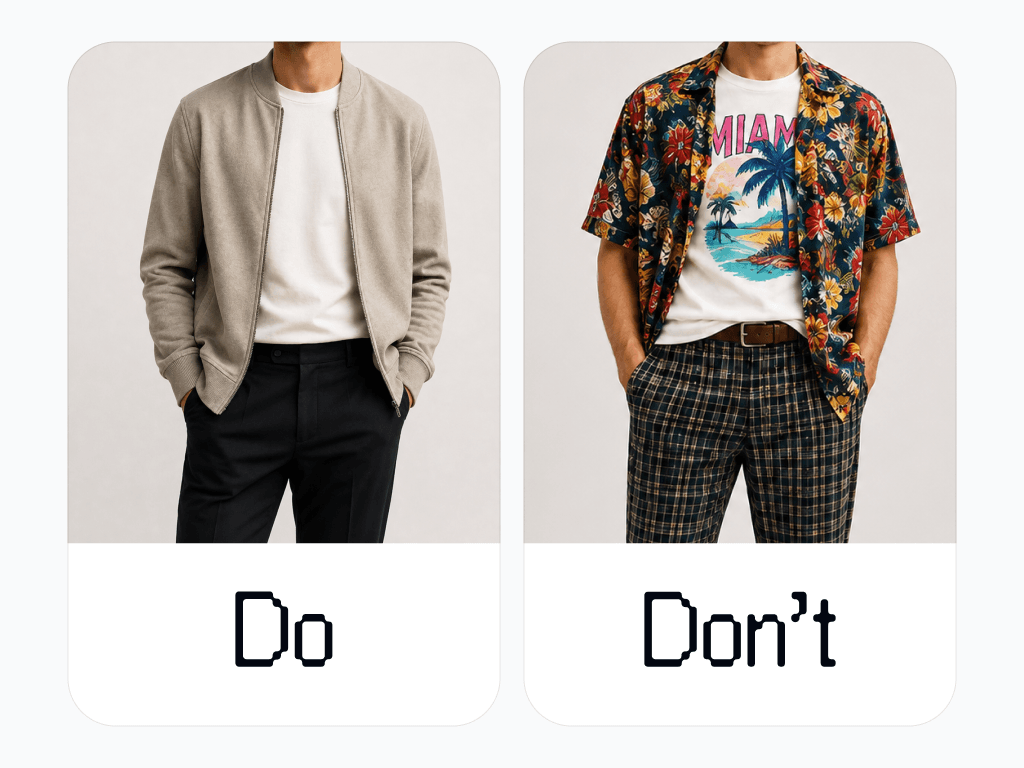
Do: build a quiet base, then add the one loud thing.
Don't: stack three statements and call it personality.
Test: stand three steps back from the mirror and name the first thing you see. If you need two answers, take one thing off.
The sample analysis shows the rule at work. Its "Color statement" combination reads: "Wine carries the chest, midnight blue layers beside it, warm greige keeps the trousers calm and low." One color leads and the others hold still. Pattern follows the same rule: it works best in "something fine and low-key like a marl knit or a small bird's eye texture on tailoring." Color block is a Skip, because "panels this large read as shapes on you, not as clothing," and so is tartan, which "takes over instead of dressing you."
6. Match your contrast
Contrast is the gap in depth between your hair, your skin and your eyes, and it sets how far apart two colors in one outfit should sit. If those three sit close in depth, hard black-and-white blocks will wear you. If you are naturally high-contrast, all-beige will erase you. Your outfit's contrast should echo your face's.
Menswear has dressed by contrast for a while. Alan Flusser's Dressing the Man advises echoing the contrast of your hair and skin in the clothes you wear, particularly the garments that frame your face (as The Rake sums it up). A high-contrast man does well in a dark suit with a white or very light shirt, a medium-contrast man in a navy blazer with a chambray shirt.
Do: low contrast coloring, tonal outfits; high contrast coloring, crisp blocks.
Don't: copy an outfit off someone with the opposite contrast and expect the same result.
Test: a black-and-white photo of your face in daylight. The FAQ below says how to read it.
Contrast is a dial in the sample analysis, and Filip's leans high. His everyday base puts ivory at the chest against deep colors below: "Ivory opens the chest, chocolate layers deep above it, and espresso trousers hold the whole outfit down." Houndstooth is a Wear for him, because "fine scale and sharp edges suit your frame and this clear, contrasted coloring."
7. Buy for the life you have
The fantasy-self purchase (the gala dress, the third suit for a hoodie job) is the most expensive item in a closet, measured per wear. Cost per wear is the price divided by the number of wears: a $300 dress worn twice costs $150 a wear, and a $60 pair of jeans worn 100 times costs 60 cents.
Wardrobe data points the same way. In the UK, WRAP's 2022 survey of more than 6,000 adults found 118 items of clothing in the average wardrobe, a quarter of them (26 percent, 31 items) unworn for at least a year. Dresses and skirts were the most likely to be owned and not worn (43 and 44 percent), while core staples such as jeans and sweatshirts were worn much more.
Do: look at your actual calendar before buying, and rent or borrow what it shows once a year.
Don't: own occasionwear for occasions you attend annually.
Test: before you pay, name the day you will first wear it. If you cannot, put it back.
The sample analysis starts from the same place. The questionnaire asks which situations you dress for, and the six outfits follow. Filip's are daily casual, weekend, relaxed, streetwear, urban and date night. There is no gala among them, because he did not pick one.
8. Repeat what works
Well-dressed people are often quietly repetitive. When an outfit works, that is data. Log it, rebuy it, build variations of it. A personal uniform is not a lack of imagination; it is a solved problem. What you repeat is a formula, not a garment: photograph the outfit in the mirror the day it works, and write down what led, what sat under it and what sat below the waist.
Do: rebuy proven pieces before they discontinue.
Don't: abandon a winning formula out of boredom the formula did not cause.
Test: look back over the last month and find the outfit you reached for twice. Write it down. That is your first formula.
The sample analysis hands over five of them under "Combinations that always work." Read two side by side. For work: "Rust leads at the top with camel underneath, and khaki keeps a low profile in the trousers." Weekend: "Terracotta warms the chest, mustard deepens the layer over it, charcoal grounds everything below the waist." The shape is the same both times: a lead color at the chest, a layer under or over it, a quiet color below the waist. Khaki and charcoal are Depends colors for him, and both formulas keep them in the trousers.
The pattern behind all eight
Six of these eight depend on facts about you: your body (basics 1 and 3), your undertone (2), your contrast (6), your actual life (7) and what has already worked on you (8). Which means dressing well is mostly a knowledge problem, and knowledge problems have a nice property: you can just go get the knowledge. A window, a mirror and a phone camera get you most of the way. A color and body type analysis measures basics 2, 3 and 6 for you, and the sample analysis shows what comes back.
FAQ
Fit, by a distance. One afternoon of alterations on clothes you already own outperforms a shopping spree. Start with the trouser hems, the sleeve lengths and the waists, the changes a tailor makes easily (see the table under basic 1).
A black-and-white photo of your face tells you instantly: if hair, skin, and eyes blur together, you are low contrast; if they separate sharply, high; somewhere between, medium. Take it in daylight and without a filter, because both change the gap.
Start with your undertone and your contrast, in daylight. Together with how light or deep and how clear or muted your coloring is, they place you in one of 12 color seasons, and a season gives you a palette. Seasonal color analysis, explained walks through all twelve, and the color analysis page shows how a Wearly Labs analysis marks each color Wear, Depends or Skip.
Buy what you will wear most, and judge it per wear. A $60 pair of jeans worn 100 times costs less per wear than a $300 dress worn twice, and fit, fabric and your calendar decide those wear counts more than the price does.
Start with the three places a garment has to agree with you: where the rise sits, where the shoulder seam lands and where the hem ends. Then choose cuts that follow the balance of your shoulders, waist and hips instead of hiding any of it. The body type analysis reads your shape and your line (sharp, medium or soft) and says which cuts follow.
No. Trends change on a cycle; fit, undertone, contrast and your calendar do not. Trends are temporary, your colors aren't has a two-question filter for the trends worth borrowing.
No. Nothing here caps how many clothes you own or how bold they are. These are constraints on what fits you, not on how much fun you have inside them.