Kibbe body types are the style categories David Kibbe set out in his 1987 book Metamorphosis: thirteen in the book, ten in the version most people use today. Each one is a blend of yang (sharp, straight, long) and yin (soft, rounded, compact), read from your bone structure, your flesh, your face and how tall you look, and each comes with the clothing lines that echo it.
On this page
Most body-type advice sorts you into a fruit. Apple, pear, hourglass, "rectangle". Those labels answer a real question, and they answer it in words anyone can picture: where your body carries its width, and therefore what your clothes have to balance. That is worth knowing. It is also where they stop.
Because there's a second question underneath, and no amount of knowing you're a pear will answer it. Sharp or soft. Long or compact. Structured or draped. It's the question that decides whether a stiff tailored blazer looks like you or looks like armor on you, and it has nothing to do with your waist measurement.
Kibbe is the system that answers that one. It's also the one with the worst reputation online, buried under a decade of bad quizzes and forums that argue like it's a religion. Strip that away and it's genuinely useful. Here's the plain version.
Two layers, then. Shape tells you where the volume sits. Line tells you what the clothes should do about it. You want both.
What Kibbe actually is
David Kibbe, a Manhattan-based stylist, built this system in the 1980s and published it in 1987 as David Kibbe's Metamorphosis (Atheneum). The book pairs a quiz with a profile for each type and advice on clothes, color, makeup and hair. The vocabulary is older than the book: Vox points to Harriet Tilden McJimsey's 1963 textbook Art in Clothing Selection, which already used yin and yang body types and has been credited with naming the archetypes Kibbe popularized: dramatic, classic, natural, romantic and gamine.
He still offers his own analysis, which his site calls the Certified KIBBE ANALYSIS, and in January 2025 he published a second book, David Kibbe's Power of Style (Rodale Books), whose publisher lists "overhauls and updates" of his Image Identity and Color systems. Most of what circulates online about the system is secondhand or thirdhand, as Kibbe himself has pointed out (Vox, 2022).
The thing that makes it different: it doesn't measure your weight or your dress size, and Kibbe told Vox the read is not based on bust and hip measurements either. It reads the lines of your body, sharp or soft, long or compact, and tells you which clothing lines echo them. "It's not like putting people in categories," Kibbe told MEL Magazine in 2021. "That's the big mistake." The book also ties a personality, which Kibbe calls an essence, to yin, to yang and to each type. This article sticks to the physical read.
The premise is one idea. Your clothes look best when their lines agree with your body's own lines. Put a sharp, angular person in soft ruffles and it reads as fussy. Put a soft, rounded person in stark, severe tailoring and the clothes look like armor. Match the lines and everything calms down.
The two things it measures: yin and yang
Kibbe sorts everyone along a scale between two poles.
Yang is sharp. Angular bones, straight lines, length, narrowness. Tall and geometric.
Yin is soft. Rounded bones, curves, lushness, compactness. Small and circular.
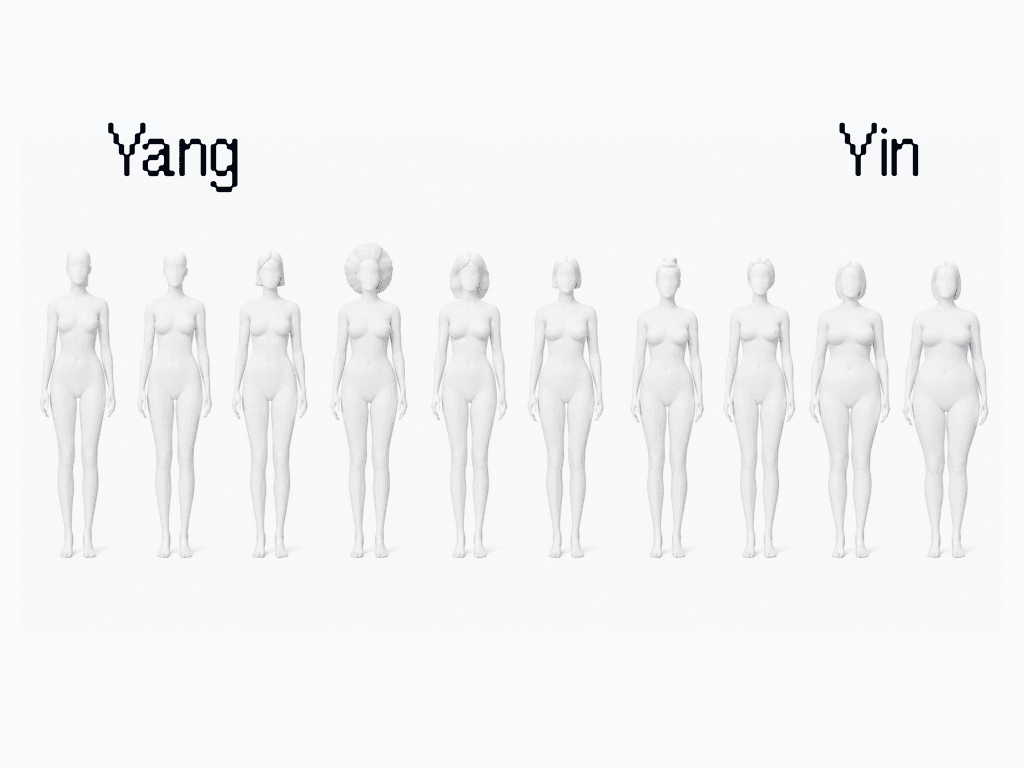
Nobody is fully one or the other. You're a mix, and the quiz in Metamorphosis reads that mix across your bone structure (sharp or blunt, with your vertical line counted here), your flesh (lean or soft), your facial bones, your facial features and even your hair, each answered on a scale from the yang end to the yin end. Where you land on that blend is your type. Kibbe himself calls his types Image Identities. Neither end is better: Kibbe calls yin and yang neutral descriptors (Vox).
The five families
The ten types group into five families, each a different balance of yin and yang:
- Dramatic: yang. Sharp, long, narrow.
- Natural: soft yang. Blunt edges, relaxed, slightly broad.
- Classic: balanced. Symmetrical, even, moderate.
- Gamine: yin and yang mixed on a compact frame. Sharp and soft at once.
- Romantic: yin. Soft, rounded, curved.
The modern 10 types
Metamorphosis (1987) described thirteen types. Most current guides work with ten. The three from the book that are not among the ten are Natural, Classic and Gamine, the central type of each of those three families. MEL Magazine reported in 2021 that, according to Kibbe, there are no more "true" Naturals or Gamines, only Soft and Flamboyant ones. Vox reported in 2022 that the physical descriptions of the types did not change when he narrowed the thirteen to ten, and a reviewer of Power of Style says the 2025 book confirms the three are gone and gives each of the five families two options. These are the ten.
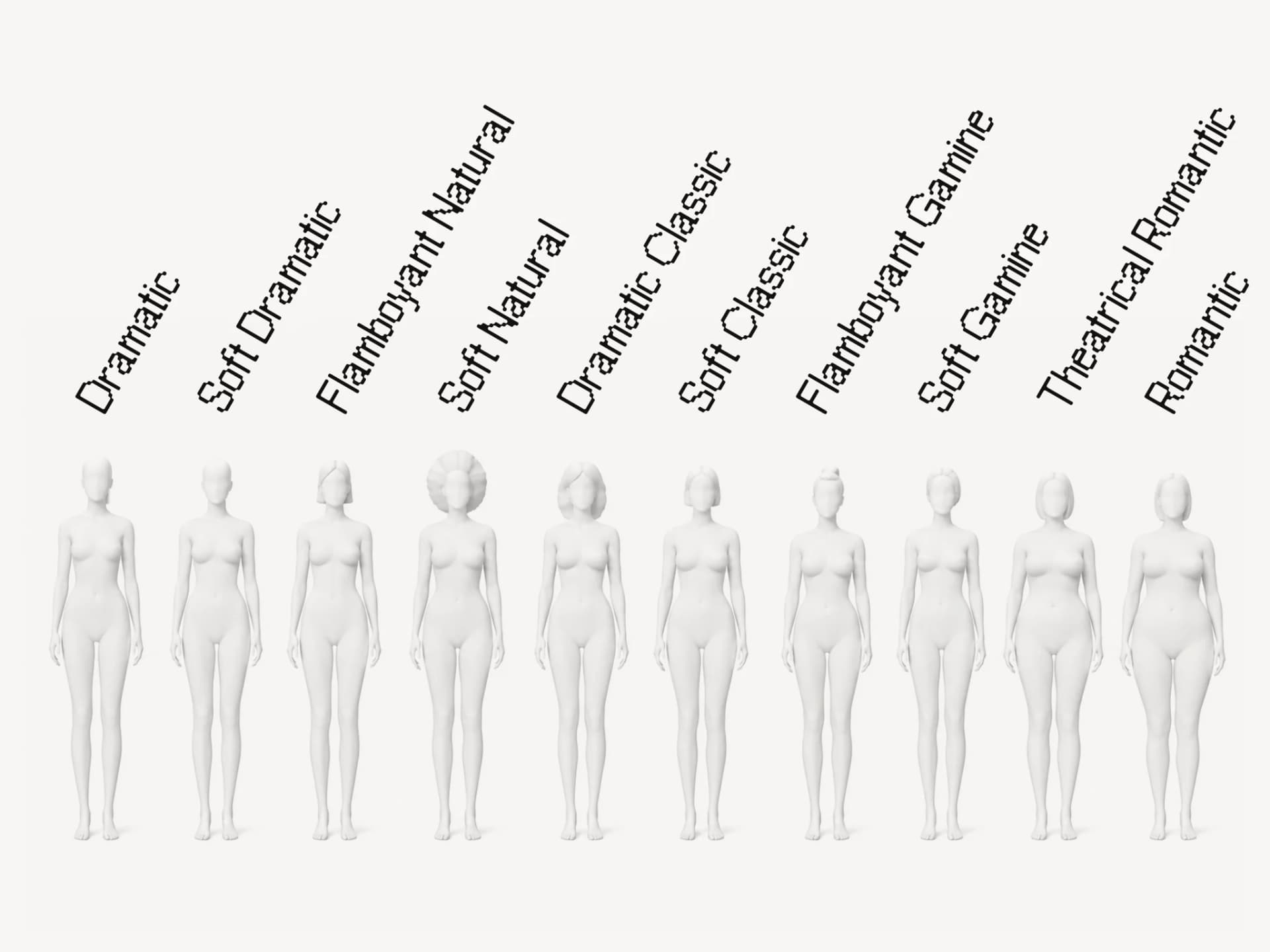
Here they are with the yin and yang balance and the height that Metamorphosis gives each one, the balance in Kibbe's own words:
| Image Identity | Family | Balance in the 1987 book | Height in the 1987 book |
|---|---|---|---|
| Dramatic | Dramatic | Extreme, sharp yang | Moderate to tall, usually 5'5" and over |
| Soft Dramatic | Dramatic | Bold yang with a pronounced yin undercurrent | Moderate to tall, usually 5'5" and over |
| Flamboyant Natural | Natural | Strong yang with blunt edges | Moderate to very tall, usually 5'5" and over |
| Soft Natural | Natural | Soft yang with a yin undercurrent | Up to 5'7" |
| Dramatic Classic | Classic | Balanced, with a yang influence | Moderate, up to 5'7" |
| Soft Classic | Classic | Balanced, with a yin influence | Moderate, up to 5'6" |
| Flamboyant Gamine | Gamine | Combination of opposites, extra yang | 5'6" and under |
| Soft Gamine | Gamine | Combination of opposites, extra yin | Under 5'5" |
| Theatrical Romantic | Romantic | Soft yin with a slight yang undercurrent | Moderate to petite, usually 5'5" and under |
| Romantic | Romantic | Extreme, soft yin | Moderate to petite, usually 5'5" and under |
Kibbe treats those heights as guidelines, not cutoffs: every profile in the book says a slight deviation here or there "should not be worried over" as long as it does not upset your yin and yang balance. In metric, 5'5" is 165 cm, 5'6" is 168 cm and 5'7" is 170 cm. These are the 1987 outlines. Because Power of Style is billed as overhauling and updating the system, read them as where it started, not as Kibbe's latest word.
Dramatic. Pure yang. Tall, sharp, narrow, straight. Best in long, clean, tailored lines and monochrome. Ruffles are the enemy.
Soft Dramatic. Sharp bones, soft lush flesh, on a tall frame. Best in bold, dramatic shapes with draped, rich fabric. Needs scale; small and prim falls flat.
Flamboyant Natural. Tall, broad, blunt-edged, slightly athletic. Best in relaxed, long, unstructured lines and natural fabrics. Stiff tailoring fights the frame.
Soft Natural. Moderate, blunt bones with soft flesh and a gentle waist. Best in relaxed shapes that drape, with a soft nod to the waist. Sharp structure looks harsh.
Dramatic Classic. Balanced, with a slight edge. Symmetrical and moderate. Best in clean, polished tailoring. Anything too soft or too loud reads as off.
Soft Classic. Balanced, with a slight softness. Best in refined tailoring with soft detail. Stark minimalism looks severe on it.
Flamboyant Gamine. Compact and spirited, leaning yang: broad, angular bones and lean, straight flesh on a small frame. Best in crisp, broken lines and mixed pieces. Long flowing looks swamp the frame.
Soft Gamine. Compact, leaning yin: small, slightly angular bones with soft, rounded flesh. Best in fitted, crisp shapes with rounded detail. Long monochrome washes it out.
Theatrical Romantic. Moderate to petite, a soft hourglass on small bones with slightly sharp edges. Best in fitted, curve-following shapes with a bit of crispness. Oversized anything hides the point.
Romantic. Pure yin. Soft, rounded, a full hourglass. Best in soft, fitted shapes that follow the curves. Boxy and severe both fight the body.
How to start reading yourself
You can't fully self-type in a mirror, and even seasoned Kibbe people argue over edge cases. Kibbe says so himself: "You can't analyze yourself," he told Vox in 2022. "You're never going to be objective. Nobody is." But you can find your lean.
Three questions, asked honestly in good light:
- Vertical line. Do you read long and elongated, or compact and petite? This is how tall you look, not what the tape says: the long answer in Kibbe's quiz is "People always think I'm taller than I really am." Height still shapes which types fit, as the table above shows.
- Bone structure. Are your features and joints sharp and angular (yang), or blunt and rounded (yin)? Look at your shoulders, your jaw, your wrists, your hands and feet.
- Flesh. Is your body lean and taut (yang), or soft and rounded (yin)?
Then the test that cuts through the theory: put on something very sharp and structured, a stiff tailored blazer, then something soft and draped. One will look like you. The other will look like it's wearing you. That tension is the clearest signal you'll get at home.
If you try the quiz itself, keep the instructions that come with it in Metamorphosis: wear a leotard or at least clothing that shows your body, nothing unstructured and no shoulder pads, take your makeup off, and if you can, do it with four to eight friends, because a mirror gives you only your own reflection to compare to. The 2025 book works differently, according to one reviewer: DoctorTDesigns writes that Power of Style drops the quiz and has you drape a lightweight fabric over your shoulders, pick a primary characteristic (vertical or curved) and then a secondary one, and counts anyone over 5'6" as vertical dominant.
"Dress for your body type" isn't an insult
Years of advice gave this idea a bad name by framing it as concealment: a body part to disguise, a silhouette to correct. Kibbe isn't that, and neither is knowing your shape. Both are about harmony, clothes whose lines agree with yours, not a list of things to cover up. Kibbe's own site says people have "only unique characteristics" and that the point is to emphasize them "instead of trying to conceal them to fit into some arbitrary standard of beauty."
A Dramatic in fussy ruffles isn't flawed, the outfit is just out of tune with her. A Romantic in cold, stark minimalism isn't wrong either, the lines are just fighting her curves. There's no bad body in this system. There's only "in tune" and "out of tune".
The mistakes people make
- Typing by weight or size. Kibbe reads bone structure, how tall you look and the kind of flesh you carry, not your measurements. You don't change types by gaining or losing weight; you change how a type is dressed.
- Chasing celebrity examples. Most celebrity type lists online are other people's guesses from photos, and they send people down the wrong path. Kibbe meant his celebrity examples as image guides, not bodies to match limb for limb, and he has said that typing other people from photos runs against his philosophy (Vox). Use them lightly.
- Forcing the "prettiest" type. People want to be Romantic or Soft Dramatic because the words sound nice. The goal is accuracy, not aspiration. Your real type is the one that makes you look effortless.
- Trusting the quizzes. Same flaw as online color quizzes: they ask you to judge your own bone structure, which is exactly the part beginners get wrong. Kibbe's own view, to MEL Magazine: "If you don't know how to answer the questions in the quiz, then the quiz is pointless."
Why it's worth the trouble
Once you know your lines, shopping changes. You can look at a jacket on a hanger and know whether its lines are yours, before you ever try it on. Fewer mistakes, faster calls, and a closet where things actually work together, because they all suit the same body. Yours.
A shop test that works even before you know your type: on the hanger, check three things, the shoulder (built or soft), the edges (crisp or curved) and the cloth (holds its shape or falls). Then try it on. If the garment and your frame say the same thing, it is in tune. If they argue, you will see it in the mirror before you reach the till.
Want yours pinned down?
The at-home questions get you a lean. If you want both layers pinned down, your shape and your line, with the specific cuts that follow from them and your color palette beside it, that's what Wearly Labs does, and every cut gets a verdict, Wear, Depends or Skip, with the reason behind it. Depends means a color below the waist or as an accent only, or a garment that works under a condition, such as a longer cut.
In the sample analysis, co-founder Filip Poláček reads as a men's Trapezoid with a medium line, and his page answers the structured-or-draped question directly: "where a piece sits between structured and relaxed, lean toward the structured side". The verdicts that follow, with the page's own reasons:
| Layer | Verdict | Item | The reason on the page |
|---|---|---|---|
| Cut | Wear | Structured classic suit | Shoulder and body are cut the way you are built, so it closes without strain. |
| Cut | Depends | Padded-shoulder blazer | In a longer cut. Padded shoulders extend your own line without adding strain at the back. |
| Cut | Skip | Boxy oversized t-shirt | Dropped shoulders and a boxy body bury your own outline under loose fabric. |
| Color | Wear | Ivory | A warm, soft neutral that gives your darker colors somewhere to rest. |
| Color | Depends | Pure white (below the waist only) | Clean and bright, but with none of the warmth your face needs. |
| Color | Skip | Sharp red | A cold, sharp red that fights the warmth in your skin. |
The page sums up the cuts in one line: skip the boxy, the oversized and the skin-tight, because "all three work against the crisp, structured shape you are building."
A short questionnaire and five photos, one payment of $29, and the key to your page arrives by email, usually within 10 minutes. Start your analysis
FAQ
Ten in most current guides and thirteen in the original 1987 book, grouped into five families: Dramatic, Natural, Classic, Gamine and Romantic. The ten are Dramatic, Soft Dramatic, Flamboyant Natural, Soft Natural, Dramatic Classic, Soft Classic, Flamboyant Gamine, Soft Gamine, Theatrical Romantic and Romantic.
Yes. Metamorphosis (1987) described thirteen types. Most current guides work with ten. If you find an old list with thirteen, that's the original version. Kibbe published a second book, David Kibbe's Power of Style, in January 2025, and he still offers his own analysis in New York.
Natural, Classic and Gamine, the central type of each of those three families. Each of those families keeps two variants (Soft and Flamboyant Natural, Dramatic and Soft Classic, Flamboyant and Soft Gamine), and the Dramatic and Romantic families keep the two they had.
Not online. Metamorphosis contains a quiz you score yourself, but Vox reported in 2022 that there is no official quiz and that the definitive way to know is an in-person session with Kibbe. His own Services page, checked in October 2026, lists a "Certified KIBBE ANALYSIS" and no online test or app. Every Kibbe quiz, app or AI reading you find online is someone else's interpretation of the book.
Read how tall you look, how sharp or blunt your bones are and how lean or soft your flesh is, in good light and ideally with friends, then check the lean with the blazer test above. Treat the result as a lean, not a verdict: Kibbe says you cannot analyze yourself objectively.
The book advises against it: settle on the type you most closely resemble, because describing yourself as a "mixture" gives you "a mishmash of opposing ideas, lines, and shapes that cancel each other out." For pairs that are easy to confuse, such as Romantic and Theatrical Romantic, it includes a side by side comparison list.
Yes, with a caveat. Kibbe's own site says men as well as women have had their image defined by him, but Metamorphosis was written for women, so the type names, the examples and the styling advice skew that way. The questions underneath, bone structure, flesh and how tall you look, are the same for any body, and the styling translates.
No. Your bone structure and vertical line stay put. Metamorphosis describes how each type carries extra weight, and tells the Dramatic Classic that "your body type will seem to radically change when you gain even a little weight. This is actually an illusion, because your bone structure remains the same." Weight changes how a type is styled, not the type itself.
It is a styling method, not a measurement. It rests on one stylist's judgment of bones, flesh and face, and Kibbe told Vox that he made it for personal use, not as a basis for judging people. Critics point to its roots in Old Hollywood, and so Eurocentric, ideals of beauty, and MEL Magazine reported that Kibbe maintains the system works for everyone. What you can test yourself is whether clothes whose lines match yours look better on you.
No, and they aren't rivals. Your shape says where your body carries its width, so it tells you what your clothes have to balance. Kibbe says what line those clothes should have, so it tells you how. Most people find their shape first, because you can see it in a mirror, then use the line to choose the actual garment.
No, they measure different things. Kibbe's Image Identity is about line and proportion; seasonal color analysis is about which colors suit your coloring. Kibbe's own program has a color step too, which his site calls Kibbe Color and describes as seasonal color. They work well together: one tells you the cut, the other tells you the color.
No. It reads the two layers this article describes, your body shape and your line (sharp, medium or soft), from a short questionnaire and five photos, two of them full length, and gives every cut a verdict with its reason. It never names a Kibbe type. How the two layers work is on body type analysis.
Related reading
- Kibbe Soft Natural: the cuts that work and the ones that fight you
- Kibbe Flamboyant Natural: the cuts that work and the ones that fight you
- Kibbe Soft Classic: the cuts that work and the ones that fight you
- Kibbe Dramatic Classic: the cuts that work and the ones that fight you
- Kibbe Romantic: the cuts that work and the ones that fight you
- Kibbe Theatrical Romantic: the cuts that work and the ones that fight you
- Kibbe Soft Gamine: the cuts that work and the ones that fight you
- Kibbe Flamboyant Gamine: the cuts that work and the ones that fight you
- Kibbe Soft Dramatic: the cuts that work and the ones that fight you
- Kibbe Dramatic: the cuts that work and the ones that fight you