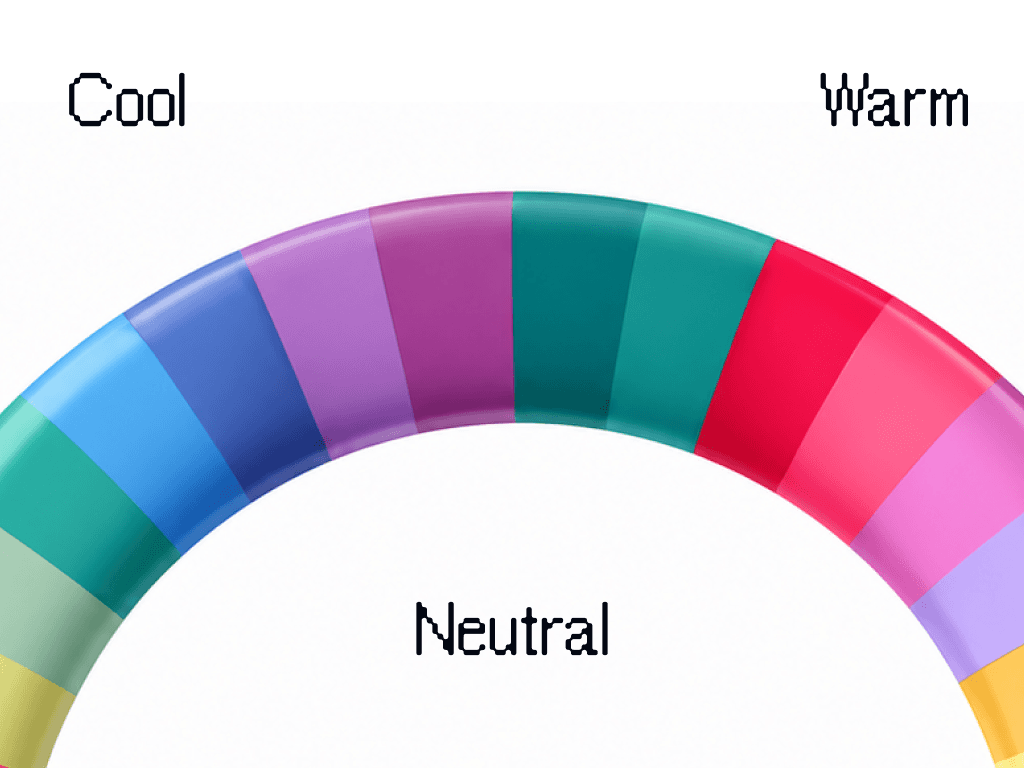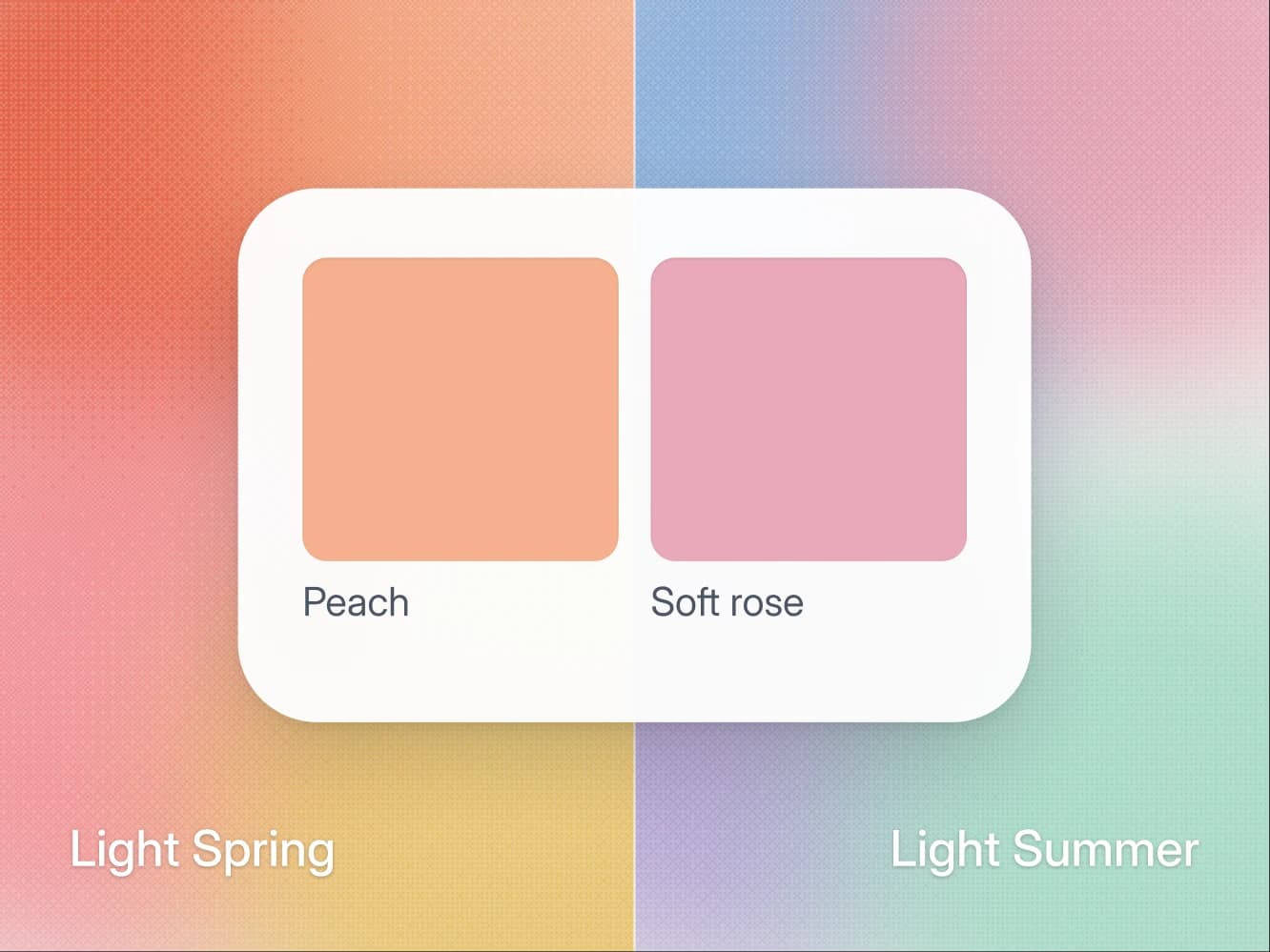
Light Spring and Light Summer are split by undertone, whether your skin leans golden or rosy: Light Spring is warm-neutral, Light Summer is cool-neutral. Both are light and low in contrast, so the quickest way to tell them apart is a peach top against a soft rose one. Your white, your metal and your best pink all follow from that single decision.
On this page
Being light is the part you have already worked out, and it is the easy half of the question. Both seasons are easily overwhelmed by anything heavy near the face, and they share one core color, a soft periwinkle blue that Wearly Labs lists as light forget-me-not. The test below does not use it.
The short answer: peach or soft rose
Hold a peach top and a soft rose one (the analysis lists it as soft pink) next to your face by a window, and keep the one that makes your face look rested rather than merely lit.
- Peach wins: you are a Light Spring, with ivory and gold.
- Soft rose wins: you are a Light Summer, with soft white and silver.
What Light Spring and Light Summer share
- Value, meaning how light or dark your coloring is. Both sit at the light end, the trait people notice before anything else and the reason these two get pooled together.
- Contrast, the gap in depth between your hair, skin and eyes. Both run low, so all three sit in a narrow band. A stark pairing of very dark against very light overwhelms both seasons, and tonal outfits in one light band suit both.
- Chroma, the strength of a color (Albert Munsell's term, from A Color Notation, 1905), is close but not identical. Light Summer is muted: soft, quiet colors are its whole palette. Light Spring accepts both ends of the scale, so it also carries a clearer color such as coral or turquoise, one piece at a time.
- One core color. Light forget-me-not, the periwinkle, sits on both core palettes. It is the one core color in this comparison that proves nothing, so do not test with it.
Where Light Spring and Light Summer split
The rows below are where your shopping actually changes.
| Axis | Light Spring | Light Summer |
|---|---|---|
| Undertone | Warm-neutral | Cool-neutral |
| Value | Light | Light |
| Chroma | Muted to clear | Muted |
| Contrast | Low | Low |
| Best white | Ivory | Soft white |
| Metal | Gold | Silver |
| Power color | Coral | Light forget-me-not |
Read it from the top: undertone, best white, metal and power color change, while value and contrast stay the same. Chroma differs by degree only.
The colors that flip between the two
Every color in a Wearly Labs analysis gets one of three verdicts, each with its reason: Wear, Depends (below the waist or as an accent only), or Skip. Set the Light Spring and Light Summer palettes side by side and only six of the 50 colors flip all the way, from Wear on one to Skip on the other. Those six are worth testing with. Most of the rest move one step, and the shared ones prove nothing.
| Color | Light Spring | Light Summer | Use it |
|---|---|---|---|
| Peach | Wear | Skip | Strongest test |
| Coral, warm pink | Wear | Skip | Test with it |
| Leaf green, warm aquamarine | Wear | Skip | Test with it |
| Ice blue | Skip | Wear | Test with it |
| Soft pink, dusty pink, lavender | Depends | Wear | Leans Light Summer |
| Mint, dusty blue, light gray | Depends | Wear | Leans Light Summer |
| Ivory, latte | Wear | Depends | Leans Light Spring |
| Camel, light gold | Wear | Depends | Leans Light Spring |
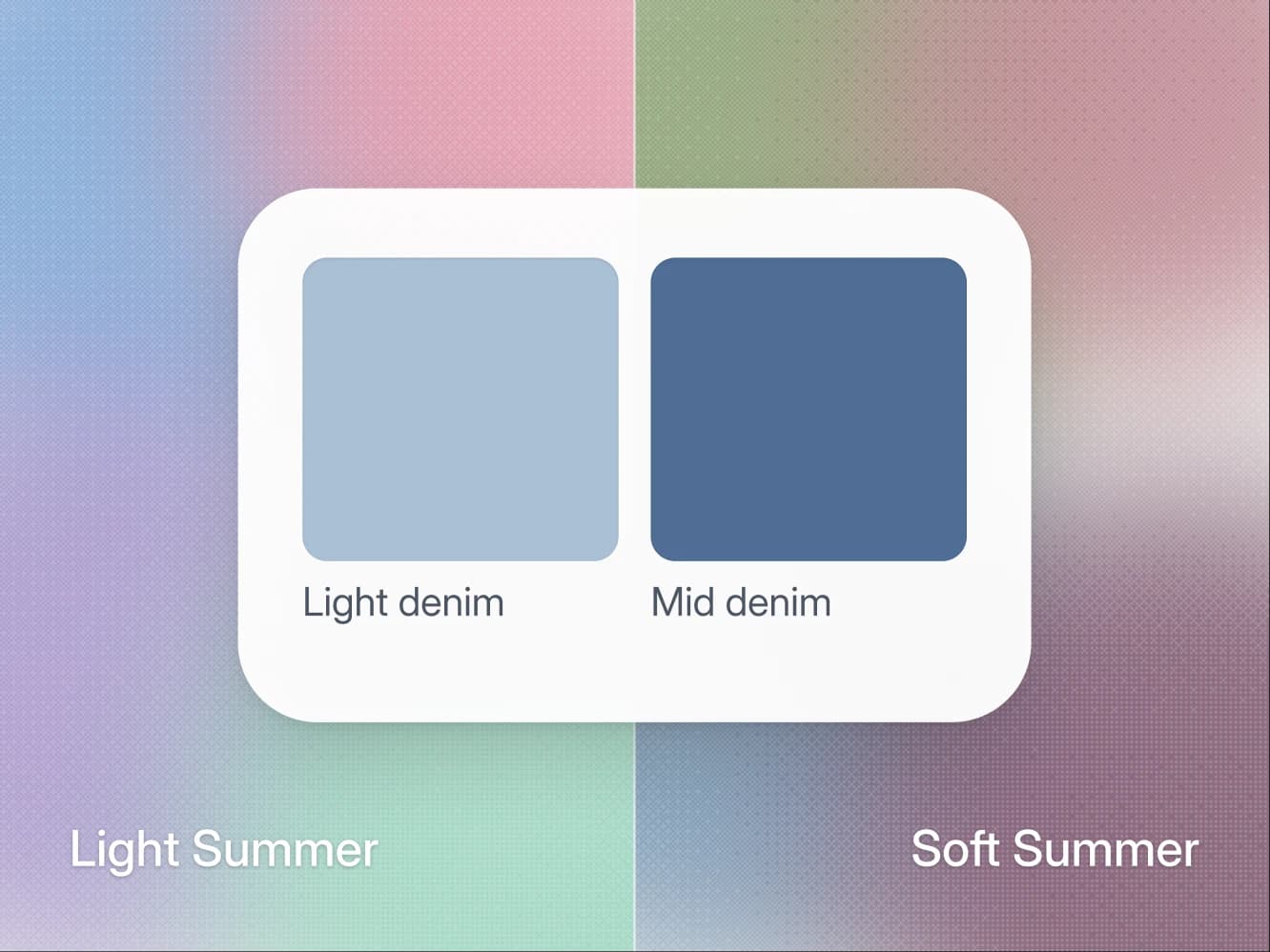
| Light forget-me-not, soft navy, light denim | Wear | Wear | Proves nothing |
| Soft white, warm greige | Wear | Wear | Proves nothing |
| Pure white, charcoal, black | Depends | Depends | Proves nothing |
Read the last column first: the "Test with it" rows flip from Wear to Skip or the reverse, the "Leans" rows move one step, and the "Proves nothing" rows give both seasons the same verdict.
The warm side carries the signal. Five of Light Spring's eight core colors are a Skip for Light Summer, while only one of Light Summer's eight, ice blue, is a Skip for Light Spring. Most of the Light Summer palette stays usable on a Light Spring in a smaller role. That is why the test below leads with peach: a peach that looks right on you says more than a soft rose that looks fine.
The peach and soft rose test
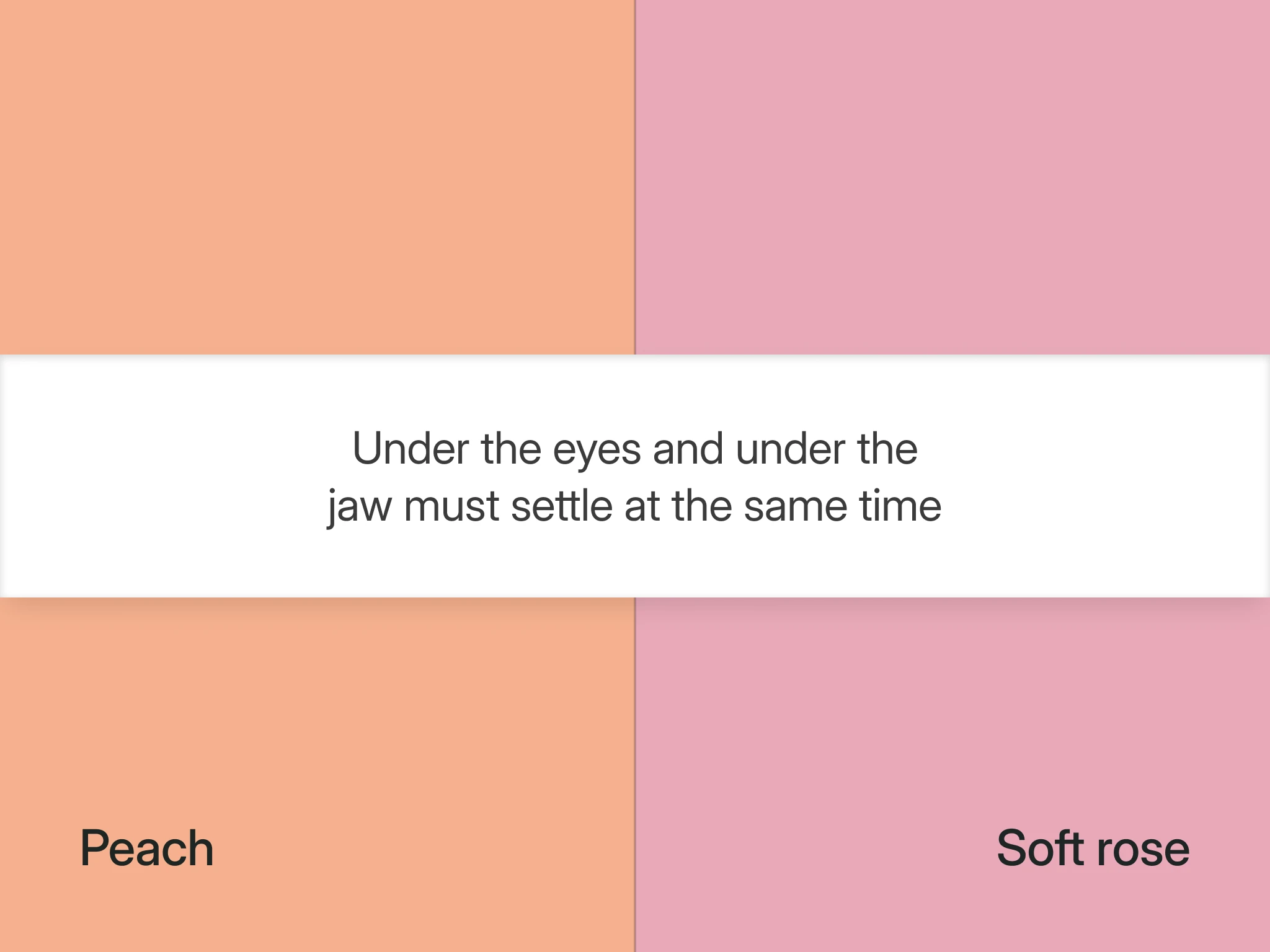
Two pale tops, and you watch the under-eye and the jaw at the same time.
- Set the scene. Take two tops in the same fabric and lightness, one peach and one soft rose. Peach belongs to Light Spring and soft rose to Light Summer, and because both are pale and quiet, the only thing separating them is which way they lean. Stand within a step of a window, switch off every other light, take off concealer and any under-eye product, and pull your hair back off your face.
- Watch two places at once. Do not judge by the cheek: on a light, low contrast face it warms up under almost any pink and tells you what you want to hear. Watch the skin directly under your eye and the shadow under your jaw instead.
- Read the edges, not the color. Peach on a Light Summer warms the cheek but hardens the line under the eye into a visible crescent, and the jaw shadow picks up a defined lower border that your face does not normally have. Soft rose on a Light Spring does the reverse: the under-eye softens, but the whole face steps down a degree, the jaw shadow spreads and loses its edge entirely, and the mouth goes with it.
- Keep the top where both edges settle. On the correct top the under-eye stops announcing itself and the jaw shadow keeps a soft, readable border rather than a hard line or a smear. One of them improving on its own is not enough.
What the wrong season does to a light face
On the light seasons a wrong color rarely looks harsh. The garment survives and you recede behind it.
A Light Summer in Light Spring's coral and light gold looks slightly sallow in photographs, and the under-eye shows it first. A Light Spring in Light Summer's dusty blue and lavender goes gray and washed out, and it gets worse in the winter months when there is less light on the face.
There is a second cost. Both palettes are low contrast, so the wrong undertone cannot be rescued by adding a stronger color. Turning up the volume on a shade that leans the wrong way just moves the problem closer to your face.
If the test stays unclear
Neither light season commits on temperature. Light Spring is warm-neutral and Light Summer is cool-neutral, which means the difference you are hunting is small in the mirror even when it is decisive in a wardrobe. If two runs of the test came back ambiguous, run it once more in midwinter rather than in high summer. A light face carries less color in the darker months, and the wrong undertone shows up faster against that paler baseline than it ever will against a tan.
If it is still split after that, Light Summer against Soft Summer is the article to read next, because value rather than undertone may be the axis you are actually feeling. A full color analysis reads undertone, value and chroma together: AI reads your five photos, with a white sheet of paper in frame to correct the light, fixed rules make the call. When a photo contradicts a clear answer, the answer decides. Photos fill in what the questionnaire doesn't ask. Next to your season it names the sister season you sit closest to, and says why.
Until it settles, buy from the overlap. Light forget-me-not, soft white, soft navy, warm greige and light denim are Wear for both seasons, so a shirt or a knit in any of them is right whichever way the answer falls.
Light Spring vs Light Summer: common questions
No. Light hair sets your value and it is why you are in the light group, but it says nothing about undertone, and both of these seasons are full of blondes. The shade of blonde is a hint at most, golden for Light Spring and ash for Light Summer, and dye and sun change it, so let the test decide.
Neither, on its own: periwinkle, which the analysis lists as light forget-me-not, sits on both core palettes and settles nothing by itself. There is one asymmetry worth knowing: it is Light Summer's power color and only one of eight core colors for Light Spring. A periwinkle that people comment on is a small point for Light Summer, and one that is merely fine is a point for neither. The decision still comes from peach against soft rose.
Yes, below the waist. Black and charcoal are a Depends for both light seasons: trousers, skirts, shoes, a bag, never the collar. Soft navy is the darkest color either palette wears at the face. The sample analysis, a Deep Autumn's real result, shows the same rule from the dark side: soft white and light gold are marked below the waist only, with reasons like "Not enough weight to hold near your face, but it works lower down."
A Light Spring can borrow most of them in a smaller role, and a Light Summer can borrow far fewer in the other direction. Light Summer's eight core colors sort like this for a Light Spring:
Compare your whites instead of your metals, because ivory against soft white gives a bigger, more readable signal than a thin chain, and a tie between gold and silver is common in the light group, where both undertones only lean. Soft white suits both seasons, so the question is whether ivory beats it at your collar. Ivory is Light Spring's best white and only a Depends for Light Summer, so this pair reads temperature directly. Leave pure white out of the test: it is a Depends for both, and the question it answers is about chroma and value, not undertone.