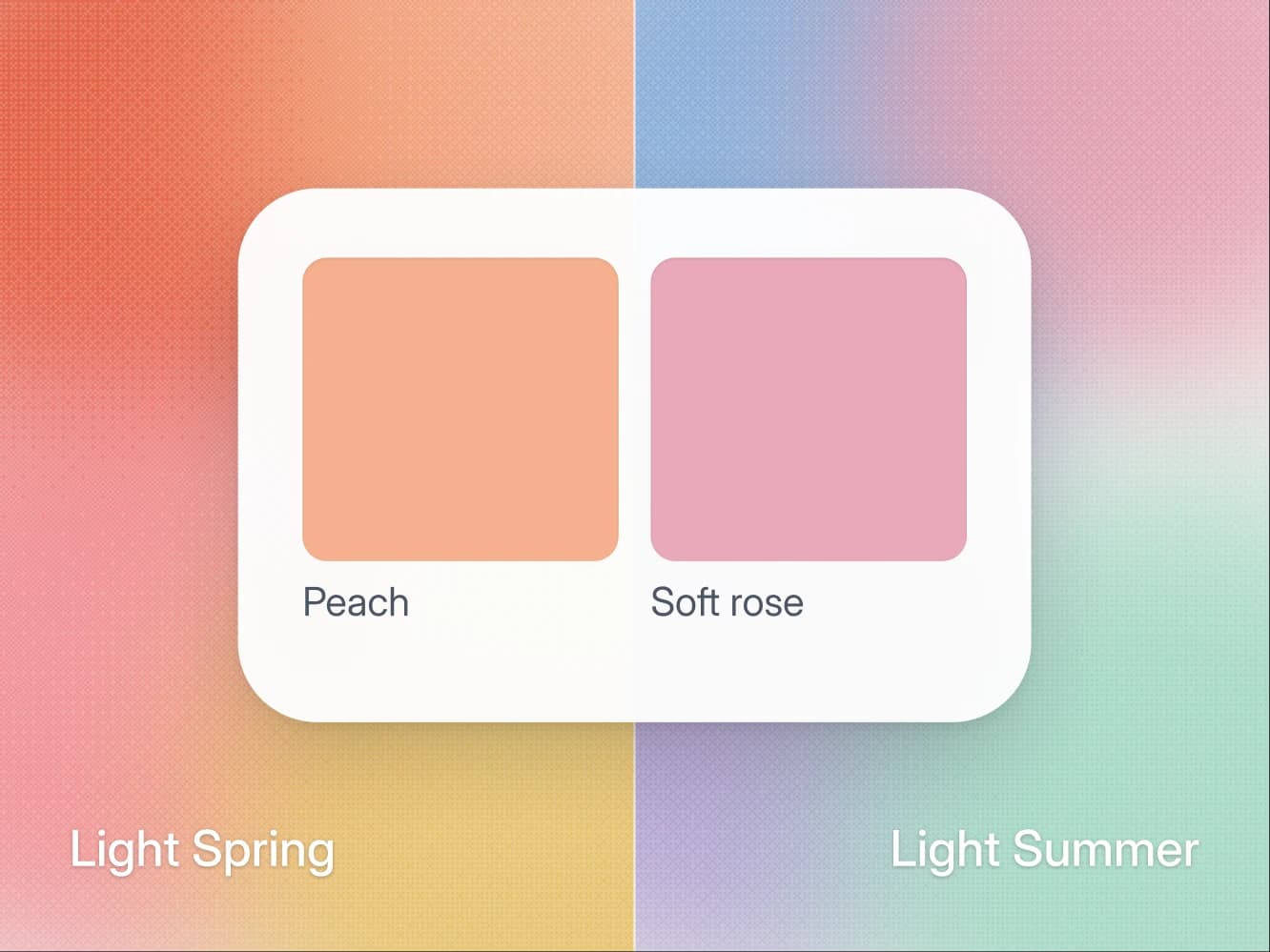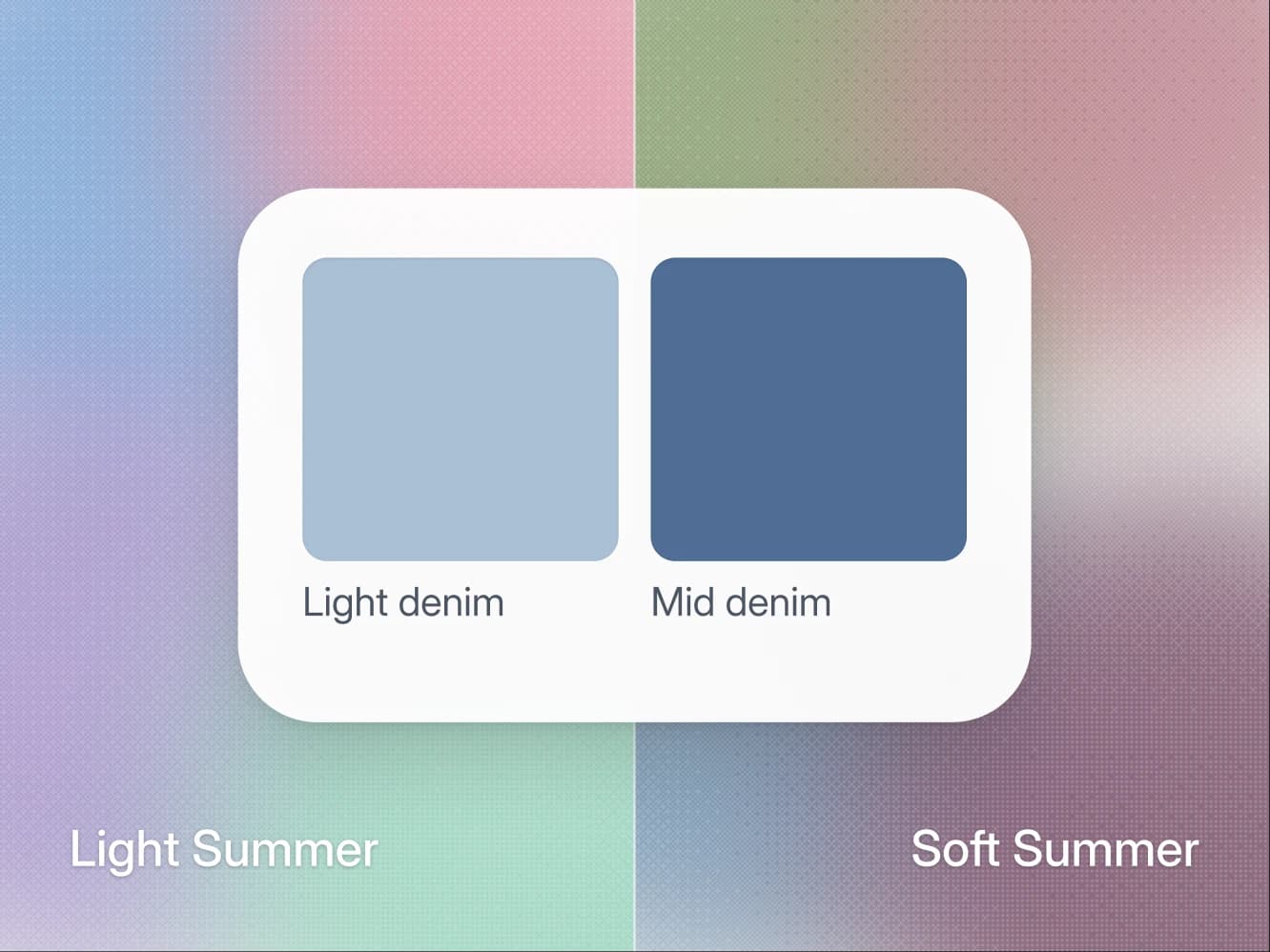
Light Summer and Soft Summer share a cool-neutral undertone and low contrast, so depth tells them apart: Light Summer is light, while Soft Summer sits at medium value and is the more muted of the two. You can check which one is yours with a light denim shirt and a mid denim shirt held at your face in daylight, because each season wears one of those washes at the collar and keeps the other below the waist.
On this page
- Light Summer vs Soft Summer at a glance
- The quick test: two denim shirts
- Where the two seasons agree
- Where the two seasons split
- The colors that change verdict
- The tell: the shadow under your jaw
- What a wrong pick looks like
- Still not sure? Check the light, then True Summer
- Light Summer vs Soft Summer: common questions
Light Summer vs Soft Summer at a glance
- Shared: a cool-neutral undertone, low contrast, soft white as the best white, and silver rather than gold.
- Split: Light Summer leads with lightness at light value. Soft Summer leads with softness (low chroma) at medium value.
- Test: hold light denim and mid denim at your face. Light denim matches a Light Summer's jaw shadow, and mid denim matches a Soft Summer's.
- Verdicts: 19 of the 50 colors change verdict between the two, each by one step, and nine are a Wear for both.
- Next border: if mid denim wins but the colors still look dull, check True Summer, which sits between the two on the wheel.
The quick test: two denim shirts
Hang a light denim shirt and a mid denim shirt next to your face in daylight and pick the one that looks like it belongs to you rather than to the room. Light denim is Light Summer core, mid denim is Soft Summer core, and almost nobody wears both well. In a Wearly Labs analysis each season gets the other one's wash as a Depends, the verdict for below the waist or an accent: fine as jeans, not as the shirt.
Where the two seasons agree
They agree on undertone and contrast, the two axes people lean on hardest, and on white and metal:
- Undertone: whether your skin leans golden or rosy (more in how to find your undertone at home). Both are cool-neutral, so both carry a little warmth without breaking: warm greige is a Wear for both, at the face included.
- Contrast: the gap in depth between your hair, skin, and eyes. Both are low contrast, meaning the three sit close together with no big jump between them.
- White: soft white, not pure white and not ivory.
- Metal: silver rather than gold, polished for one and matte for the other.
Five core colors are shared outright: periwinkle (light forget-me-not on your page), lavender, dusty blue, mint, and dusty rose (dusty pink). Add the four neutrals both seasons wear at the face, soft white, light gray, warm greige, and soft navy, and nine of the 50 colors in a Wearly Labs analysis are a Wear for both. That is a workable wardrobe on its own, and it is why so many people sit between these two seasons for a long time without anything going visibly wrong.
Where the two seasons split
These two are not neighbors on the twelve-season wheel. Each season is named after its leading trait: Light Summer leads with lightness, Soft Summer with softness, which means low chroma. True Summer sits between them, Light Summer's other neighbor is Light Spring, and Soft Summer's is Soft Autumn (The Concept Wardrobe sets the wheel out this way in its Light Summer and Soft Summer guides). So the split has two parts: how deep your coloring runs, and how much color strength your face can carry.
Albert Munsell defined both in A Color Notation, first published in 1905. Value is "the quality by which we distinguish a light color from a dark one," and chroma is "the quality by which we distinguish a strong color from a weak one." Value is the one you can see in a mirror, which is why the test below runs on it.
| Axis | Light Summer | Soft Summer |
|---|---|---|
| Leads with | Lightness | Softness (low chroma) |
| Undertone | Cool-neutral | Cool-neutral |
| Value | Light | Medium |
| Chroma | Soft | Muted |
| Contrast | Low | Low |
| Best white | Soft white | Soft white |
| Metal | Silver | Matte silver |
| Denim at the collar | Light denim | Medium denim |
| Gray at the collar | Light gray | Light and medium gray |
Undertone, contrast and white match. The other six rows differ, and every one of them follows from value or chroma.
The colors that change verdict
Every color in a Wearly Labs analysis gets one of three verdicts, each with its reason: Wear, Depends (below the waist or as an accent only), or Skip. Between these two seasons, 19 of the 50 colors change verdict, and every change is one step. No color is a Wear for one season and a Skip for the other, which is why getting this one wrong is never dramatic.
Seven of those changes happen at the face, where they show. The last row is the overlap that stays a Wear for both:
| Color | Light Summer | Soft Summer | Points to |
|---|---|---|---|
| Light denim, soft pink, ice blue | Wear | Depends | Light Summer |
| Medium denim, medium gray, mauve, sage | Depends | Wear | Soft Summer |
| The nine shared colors | Wear | Wear | Either |
Read across: a Wear is a color for the face, a Depends moves it away from the face, and the last column names the season that wears it at the face. Every Depends here has its own placement. Light denim and soft pink go below the waist on a Soft Summer, and ice blue is an accent. Medium denim, medium gray and mauve go below the waist on a Light Summer, and sage is an accent.
The other 12 changes are between Depends and Skip, on colors neither season wears at the collar, and half of them are about chroma. Six clear colors that Light Summer keeps for a scarf, a strap, or a shoe are a Skip for Soft Summer: sharp red, raspberry, fuchsia, emerald, royal blue, and deep purple. They are the largest group behind Soft Summer's avoid list of 21 colors against Light Summer's 11.
The tell: the shadow under your jaw
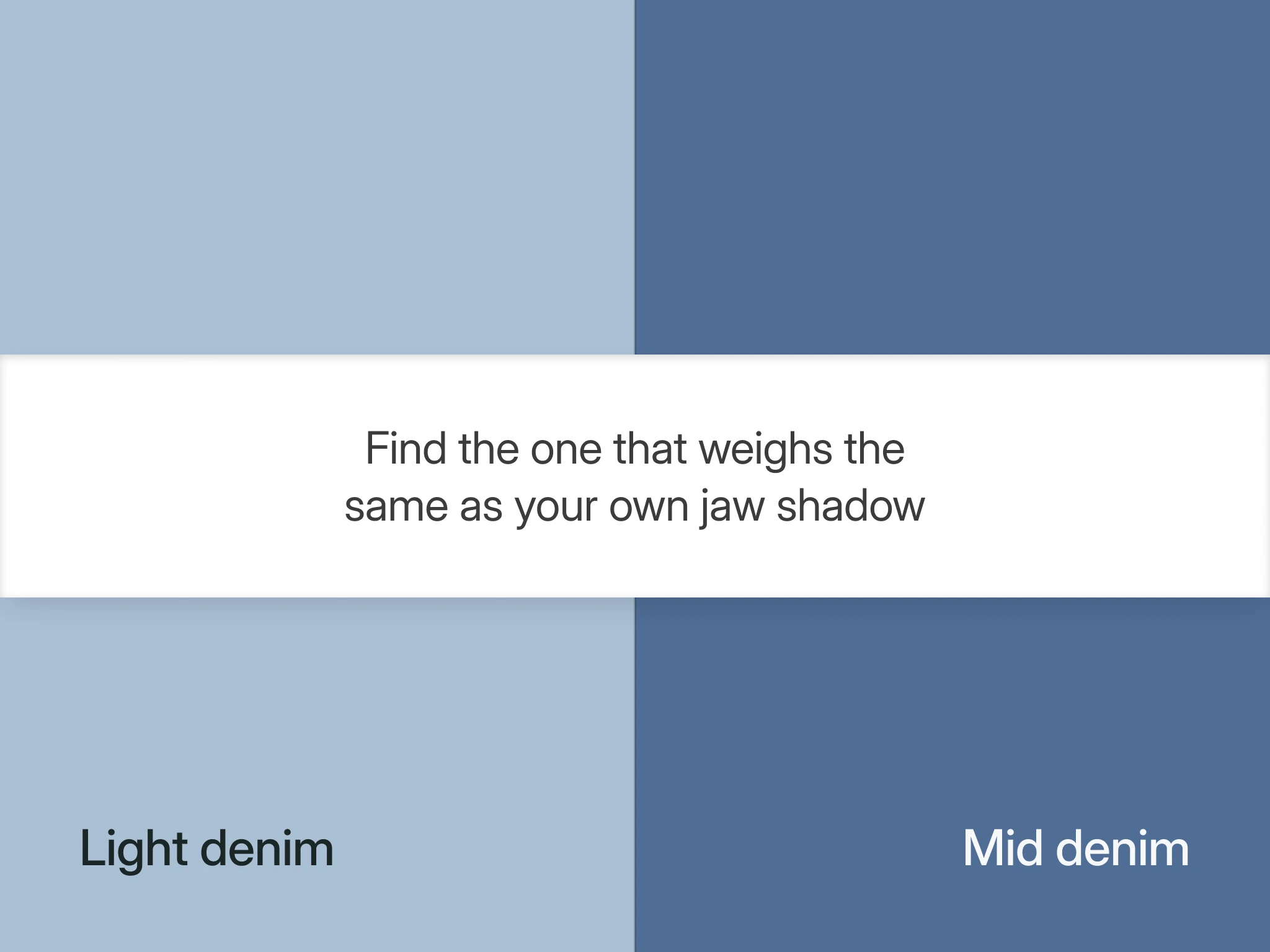
The tell is the denim ladder. Instead of judging a garment against your face, you judge it against one specific thing your face already produces: the shadow under your jaw. You need two in-palette shirts, light denim and mid denim, one for each season, and a mirror in daylight.
- Set up the light. Stand about three steps back from a mirror so your head, shoulders and both shirts fit at once, with the window to one side and no direct sun on your face. Hair back, chin level, and give your eyes half a minute to settle to the room. A yes is a mirror where your face and both shirts sit in the same even light.
- Read the shadow first. Look at the shadow under your jaw before you hold anything up, and register how dark it is on its own. A yes is a shadow you can describe as faint or as a real mid tone.
- Hold each shirt up in turn. Ask which shirt is the same weight as that shadow. A yes is the shirt that makes the jaw shadow stop being noticeable.
- Check the other shirt. A yes is a clear reason it fails: it either outweighs the shadow (mid denim on a Light Summer) or leaves the shadow standing alone (light denim on a Soft Summer).
On a Light Summer the jaw shadow is faint, so light denim matches it and the picture holds together. Mid denim is heavier than anything your own face produces, so it becomes the darkest thing in the frame, and your face is left as the palest object in the picture. That is what draining looks like.
On a Soft Summer the jaw shadow is a real mid tone, so mid denim sits at the same weight and nothing competes. Light denim leaves your face without a floor. The shadow under your jaw ends up the only dark point anywhere in view, and it reads as a smudge rather than as structure, with the whole outfit looking unfinished above the collar.
What a wrong pick looks like
Neither mistake is dramatic, and both are common. A Light Summer wearing Soft Summer's mid tones gets outweighed. Mid denim, mauve, and medium gray all carry more depth than the face does, so the face reads washed out rather than luminous. That is why a Light Summer analysis moves all three below the waist instead of off the list: as trousers they are fine.
A Soft Summer wearing Light Summer's lighter, clearer end has the reverse problem. Light denim and soft pink leave nothing to anchor the picture, so the face looks slightly unsupported and slightly grayer than it is, and ice blue drops to an accent. The metal compounds it, because polished silver adds a clarity that muted coloring is trying to avoid.
Still not sure? Check the light, then True Summer
Value is the easiest of the four axes to judge in a mirror and the easiest to get wrong in a photograph, because a phone sets the exposure for you. Apple's iPhone User Guide says the camera "automatically sets the focus and exposure" before every shot. If your denim test gave one answer indoors and a different answer outdoors, the light moved and you did not.
The fix is a reference object: put a sheet of plain white printer paper in the frame beside your face in every shot, then judge each denim against the paper rather than against your memory of the last picture. If the paper comes out gray, the exposure dropped and that shot is not evidence. On an iPhone you can also touch and hold the focus area until AE/AF Lock appears, which keeps the same exposure for the next shots, so both shirts are photographed under one setting.
If mid denim wins but the grayed Soft Summer colors still look dull on you, the season to check next is True Summer. It sits between these two on the wheel, at medium value like Soft Summer but with more clarity, and Soft Summer vs True Summer runs the test for that border.
A full color analysis corrects the light against that same white sheet before it reads your value, and where five photos leave your depth undecided, your answers settle it. That is the part a home test cannot do.
Light Summer vs Soft Summer: common questions
Yes, for exactly one decision, repeated everywhere: how dark your clothes run near your face. That covers the denim wash, the coat, knitwear and the shirt under a jacket. Trousers matter less, because each season keeps the other's depth below the waist. Get value right and the shared colors work harder for you than any new shade would.
Yes, in a smaller role. Of Soft Summer's face colors, a Light Summer wears mid denim, medium gray, and mauve below the waist and sage as an accent. A Soft Summer wears Light Summer's light denim and soft pink below the waist and ice blue as an accent. Nothing either season wears at the face is a Skip for the other.
Because two washes of denim are the same blue at two depths, so value is the only thing that changes between the shirts. The sample analysis, co-founder Filip Poláček's real result, shows the same logic from the dark end: as a Deep Autumn he gets both washes below the waist only, and the reason given for medium denim is "A faded cool blue that reads too light beside your depth."
As an accent: a belt, shoes, or a bag. It is a warm neutral in a cool-neutral palette, so it stays away from the jaw. For a Soft Summer camel goes one size up, to trousers, though still not to the collar.
Chroma, not value. Soft Summer is muted and shine reads as clarity, so it wants a brushed finish. Light Summer sits one step up at soft, so polished silver stays comfortable.
Only as a hint. Light Summer hair tends to run very light ash blonde to light ash brown, with light gray, blue, or green eyes. Soft Summer hair runs medium ash blonde to medium ash brown, with gray, gray-green, or grayish brown eyes (Curate Your Style describes both this way). The difference is the same one again, depth, and dye and sun change hair, so let the denim decide.
You can, and it is a reasonable holding pattern. Periwinkle, lavender, dusty blue, mint, and dusty rose are safe on both, and so are soft white, light gray, warm greige, and soft navy. The decision arrives with your next coat, because a coat is a value commitment. Until then, a soft navy or warm greige coat is right for either.