Soft Summer and True Summer differ in chroma, the strength of color your face can carry. Hold a clear raspberry at your jaw in daylight: if your face holds its own beside it you are True Summer, and if the color arrives first you are Soft Summer. True Summer, also called Cool Summer, is fully cool and wears raspberry at full strength, while Soft Summer is cool-neutral and needs the same raspberry grayed down. The two sit at the same depth, want the same soft white and share five of their eight core colors, which is why people swap between them for months.
On this page
Soft Summer vs True Summer at a glance
- The split: chroma. True Summer holds clear raspberry at full strength, Soft Summer needs it grayed down.
- Shared: cool, medium depth, soft white, silver metals, and five core colors from dusty blue to lavender.
- Verdicts: 40 of 50 colors get the same verdict in both seasons, and ten change.
- Contrast: medium for True Summer, low for Soft Summer, so Soft Summer wants neighboring tones.
- Metal and black: polished silver for True Summer, matte silver for Soft Summer, black below the waist for both.
Where the two seasons agree
Almost everything except chroma. Both seasons sit at medium value, so neither is pale and neither is deep. Both lean cool, so both take silver over gold and soft white over ivory. Five of the eight core colors are the same shade in both palettes: dusty blue, mauve, periwinkle, mid denim, and lavender. Any of those five works whichever season you turn out to be.
The overlap runs wider than the core lists. A Wearly Labs analysis judges 50 colors, and 40 of them get the same verdict in both seasons. Eleven are a Wear for both, the collar included: those five, plus dusty pink, soft navy, soft white, light gray, medium gray, and warm greige. On an analysis page, periwinkle appears as light forget-me-not.
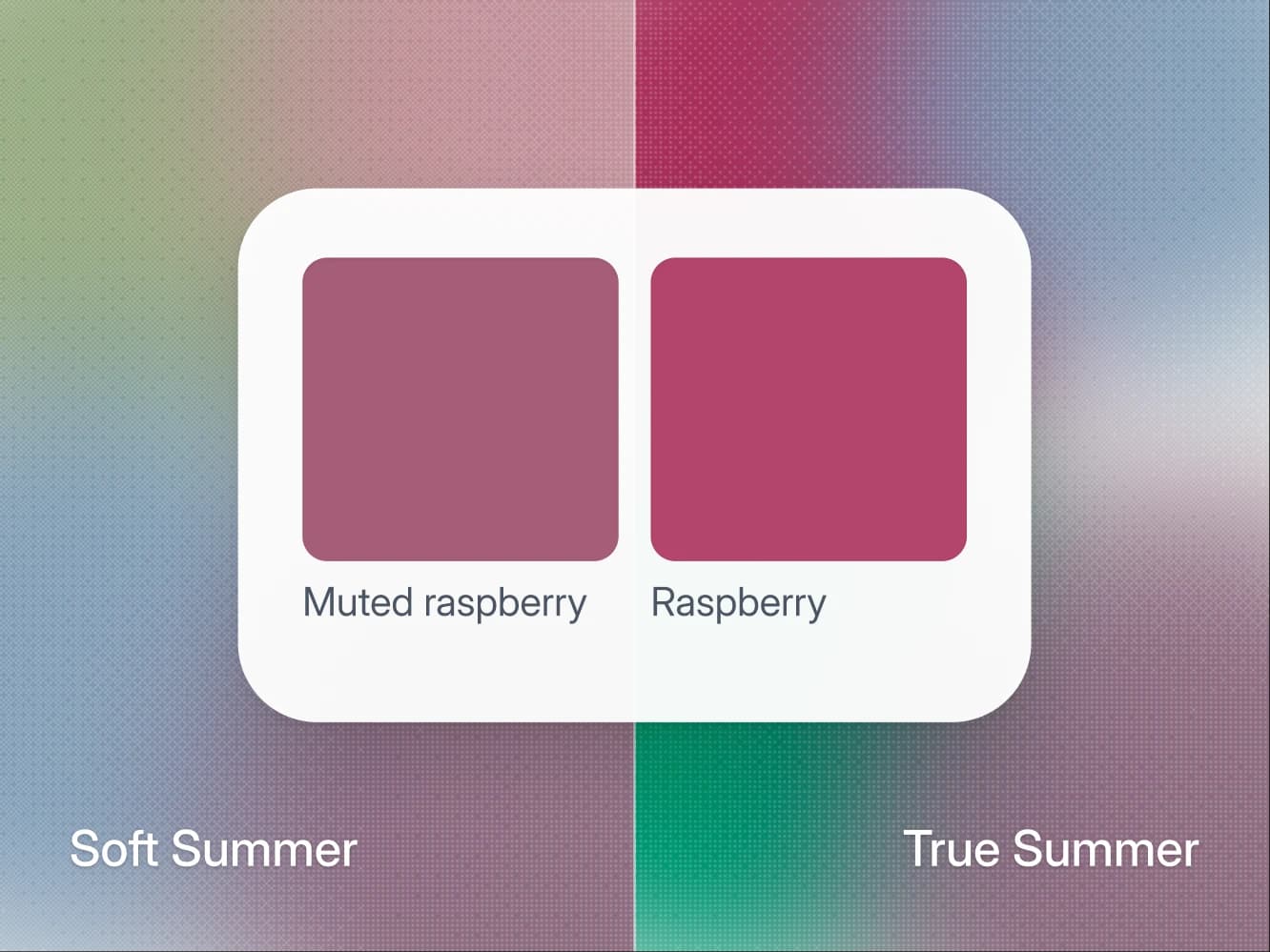
The power color is shared in family too. True Summer's raspberry and Soft Summer's muted raspberry are one color at two strengths, which is the whole confusion in a sentence.
Where they split
Color analysts describe each of the twelve seasons by a leading trait and a second one. True Summer leads with coolness and is muted second; Soft Summer leads with softness, which is low chroma, and is cool second, as The Concept Wardrobe sets out in its True Summer and Soft Summer guides. On the season wheel they are next-door neighbors: True Summer sits between Light Summer and Soft Summer, and Soft Summer sits between True Summer and Soft Autumn, the Summer nearest the Autumns, which is where its touch of neutral comes from.
Chroma is the strength of a color, how far it sits from gray. Albert Munsell showed it in A Color Notation with three reds written R 5/1, R 5/5 and R 5/9: "both hue and value are unchanged," and "the chroma passes from grayish red to middle red" and on to the strongest red. Muted raspberry and clear raspberry are two steps on a scale like that, and each season owns one of them.
| Axis | Soft Summer | True Summer |
|---|---|---|
| Leads with | Softness (low chroma) | Coolness |
| Undertone | Cool-neutral | Fully cool |
| Value | Medium | Medium |
| Chroma | Markedly muted | Softly muted |
| Contrast | Low | Medium |
| Best white | Soft white | Soft white |
| Black | Below the waist only | Below the waist only |
| Metal | Matte silver | Silver |
| Power color | Muted raspberry | Raspberry |
Three rows match: value, best white and black. The other six differ, and the chroma row is the one the rest of this page tests: True Summer is softly muted and still holds some clear color, Soft Summer is markedly muted.
The ten colors where the verdicts part
A Wearly Labs analysis gives each of its 50 colors a verdict, Wear, Depends or Skip, with the reason, and Depends means below the waist or as an accent only. Between these two seasons, ten colors change verdict:
| Color | Soft Summer | True Summer |
|---|---|---|
| Raspberry | Skip | Wear |
| Sharp red | Skip | Wear |
| Fuchsia | Skip | Wear |
| Emerald | Skip | Wear |
| Royal blue | Skip | Wear |
| Deep purple | Skip | Wear |
| Turquoise | Skip | Depends |
| Soft pink | Depends | Wear |
| Sage | Wear | Depends |
| Mint | Wear | Depends |
Read the Depends cells this way: Soft Summer's soft pink goes below the waist, and True Summer's turquoise, sage and mint stay accents.
The pattern is chroma, almost without exception. Every color True Summer skips, Soft Summer skips too: all fourteen, nearly all of them warm, from orange and rust to olive and peach. Soft Summer then adds seven of its own, and all seven are clear, strong colors, from raspberry and fuchsia to royal blue and emerald. What Soft Summer gains back is two soft greens with a neutral undertone, sage and mint, which a fully cool True Summer keeps to a scarf or a shoe. Both full palettes are on the Soft Summer and True Summer pages.
The raspberry test, step by step
You need two tops in the same color family at two strengths: one clear raspberry, one dusty or muted version of it. Mauve works as the muted stand-in if you do not own muted raspberry.
Choose an overcast day, because the flat, even light of a gray sky is the least likely to add a sparkle that a muted season does not have. Stand within a step of a window, out of any direct sun, face clean and hair back, and give your eyes a full minute in that light before you judge anything. When the color of the light changes, the eye's adjustment to it is about 90% complete after roughly a minute, as Mark Fairchild and Lisa Reniff measured in 1995.
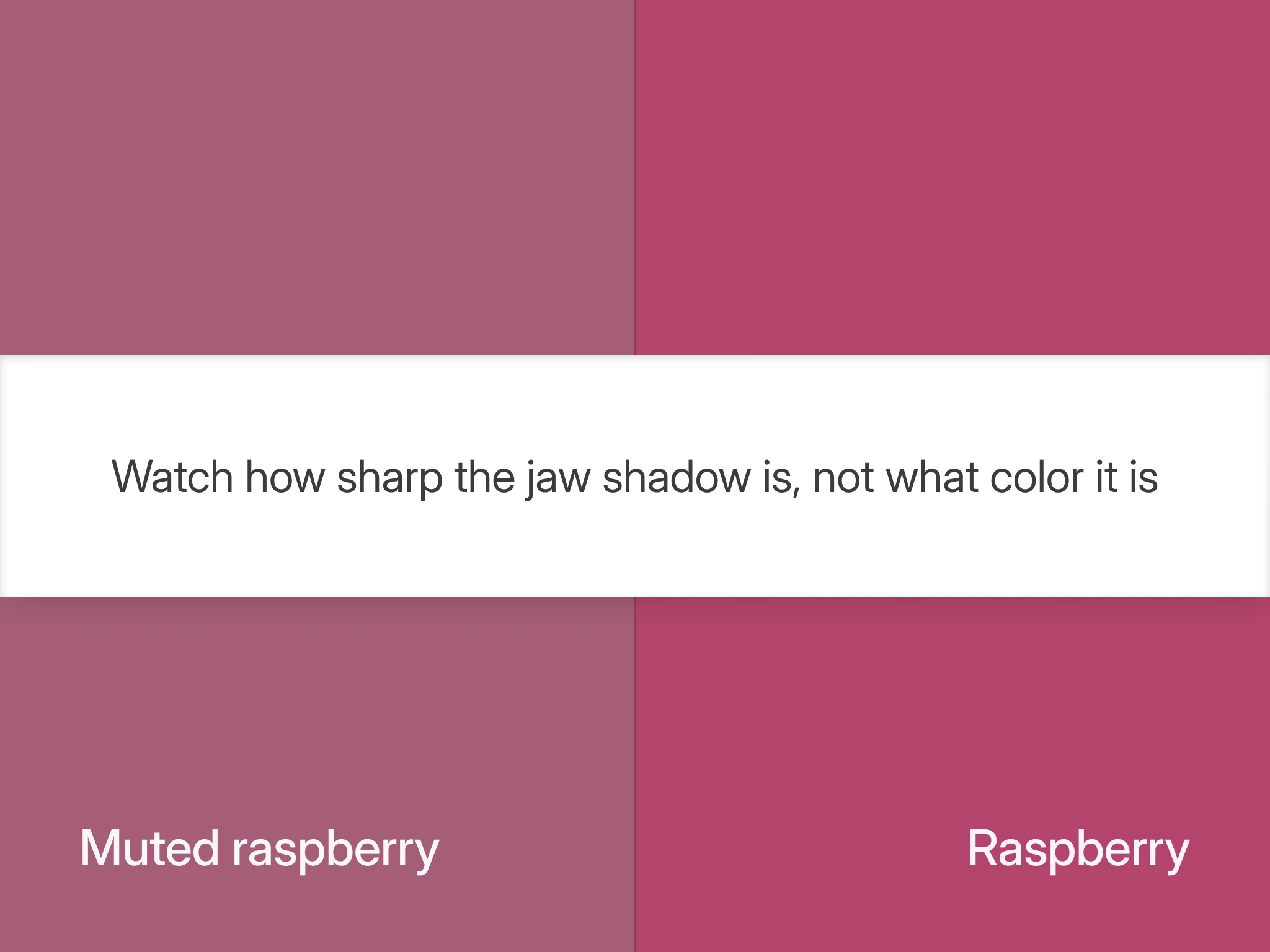
- Clear raspberry first. Hold it under your chin for ten seconds and look only at the edge where the shadow under your jaw meets your neck. On a True Summer that edge stays defined and the shadow stays a clean cool gray, so your jawline still reads as a line. On a Soft Summer the shadow thickens and turns slightly muddy, and your eye keeps sliding off your face and back onto the top.
- Muted version second. Swap tops without leaving the window. On a Soft Summer the jaw shadow lightens and its edge softens back into the face, which is the result you want. On a True Summer it looks acceptable but noticeably drained, as though the color had been turned down across the whole picture.
- Read the pair together. The version that keeps your jawline clearest is your season: clear raspberry points to True Summer, muted raspberry to Soft Summer.
What a wrong season looks like
Nothing dramatic happens either way. A Soft Summer in True Summer clarity looks slightly overtaken by the clothes. Clear raspberry and emerald at the collar make the garment the first thing anyone sees, the jaw shadow deepens, and features that were already low contrast lose the definition they had. Most people read that as tiredness rather than as a color problem.
A True Summer in Soft Summer grayness has the opposite outcome. Everything is in the right neighborhood, nothing is actively wrong, and the whole effect is flat. You give up raspberry, which is the single color doing the most work for you, along with emerald and royal blue, and you trade polished silver for matte, which removes the last bit of light the outfit had at the wrist.
When the raspberry test comes back split
Chroma is the hardest of the four axes to judge on yourself. Munsell himself called chroma difference "the third and most subtle color quality." Value you can check with a squint, and undertone has tests you can run at home, but chroma mostly you cannot, which is why people stall exactly here.
Take your second opinion off the metal rather than the cloth. Hold a brushed silver chain and a polished one at your collarbone, and the finish that reads as jewelry rather than as a small light source tells you which side of the chroma line you are on.
The sample analysis shows what a verdict and its reason look like when a color moves between seasons. It is the real result of co-founder Filip Poláček, whose season is Deep Autumn, which Wearly Labs calls Dark Autumn, so the Summer colors land differently on him: raspberry is a Skip, "Too cool a pink to sit near coloring built on warmth," and mauve, a Wear for both Summers, is a Depends, "From the waist down only." A full analysis reads undertone, value, chroma, and contrast together from five photos, with a white sheet of paper in frame to correct the light, and your answers carry the most weight.
FAQ
Not at full strength. In the Soft Summer palette clear raspberry is a Skip rather than a Depends, because at that chroma it is too clean for markedly muted coloring wherever it sits. The muted version is the Soft Summer power color, and when you cannot find it, mauve and dusty pink are the nearest colors that are a Wear for you, the collar included.
Yes, and it matters more than it sounds. Shine behaves like clarity, and Soft Summer is defined by the absence of clarity. True Summer carries polished silver comfortably. Soft Summer wants brushed or matte.
True Summer. Its contrast is medium and Soft Summer's is low, so a True Summer can put a soft navy blazer over a soft white shirt, while a Soft Summer does best with neighboring tones that sit close in depth, like mauve with dusty pink, or dusty blue with periwinkle.
You can, and plenty of people do while they work the rest out. Eleven colors are a Wear for both seasons: dusty blue, mauve, periwinkle, mid denim, lavender, dusty pink, soft navy, soft white, light gray, medium gray, and warm greige. The two seasons only diverge once you add a strong color or pick a metal.
Below the waist, in both seasons. Black is a Depends for Soft Summer and True Summer alike, kept to trousers and shoes, because it is harder and darker than either palette and flattens muted coloring near the face. Soft navy and medium gray take the jacket and the coat, and both are a Wear for both seasons.
It can lean you one way, not settle it. The classic True Summer eye is gray-blue with a soft, slightly clouded look. A Soft Summer eye looks smoky, and its pattern blurs at conversation distance instead of resolving into clean lines. Eyes vary within both seasons, so let the raspberry at your jaw decide.