Summer · color season
True Summer: your palette, and what to leave on the rail.
True Summer is fully cool and softly muted. Here is the palette that follows from that, the neutrals to build on, and how to wear them together.
- 8 core colors
- silver at the wrist
- 10 minutes to get yours
Last updated
At a glance
Where True Summer sits, and what follows from it.
- Light Summer
- True Summer
- Soft Summer
- Soft Autumn
- True Autumn
- Deep Autumn
- Deep Winter
- True Winter
- Bright Winter
- Bright Spring
- True Spring
- Light Spring
Each season sits between the two it shades into. The two Light seasons meet at the top, the two Deep ones at the bottom, the two Bright ones on the clear side and the two Soft ones on the muted side. Spring and Autumn are warm, Summer and Winter are cool.
- Undertone
- cool
- Value
- medium
- Chroma
- saturated
- Buy first
- Raspberry
- Metal
- Silver
- Keep from the face
- Tomato red
- Warm pink
- Warm aquamarine
- Olive
- Mistaken for
- Soft SummerDeep WinterHow they differ
Am I a True Summer?
True Summer, also called Cool Summer, is the season led by coolness: your undertone (the cast under the skin) is fully cool, your coloring sits at medium depth, and your colors are softened by a little gray yet strong enough to carry a clear raspberry.
Cool colors at that middle depth make your skin look even and your eyes clear, while anything with orange or gold in it lays a yellow cast on the skin and deepens the shadows around the eyes.
Look in daylight, with no makeup and no tan. Natural hair is ash, anywhere from dark blonde to dark brown, with no red or golden glint. Eyes are most often gray-blue, blue, gray-green or a grayed hazel, and on deeper skin a grayed brown, with a soft, slightly clouded look rather than a crystalline one.
Skin carries a cool cast, sometimes pink, sometimes a cool beige, from fair to tan, and in weak light it goes ashy rather than golden. Wrist veins read blue to blue-purple, the least reliable of these signals (testing your undertone at home covers why).
If the four questions beside this text point you to "Cool above all", note that True Winter gets the same direction, so the mirror has to settle depth and softness. Take a raspberry sweater and a rust one to a window. Raspberry should make your face look clearer and more even, and rust should pull yellow into the skin and darken the shadow under your eyes.
That is cool against warm. The second step separates you from the other Summers: wear the raspberry as a whole sweater. If your face still comes first, you are a True Summer, because a Light Summer keeps raspberry to an accent and a Soft Summer skips it.
The analysis makes that call for all 50 colors: each gets Wear, Depends or Skip with its reason, and Depends means below the waist or as an accent only. A True Summer gets 18 Wear, more than either other Summer, with 18 Depends and 14 Skip.
On the sample analysis, co-founder Filip Poláček's Deep Autumn result, raspberry is a Skip: "Too cool a pink to sit near coloring built on warmth." Four more of your eight core colors are a Skip on that page too. On a True Summer the same raspberry heads the palette.
Check the direction first.
Four questions from the questionnaire, scored by the rules the analysis uses. They show a direction, not a season: the analysis also reads your photos.
Question 1 of 4
Your natural hair color?
Pick the closest match. If you dye it, go by your roots.
The palette
The eight colors True Summer is built on.
- Anywhere, the face included
Your power color: cool like your undertone, and clear enough to sharpen the face without taking it over. A sweater, a tie, a lipstick.
- Anywhere, the face included
Blue with gray in it, at your own middle depth, so it behaves like a neutral. It is the shirt under a soft navy blazer and over medium gray trousers.
- Anywhere, the face included
The green your undertone accepts at full size, because it leans blue. Buy it a shade softer than a jewel tone, in a wrap dress, a heavy knit or a coat.
- Anywhere, the face included
It does what a gray sweater does, with color in it: pink grayed down to your depth. With medium denim it is a whole outfit.
- Anywhere, the face included
The pale pink for fully cool skin. Its warm cousins, peach and warm pink, are both a Skip, so check the color in daylight before you buy the shirt or the blouse.
- Anywhere, the face included
Periwinkle by its usual name: blue with a trace of violet, which picks up the blue in gray-blue eyes. A shirt, a scarf, a summer knit.
- Anywhere, the face included
Denim at your exact depth, and so a neutral rather than weekend wear. A medium denim shirt, a chambray dress, a jacket over raspberry.
- Anywhere, the face included
The pale end of the palette, alongside soft pink and light forget-me-not. A lavender shirt under a medium gray suit keeps business dress cool without going stark.
Neutrals and metal
Your neutrals, your white, your metal
Your neutrals are soft white, light gray, medium gray, soft navy and dusty blue, all of them cool and none of them harsh. Medium gray is the suit and the trouser. Soft navy takes black's place in the coat and the blazer: deep enough to ground an outfit, without the hard edge black puts under your face. Warm greige is not on the list but is still a Wear, the one warm-leaning neutral grayed enough to suit you.
Camel, ivory and black are missing, and none of them is a Skip. Your page gives all three a Depends, below the waist, so camel chinos, ivory jeans and black shoes all work. Charcoal, chocolate and espresso follow the same rule.
Your white is soft white. Pure white is the one that fails at the collar: it is brighter than anything in medium coloring, so the shirt glares and the skin beside it looks flat and faintly gray. Ivory fails from the warm side, laying a yellow film over cool skin. Both still work below the waist, as trousers or sneakers.
Your metal is silver, which takes in white gold, platinum, pewter and a steel watch. Your power color is raspberry, and one raspberry piece does more for you than another neutral would. Fourteen colors fail you outright, nearly all of them for the same reason.
At the face
Wear this, skip that
- Sharp redTomato red
Too warm beside your cool.
- Soft pinkWarm pink
Too warm beside your cool.
- EmeraldWarm aquamarine
Too warm beside your cool.
- Warm greigeOlive
Too warm beside your cool.
The colors that fight you
Fourteen of the 50 colors are a Skip on a True Summer page, and thirteen of them share one reason.
Too warm beside your cool. Tomato red, coral, rust, warm pink, peach, orange, terracotta, mustard, golden yellow, light gold, leaf green, olive and warm aquamarine. A fully cool undertone has no warmth to meet them, so at the collar they compete with your skin instead of matching it: the skin goes sallow, the shadow under the eyes deepens, and redness shows more. Every pair above sets one of them against its cool counterpart, sharp red against tomato red, emerald against warm aquamarine, which is the rule in four swatches.
Too heavy for medium coloring. Forest green, the one Skip for depth. It carries more weight than your coloring holds at the collar, where emerald, a lighter and bluer green, is a Wear.
The trouble usually comes from colors that are not on that list. A cream with gold in it, a beige with gold in it, a green with gold in it: each feels slightly off without an obvious reason. Test them at the rail against a soft white shirt. If your soft white suddenly looks blue and clean beside the new color, the new color carries gold, and it belongs below your waist or back on the rail. Warm greige is the exception that passes, because its warmth is grayed down.
Every color
All 50 colors, judged for True Summer.
Choose a color to see where it goes, the reason, and what the two seasons True Summer is mistaken for do with it. 14 of the 50 are a Skip.
Use the arrow keys to move from color to color.
Anywhere, the face included
A shirt, a coat, anywhere.
The same color in the seasons True Summer is mistaken for
- Soft SummerNot worn
- Deep WinterAnywhere, the face included
Anywhere, the face included
A shirt, a coat, anywhere.
The same color in the seasons True Summer is mistaken for
- Soft SummerNot worn
- Deep WinterAnywhere, the face included
How to combine True Summer colors
The rule the analysis gives a True Summer is cool muted layers at medium contrast, with no orange and no warm yellow.
Medium contrast means your hair and skin sit a moderate distance apart, so an outfit can step from soft white to soft navy and still look like you, while a jump from pure white to black is wider than your coloring. Build each outfit from two or three colors close in depth, then add one strong cool color when it needs energy. A single warm piece, even a belt, pulls the cool ones off, so keep orange and warm yellow out of the frame.
- Office, men's: a medium gray suit, a dusty blue shirt, a raspberry tie, black shoes and a steel watch.
- Weekend, women's: a mauve sweater, medium denim jeans, soft white sneakers and silver hoops.
- Dinner, women's: an emerald wrap dress under a soft navy coat, with plum shoes.
- Smart casual, men's: a light forget-me-not shirt under a soft navy blazer, light gray trousers, chocolate suede shoes and a turquoise pocket square.
Two seasons get mistaken for this one from opposite directions: a softer Summer and a darker Winter.
Mistaken for
Seasons True Summer gets confused with
 This pageTrue Summerfully cool and softly muted | 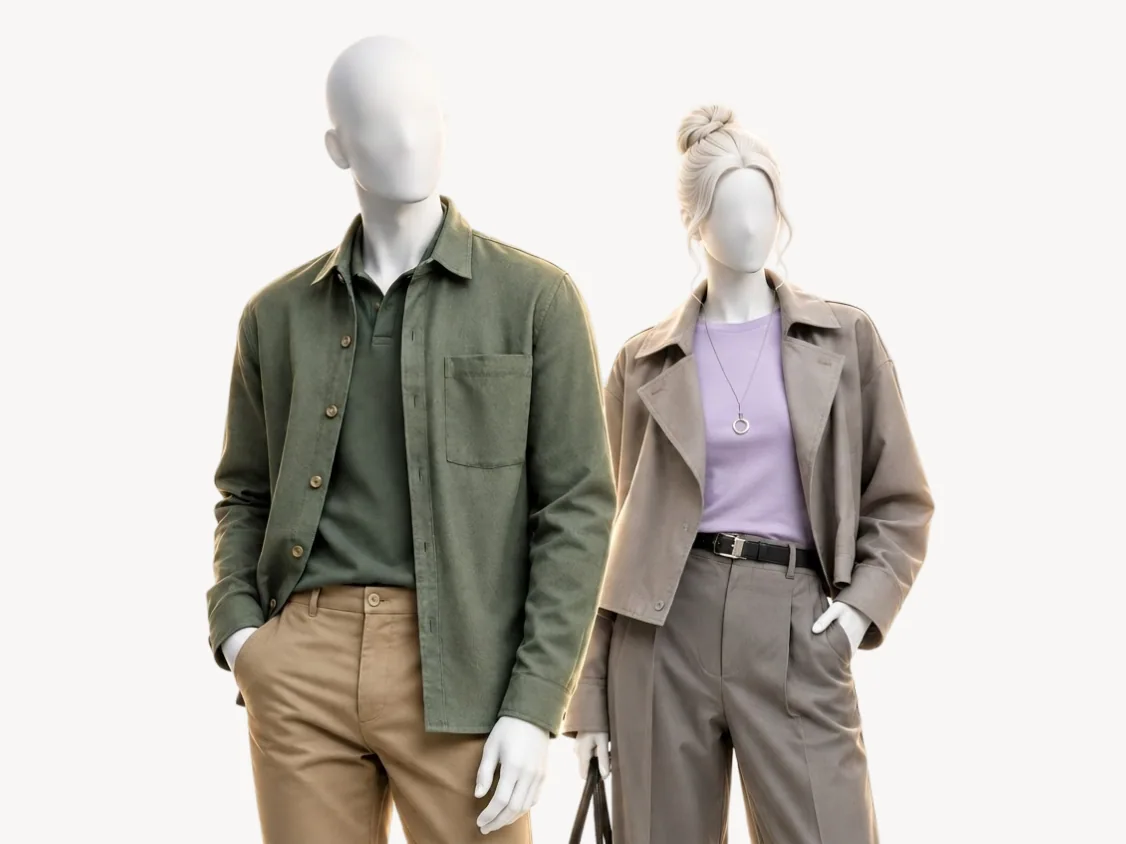 Mistaken forSoft Summercool and grayed down | 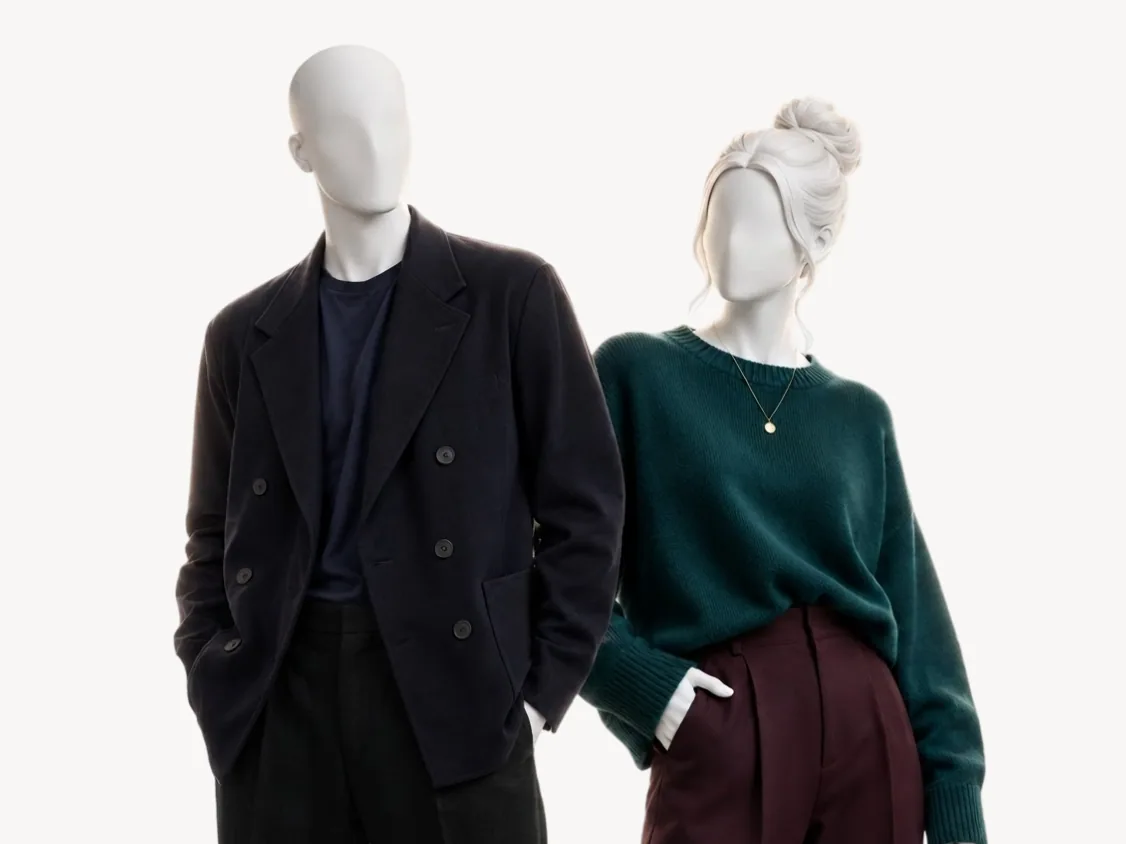 Mistaken forDeep Wintercool and deep with high contrast | |
|---|---|---|---|
| Undertone | cool | cool | cool |
| Value | medium | medium | dark |
| Chroma | saturated | muted | saturated |
| Metal | silver | matte silver | silver |
| Raspberry | |||
| Emerald | |||
| Sage | |||
| Soft navy | |||
| Pure white | |||
| Black |
Soft Summer. Both are cool and both sit at medium depth, and they give the same verdict on 40 of the 50 colors, the most of any two Summers. The tell is how much clean color you carry.
Raspberry and emerald are a Wear for you and a Skip for a Soft Summer, too clean for that softness, while sage, which you keep to an accent, is a Wear at a Soft Summer's collar. Hold raspberry, then sage, at your jaw: if raspberry clears your face and sage looks flat, you are a True Summer.
Deep Winter. Both are cool, both wear raspberry and emerald at the collar, and both look wrong in orange, so the undertone test settles nothing; they give the same verdict on 31 of the 50. The tell is contrast. Deep Winter wears black and pure white at the face, where you keep both below the waist, and soft navy, your coat color, is a Skip for Deep Winter, too dusty for its clarity.
Put soft navy at your collarbone, then black. If soft navy looks finished and black looks severe, you are a True Summer. True Winter gives the same three verdicts as Deep Winter and agrees with it on 46 of the 50 colors, so this test answers for both Winters.
If you are still between two Summers, Soft Summer vs True Summer runs the raspberry test step by step, with the light set up properly. On the Winter side, repeat the soft navy test on an overcast day, when the light is flattest. The sample analysis shows what the final answer looks like: a verdict and a reason for each of the 50 colors, on one page.
Where to go from True Summer
How the color analysis works Color seasonSoft Summercool and grayed down
 Color seasonDeep Wintercool and deep with high contrast
Seasons · 9 min
Soft Summer vs True Summer: how to tell which one you are
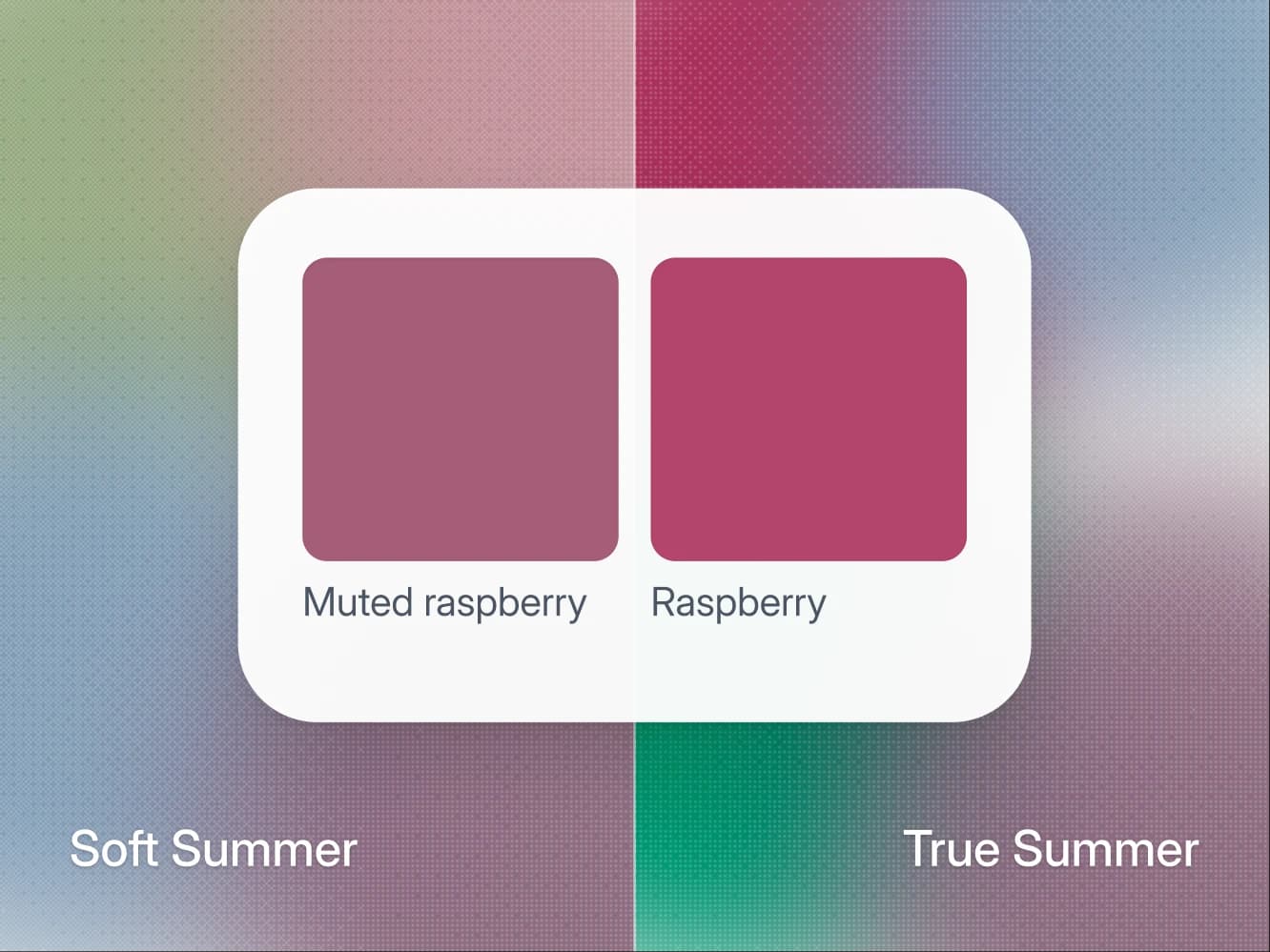
Both are cool, medium in depth and want soft white. The split is chroma: True Summer wears raspberry at full strength, Soft Summer needs it grayed down.
Seasons · 9 min
Find your undertone at home (warm, cool, or neutral)
Three daylight tests to find your undertone at home: wrist veins, gold vs silver, white paper. Plus how to read a neutral or olive result.

Method · 8 min
How to take photos for an accurate color analysis
The light, the angles, and the white paper trick. How to take five photos that give a color analysis something real to work with.
- All 12 color seasons
FAQ
True Summer questions.
True Summer is fully cool and softly muted. The quick check is whether cool colors at a medium value look better on you than their opposite, and whether silver suits you better than the other metal. That gets you close. The reason people land between two seasons is that the eye compares badly under mixed light, which is what a measured analysis is for.
Nothing dramatic. The colors furthest from your palette pull attention to shadows and to any unevenness in your skin, so you look tired rather than the color looking wrong. It shows most in the piece nearest your face and barely at all below the waist, which is why the palette matters more for a shirt than for trousers.
Below the waist. Black is harder and darker than your softly muted coloring and puts a hard edge under your face. Wear it as trousers or shoes and let soft navy carry the suit and the coat.
No. True Summer is cool at its root, and that is the axis the whole system turns on. Two seasons can share a value and a chroma and still want opposite colors, because the undertone decides which version of a color suits you.
That is what the analysis does, but not from one photo and not from the photo alone. It reads five photos against your own answers about how you burn, what your veins look like and which metal suits you, and your answers outrank the photos where the two disagree. Your photos are used for your analysis and nothing else. They are never used to train AI models.
Yes. True Summer and Cool Summer are two names for one season, the fully cool center of the Summer family. True because it is the Summer of the original four-season system, Cool because coolness is its leading trait.
The cool ones, yes. Sharp red, raspberry, fuchsia, emerald, royal blue and deep purple are all a Wear on a True Summer page, the collar included. What you skip is warmth, not strength: coral, orange and golden yellow are a Skip at any size. Turquoise, ice blue and lemon sit in between, as accents.
Below the waist. Camel, chocolate, espresso, latte and khaki all get a Depends on a True Summer page: their warmth pulls yellow into a cool face at the collar, while trousers, shoes and a bag carry them without trouble. Above the waist, soft navy and medium gray do the jobs brown would. A cool, grayed brown such as taupe is not among the 50 colors, so give it the soft white test from the colors that fight you before you buy it.
Depth decides it. Both are cool and they share 33 of the 50 verdicts, but Light Summer sits lighter. Medium denim and medium gray are a Wear for you and a Depends below the waist for a Light Summer, while light denim and ice blue are a Wear for a Light Summer and only a Depends for you. Hold a light and a medium denim shirt at your face: if the medium wash looks like part of you, you are the True Summer. Raspberry agrees, a Wear for you and an accent on the Light Summer page.
No. A tan darkens your skin for a few weeks, but your undertone, your eyes and your natural hair stay where they were, and the season is read from all of them. A tanned True Summer is still cool, so raspberry and light forget-me-not still work and orange still does not. Judge colors at your face once the tan has faded.
Because a True Summer undertone has no warm component, and yellow gold brings exactly the warmth your palette leaves out, the same warmth rust carries. Silver, white gold, platinum and pewter read clean against cool skin. Copper fails for the same reason yellow gold does.
Another question about the method or your result? Write to us
Find out what suits you, and why.
A short questionnaire and five photos. Your key arrives by email, usually within 10 minutes.