ChatGPT will give you a color season from any photo, but it can only judge the colors in that photo, and your phone changed those colors before the chat ever saw them. A longer prompt does not fix that. A sheet of white printer paper in the frame, three photos instead of one and a prompt that asks for evidence before it names a season give the model something to check against. The full prompt is below, free to copy.
On this page
What the viral version asks for
The version that went around social media again in spring 2026 is simple. Upload one selfie, ask ChatGPT for your seasonal color analysis, and ask it to draw a palette card, or to show you draped in each palette. An older variant goes further: you sample your skin, hair and eyes with a color picker app and paste the values into the chat. BuzzFeed wrote that one up in June 2024, after a TikTok showing it had been saved by over 400,000 people.
It is free, it takes a minute, and the card looks good. That is why it spread. The weak point is not the question. It is the photo underneath it.
Your phone edited the photo first
A color analysis reads three things: undertone, whether your skin leans warm or cool; value, how light or deep your coloring is; and chroma, how clear or muted it is. Each of them can shift before the photo leaves your phone.
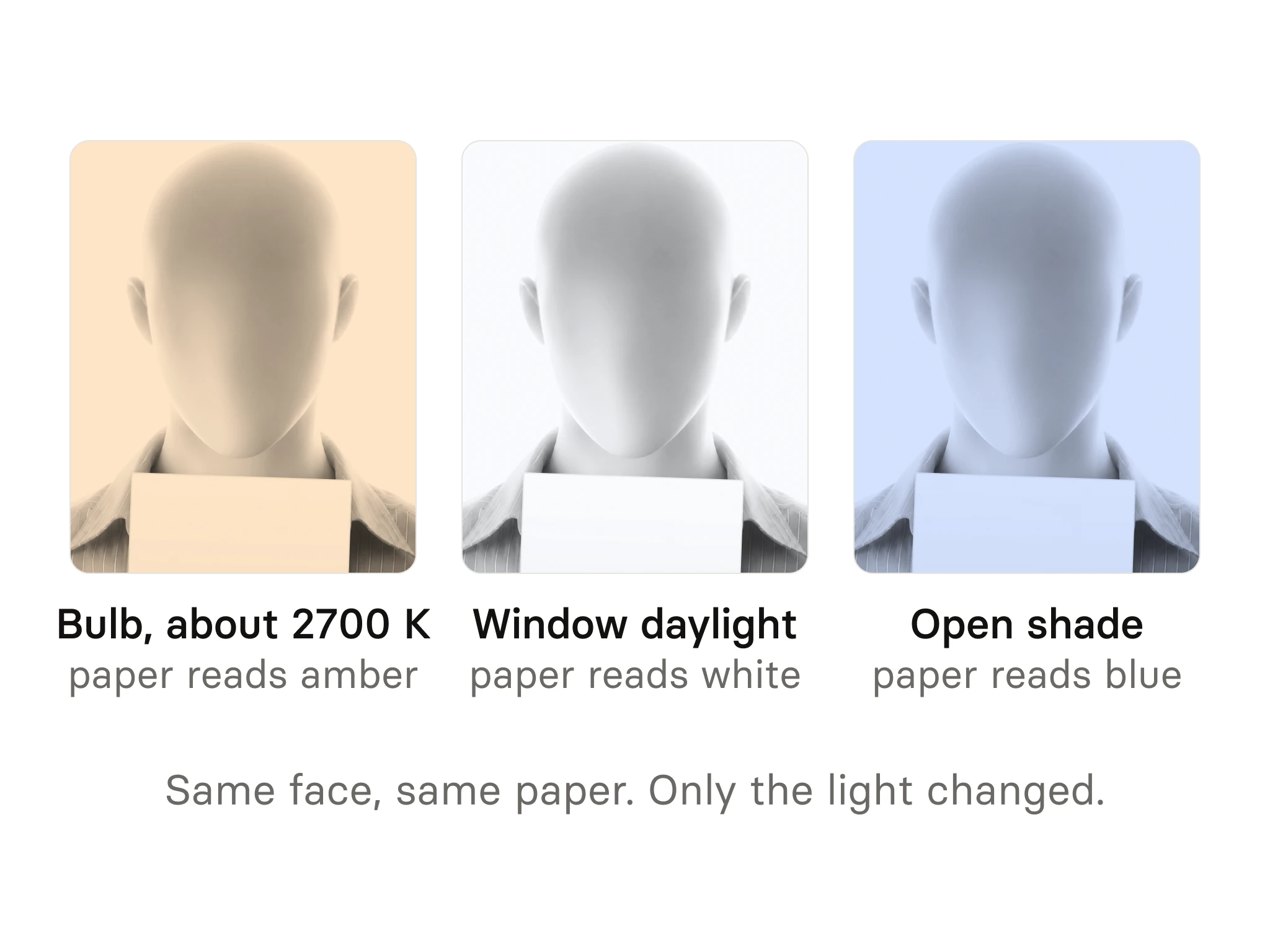
White balance is a guess. Your camera decides what white is from whatever happens to be in the frame. Google, describing its own Pixel camera, says it plainly: "auto-white balance models help determine color in a picture". A warm bulb sits around 2700 to 2900 K, and the CIE's reference for tungsten light is about 2856 K. Daylight runs from about 5200 K in sun to 6000 K under cloud and 7000 K in open shade, the values Canon's cameras use for their Daylight, Cloudy and Shade presets. Auto white balance removes part of that cast, and not always all of it: the same Canon manual describes an auto mode that keeps some of a tungsten bulb's warmth on purpose. A warm room can make cool skin read warm.
Processing changes contrast and tone. Phones tone-map and sharpen by default, and selfie cameras add settings of their own. Samsung's, for one, offers face adjustments and a Color tone choice between a warm and a natural tone for the whole image. Smoothing and brightening change how your skin reads against your hair and eyes, and that contrast is one of the things being judged.
A color picker measures the light as much as the skin. One pixel, sampled under one lamp, is a reading of that lamp on that cheek. Pasted into a prompt it looks precise and carries every error above.
Makeup, self-tan and dye count too. Foundation evens out the undertone you are trying to read. Dyed hair tells the model about the box, not about you.
None of this is specific to ChatGPT. Any reader, human or model, working from that file starts from the same shifted colors.
The setup, before you open the chat
It takes about five minutes and one sheet of printer paper.
- Face a window in daylight. No direct sun on your face, lamps off. Overcast is fine, it is even.
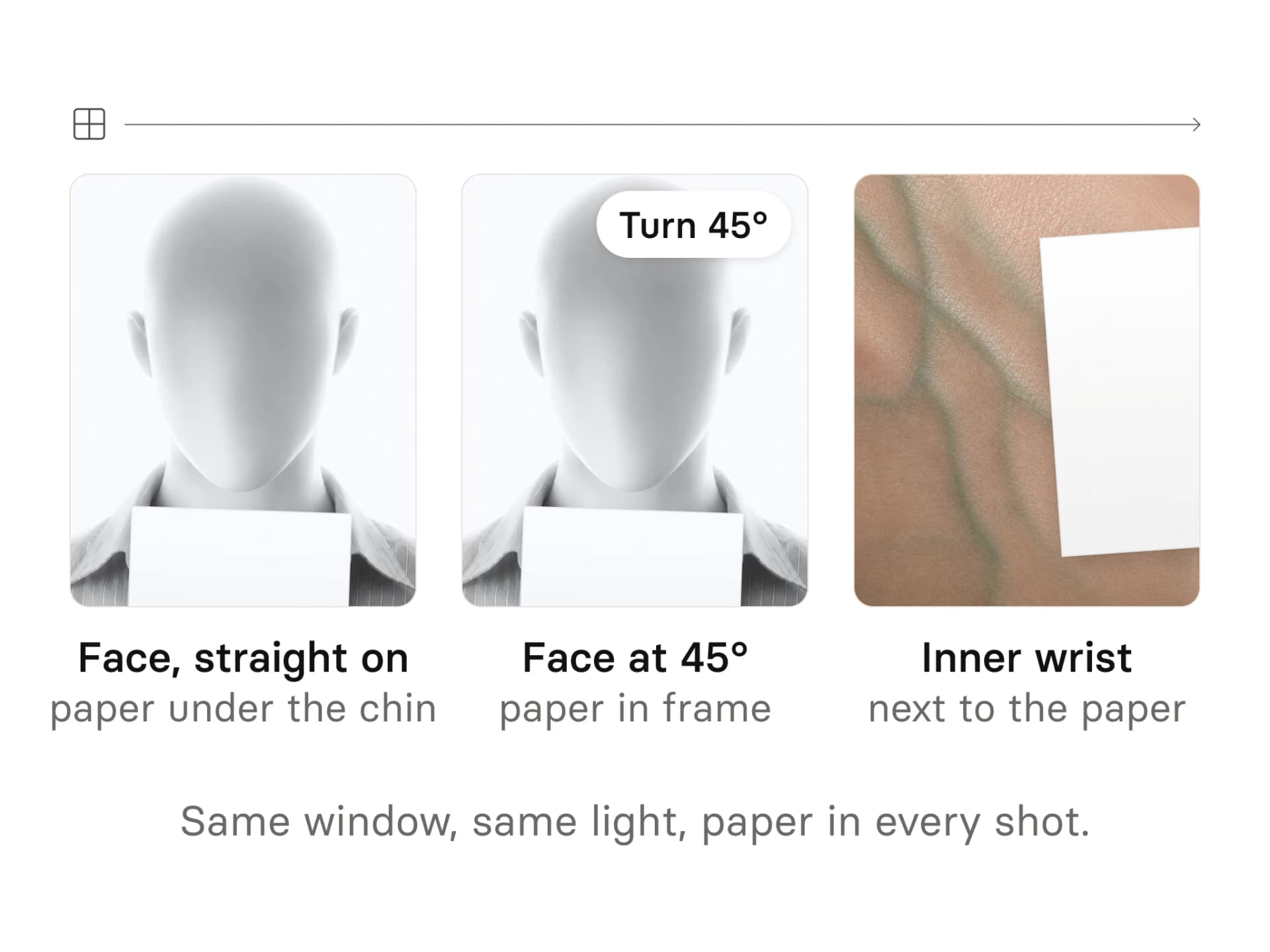
- Hold a plain sheet of white printer paper just under your chin. It should fill a fair part of the frame. This is your reference: whatever the light does to the paper, it did to your face.
- Wear a plain gray or white top, and no makeup or only what you always wear.
- Switch off filters, portrait mode and any beauty or smoothing setting. Use the rear camera if someone can take the photo for you, it is usually the better sensor.
- Take three photos in the same light: your face straight on with the paper, your face at 45 degrees with the paper, and the inside of your wrist next to the paper.
- Upload the originals. No crop, no edit, no screenshot of the photo.
If your hair is dyed or going gray, you will state your natural color in the prompt. The photos cannot show it.
Typed facts like that can decide a season. In the sample analysis, the real result of Wearly Labs co-founder Filip Poláček, the photos alone suggested True Autumn. His answers settled it one step deeper, on Deep Autumn, because in a Wearly Labs analysis the answers outrank the camera.
The prompt
Copy all of it, fill in the brackets, and attach the three photos in the same message. Send it in a temporary chat: in ChatGPT, start a new chat, select Temporary, and choose Unpersonalized before your first message, so memory and custom instructions from earlier chats cannot steer the answer. Files uploaded there are not saved to your account or Library unless you save the chat.
I am giving you three photos for a 12-season color analysis.
Each photo has a sheet of plain white printer paper in the frame.
Treat that paper as neutral white. Before you judge anything, look at
the paper in each photo. If it reads warm, cool, green or gray, correct
your reading of my skin, hair and eyes in that photo by the same amount.

Photo 1: my face straight on, window daylight, paper under my chin.
Photo 2: my face at 45 degrees, same light, paper in frame.
Photo 3: the inside of my wrist next to the paper, same light.

Facts the photos cannot show:
- My natural hair color, before dye or gray: [ ]
- In the sun I: [burn easily / burn, then tan / tan easily / almost never burn]
- The veins on my inner wrist look: [blue or purple / green / hard to tell]
- Next to my face, this looks better: [gold / silver / both / not sure]
- My eye color, in my own words: [ ]

Work in this order and show the evidence for each step:
1. Describe the paper in each photo and the correction you applied.
   If a photo is too far off to correct, say so and leave it out.
2. Undertone: warm, cool or neutral. Where the photos and my facts
   disagree, say which you trust more and why.
3. Value: light, medium or deep.
4. Chroma: clear or muted.
5. Contrast between my skin, hair and eyes: low, medium or high.
6. Only now, name the one season from the 12-season system that fits
   all four, and the neighboring season you would test it against.
7. List 10 colors for me to test in daylight against my face: 5 from
   that season and 5 from the neighbor, named in plain words.

Use color names, not codes. Do not guess my age, ethnicity or anything
about my health. If you are unsure at any step, say so.
You can paste the same prompt into Claude or Gemini and attach the same photos.
What it changes from the viral version, and why:
| Change | This version, not the viral one | Why |
|---|---|---|
| Light | Window daylight, lamps off, not whatever the room had | One light source, one cast to correct |
| Reference | White paper in every photo, not none | The paper shows how far the light moved white |
| Photos | Two face angles and the inner wrist, not one selfie | More skin to read, under the same cast |
| Facts | Natural hair, sun, veins, metal and eyes, not none | What a photo cannot show |
| Order | Evidence first, season last, not season first | You can check every step |
| Result | A season, its neighbor and 10 colors to test, not a palette card | You can test it with real fabric |
| Check | A second temporary chat, not none | Shows whether the read holds |
Read the answer like an analyst would
Check step 1 first. If the answer skips the paper or waves it away in one line, nothing after it is anchored. Ask for step 1 again before you read further.
Evidence, not adjectives. "Your skin has a lovely golden glow" is an adjective. "The paper reads slightly yellow in photo 1, after correction your skin still leans peach, and your veins read green" is evidence. You want the second kind at every step.
Run it twice. Open a second temporary chat, Unpersonalized again, and send the same photos with the same prompt. ChatGPT does not always answer the same message the same way, so one run proves little. If you land on the same season or its direct neighbor, the read is stable. If the family changes, autumn in one chat and summer in the other, the photos are not deciding it, and rewording the prompt will not change that. Reshoot in better light.
Test the 10 colors in daylight. Hold real things under your chin at the same window: shirts, scarves, towels. The right color evens out your skin and leaves the shadows under your eyes where they were. The wrong one deepens them, or turns your skin gray or yellow. This is the step that turns a label into a decision.
Where a prompt stops
If all you wanted was a season and a list of colors to try, this is enough, and it was free. Stop here.
It stops at four things.
Body shape. A photo of a clothed body cannot measure a circumference. Your shape is how your shoulders, waist and hips relate, and that comes from honest answers weighed against two full-length photos, not from one outline a sweater has already softened.
Cuts. A season tells you which navy. It does not tell you whether the jacket should be structured, where the trousers should sit, or which neckline stops working on you. That takes a catalog of cuts and a rule for your shape.
Verdicts in writing. A chat gives you a palette. It does not give you a yes or a no, with the reason, on the exact shade you are holding in a shop, unless you ask every time. A Wearly Labs analysis marks each of 50 colors Wear, Depends or Skip, and Depends means below the waist or as an accent only. In the sample analysis, black is a Depends, kept below the waist because "its coolness sits wrong close to your skin", and espresso, a Wear, takes its place: "Espresso is your black."
A place to keep it. The answer lives in your chat history, or nowhere if the chat was temporary and you did not save it. Next month you will scroll for it, or start over.
| Compared on | ChatGPT with this prompt | Wearly Labs |
|---|---|---|
| What you give it | 3 photos and 5 facts you type | A short questionnaire and 5 photos, two full length |
| Light correction | The white paper, if the model uses it as asked | The white paper, built into the analysis |
| Season | A 12-season read with the evidence shown | A 12-season result: AI reads, fixed rules decide, when a photo contradicts a clear answer, the answer decides. Photos fill in what the questionnaire doesn't ask |
| Colors | 10 to test, if it follows step 7 | 50, each Wear, Depends or Skip, with a reason |
| Body shape | An estimate from your outline | Shape and line from your answers and two full-length photos |
| Cuts | Case by case, if you ask | 125+ cuts with a verdict and a reason, plus 20+ materials and 20+ patterns |
| Outfits | On request | 6 outfit images, generated for situations you pick |
| Where it lives | Your chat history, unless the chat was temporary | Your own page, opened with a key from your email, plus an AI profile file |
| Photos | In a regular chat, kept in your Library until you delete them (OpenAI) | Used for your analysis only, never for training |
| Cost | Free with limited uploads, or a paid plan (as of October 2026) | $29, once |
ChatGPT color analysis: common questions
It will give you a season from any photo. Whether that season is yours depends on the photo more than on the model. With daylight and a white reference in the frame, the read has something to anchor to. Without one, it is reading your lamp as much as your face. In one published test, a writer whose professional analysis said Soft Summer got Soft Autumn from ChatGPT: a neighbor that differs in undertone.
Because two things change between tries. ChatGPT does not always answer the same message the same way, and every new selfie brings new light. When your coloring sits between two seasons, either change is enough to tip the answer. Same season or a direct neighbor across two temporary chats is a stable read. A jump between families means the photos are not deciding it: reshoot with the paper before you touch the prompt.
Different photos, different light, and sometimes a different system. Some tools use 4 seasons, many use 12, some use 16, and the names do not always line up (the best AI color analysis tools, compared, shows how they differ). If the two answers are neighbors, such as Soft Autumn and Soft Summer, your coloring sits near a border and the daylight test settles it. If they are opposites, reshoot.
It adds precision without adding accuracy. A value from one pixel is a reading of the light on that pixel. If you want to use it, sample the white paper in the same photo too, so the model can see how far the light moved white.
It can draw you in them, which is good for ideas and no use for a verdict. The model draws your skin next to each color too, so the picture cannot show more than the photo it started from. For the verdict, hold real fabric under your chin at a window.
Yes, unchanged. Shoot in your usual state: if you always wear a beard, keep it for the photos, because it sits next to your face all day. If you are going gray, give your natural color and mention the gray.
It can describe the outline it sees. Shape is a relationship between measurements your clothes hide, so take them with a tape measure or answer questions about your proportions rather than trust one photo.