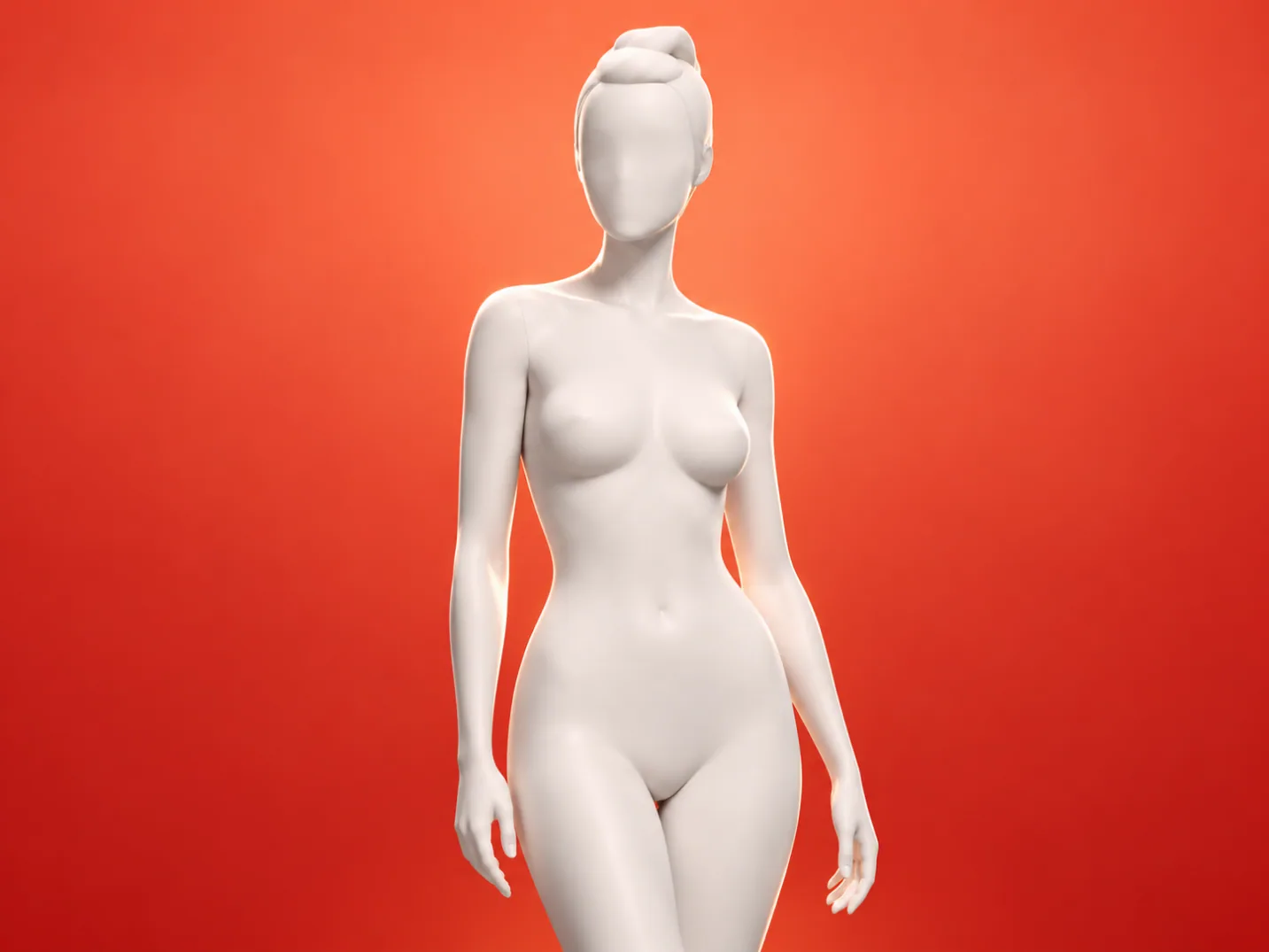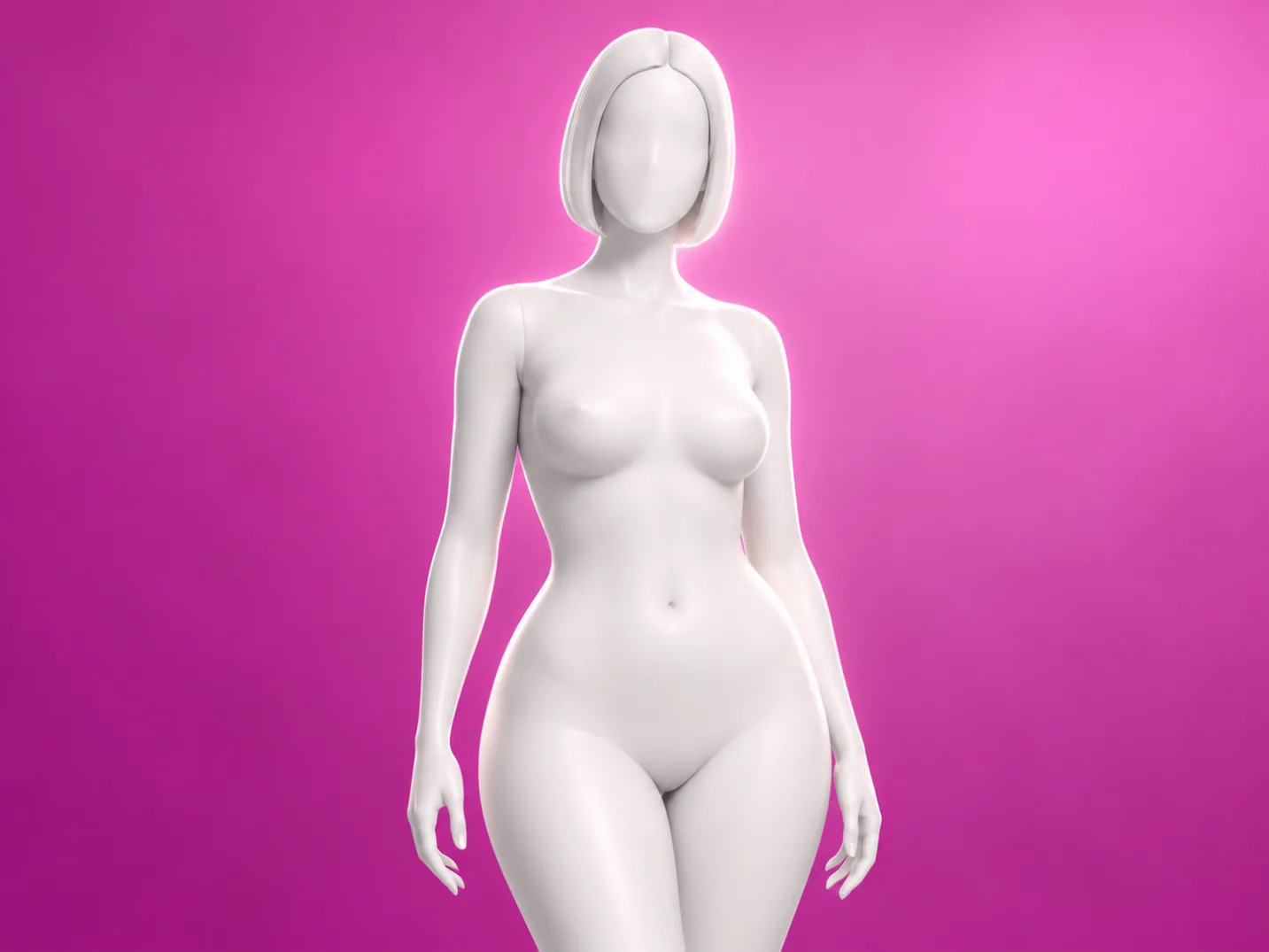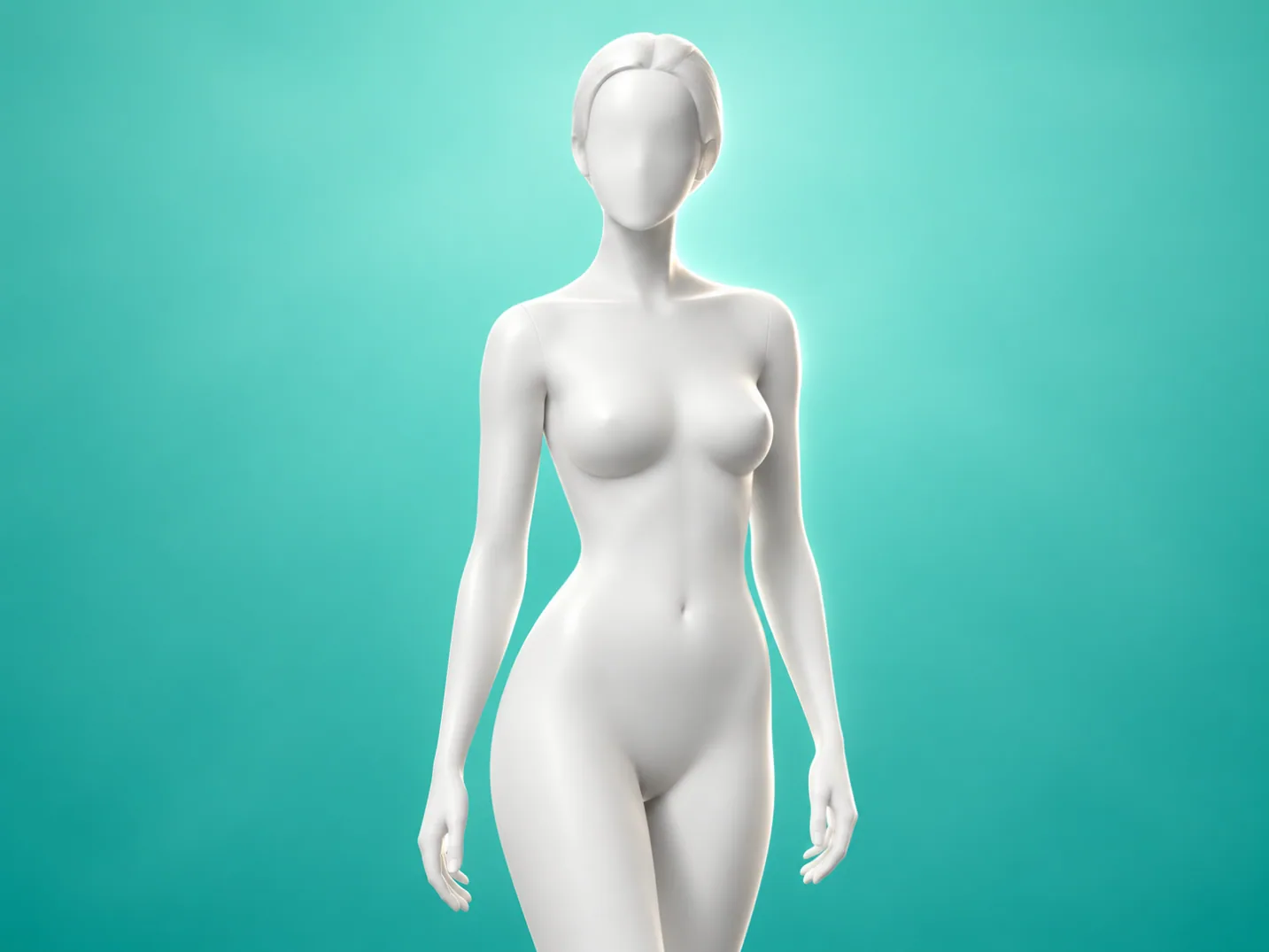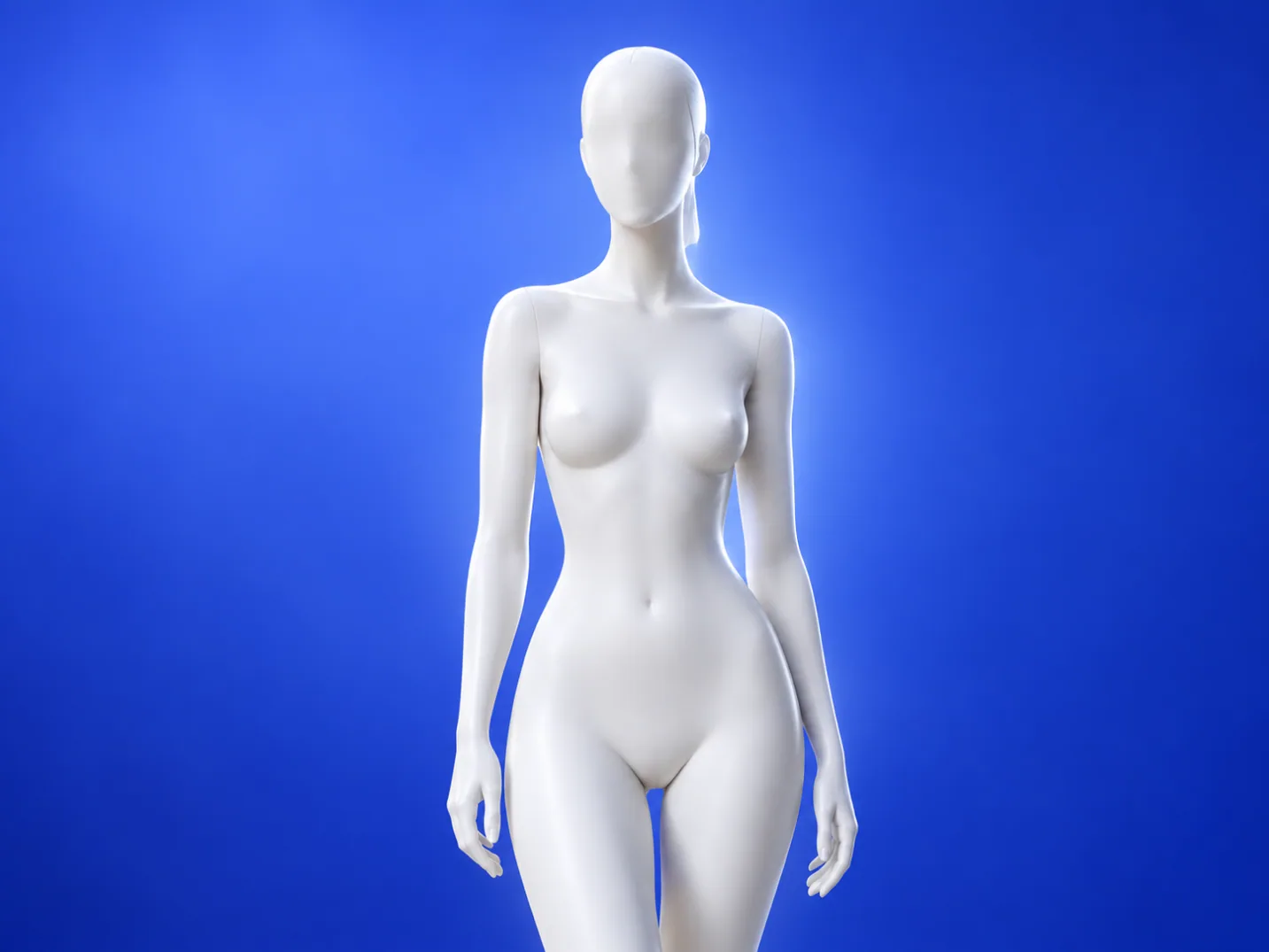
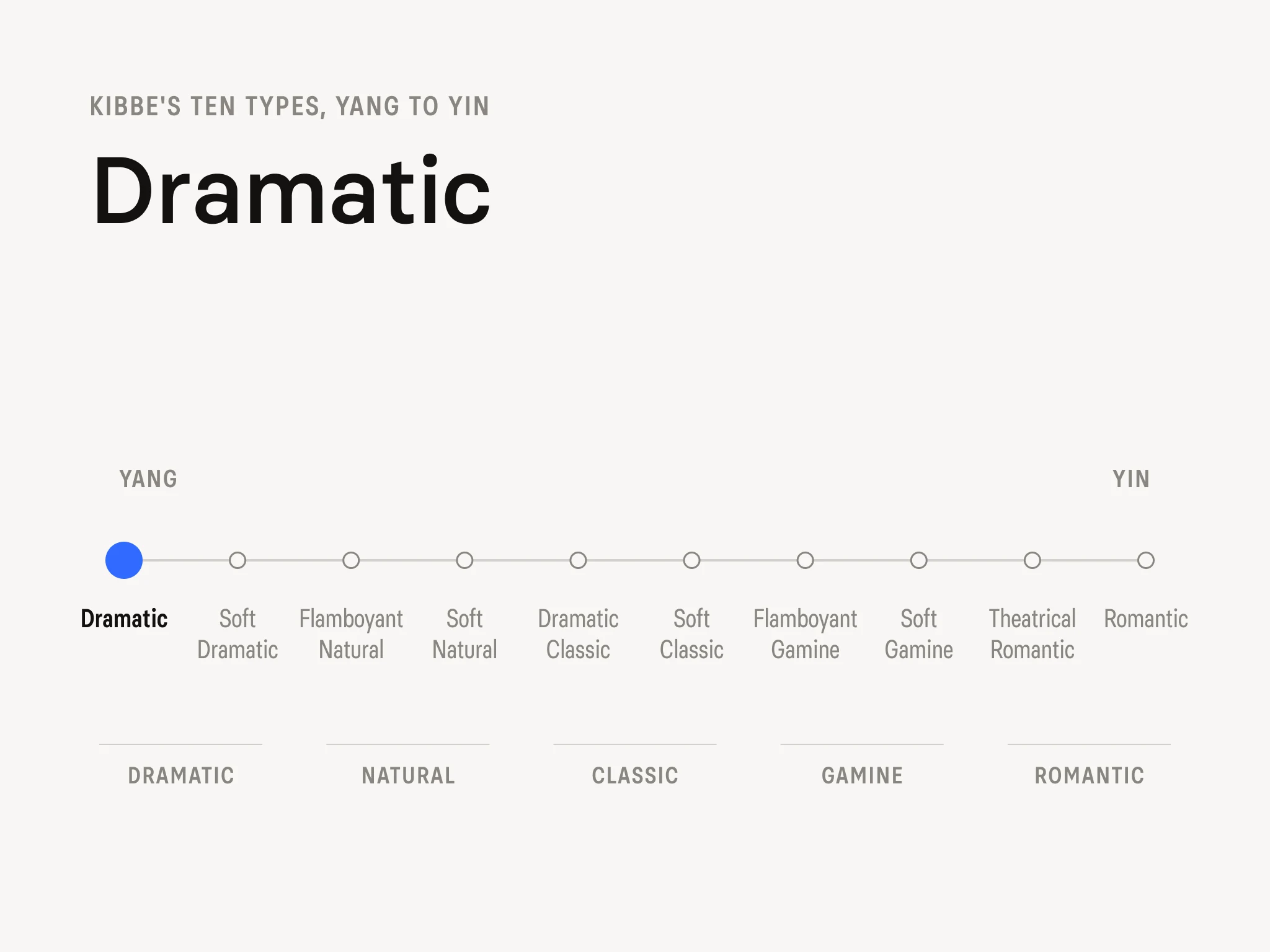
If your frame is long, narrow and angular, and a padded-shoulder blazer looks built for you while a chunky knit looks like it is wearing you, you are probably a Dramatic, the sharpest Kibbe type. Kibbe himself calls his types Image Identities. In Metamorphosis (1987) David Kibbe defines it as "extreme, sharp Yang": a long, narrow, angular frame with sharp bones and no lushness in the features. It dresses best in long straight lines, built shoulders and fabrics that hold their shape. The whole system is laid out in Kibbe body types, explained.
On this page
Kibbe Dramatic at a glance
- Frame in Kibbe's 1987 outline: long, narrow and angular, with sharp bones and square shoulders, usually 5 feet 5 inches and over.
- What the clothes ask for, in our reading: structured construction, fitted to regular volume, a straight and sharp line, a vertical that lengthens.
- Pieces that work: a padded-shoulder blazer, a straight knee-length coat, an oxford shirt, high-rise straight trousers, one color from neck to shoe.
- Pieces that fight: flowing drape, chunky knits, cropped jackets, boxy unconstructed blazers, ruffles.
- Most often mistaken for: Flamboyant Natural, which wants texture and room where Dramatic wants an edge.
Am I a Dramatic?
Dramatic names a type, not a shape, so the question is how your frame wants clothes cut rather than where you carry your width. A Dramatic frame reads long and angular at the same time. The shoulder line is the tell: square and defined, sometimes narrow, never broad or blunt. The body reads vertical, and the bones show rather than blur.
Kibbe's own outline, which he calls broad and says can bend here and there as long as nothing upsets the extreme, sharp yang balance:
- Height: moderate to tall, "usually 5 feet 5 inches and over".
- Body: straight and angular, narrow in width, usually with long arms and legs.
- Bones: angular, "with sharp edges". Usually square shoulders (they may be narrow), long and narrow hands and feet, and sharp or prominent facial bones.
- What a Dramatic will not have: an hourglass figure, lush and full features, a broad or blunt bone structure, a petite frame, or perfect symmetry.
He adds a warning that fits this type in particular: a Dramatic "might not tend to accurately record the sharpness of her bone structure", which is why, in his workshops, he filled in the same questionnaire as the client and compared the two. That is the 1987 text, written for women. David Kibbe's Power of Style (2025) is described by its publisher as an overhaul and update of the Image Identity system, so take the 1987 outline as where the system started, not as his latest word.
The changing room test takes three checks:
- Put on a padded-shoulder blazer that closes cleanly. A yes: it seems to belong to you, and the shoulder carries on the line your own shoulder draws.
- Put on a chunky knit. A yes: the knit seems to be wearing you, and it blurs the edge of your shoulder.
- Compare two cloths, a smooth, tightly woven gabardine or twill against something nubby and loosely woven. A yes: the smooth one wins. Kibbe asks for "a matte finish and a smooth surface" on a Dramatic.
Three yeses make Dramatic the reading to test first. In our reading it sits at the lengthening end of the vertical axis, so long unbroken lines matter more than any single measurement. Kibbe puts it in five words: "Long, vertical lines are essential."
A Kibbe type is not a body shape
Shape says where you carry your width: trapezoid, rectangle or triangle for men, hourglass, pear or rectangle for women. Those are words you already own, and you can take them into a shop without a glossary. A Kibbe type answers a different question: how your clothes should be built.
Take two men who both read as a trapezoid. On the one who is a Dramatic, a padded-shoulder blazer looks built for him. On the one who is a Soft Natural, the identical blazer looks stuck on, because his frame wants give and texture where the other wants an edge. Same shape, opposite verdict. The shape does not tell you the type, and the type does not tell you the shape.
Our analysis starts from the same question, but your page does not name a Kibbe type. It reads two things, your shape and your line (sharp, medium or soft), and gives every cut a verdict, Wear, Depends or Skip, with a reason. In the sample analysis, a men's Trapezoid with a medium line, the knee-length straight coat is a Wear because "the shoulder is drawn along the line your own shoulder actually runs", the padded-shoulder blazer is a Depends, "in a longer cut", and chunky knit is a Skip: "it collapses into folds rather than holding a line." The full method is on the body type analysis page.
What Dramatic asks of your clothes
Kibbe's 1987 chapter pairs the body with a personality, the "bold and charismatic" leader. The four axes below leave the personality out. They are our translation of what he asks of the clothes into something you can check a garment against.
Construction: structured. Built shoulders, a defined edge, a garment that holds its shape off the hanger. Unconstructed pieces go soft exactly where this frame wants a line. Kibbe's fabric rule is the same idea: "Fabrics that hold a defined shape are necessary."
Volume: fitted to regular. Close to the body or normally cut. Not tight for its own sake, and not swallowed. Volume has the most give of the four here, but his avoid list still names oversized, baggy trousers and shapeless, oversized sleeves.
Line: straight and sharp. Straight seams, clean edges, geometry instead of curve. In Kibbe's words: "Triangles, rectangles, and anything sculpted, sleek, and elongated, with crisp edges."
Vertical: lengthens. Every choice should add to the vertical rather than cut it in half.
Line and construction are the primary axes for this type, and a conflict on either one is a hard no rather than a compromise. A garment can hit volume and vertical perfectly and still fail, because it drapes where it should hold.
The cuts that work
A shoulder that is actually built (Wear). A padded-shoulder blazer is the clearest single garment on this profile. The sharp shoulder does the geometry the frame is already suggesting. Kibbe's 1987 rule is absolute: "shoulder pads are essential in every garment you own, without exception."
Long outerwear with a straight cut (Wear). A straight knee-length coat or a trench, open or closed, keeps the vertical unbroken from shoulder to hem.
A crisp shirt (Wear). An oxford shirt gives you a collar with structure and a flat, clean front, so it reads sharp even though it is a light garment. Kibbe's necklines for the type run the same way: plunging V's, skinny turtlenecks, high mandarin collars, man-tailored collars.
A narrow, high trouser (Wear). High-rise straight trousers extend the leg and keep the silhouette narrow the whole way down. Kibbe asks for pants that are "straight and tailored", with a long hem that breaks gently at the shoe, and rules out drapey, clingy pants that taper at the ankle.
Monochrome layering (Wear). One color from neck to shoe removes every horizontal break in an outfit. Color is doing line work here, not decoration. Kibbe's color advice for the type starts from the same place, "Always think 'head-to-toe'", rates all monochromatic schemes excellent, and puts multicolor splashes and a mix and match approach on the avoid list.
The list is not a ceiling. A piece that appears on no list can be checked against the same four axes, which is why the axes matter more than the list does. And the final call is per person, not per type. The same coat can pass on one Dramatic and fail on another once their proportions come in.
The cuts that fight you
Flowing drape (Skip). A swingy bias midi or a slip dress in a fluid fabric fails on the two axes that cannot be negotiated: there is no construction, and the line curves where this frame runs straight. Kibbe's avoid list names "soft, flowing lines" and anything "overly draped". Drape in itself is fine, it just says something different from what this frame already says. A very narrow bias cut is the exception, a Depends: his version of a soft line for a Dramatic is "elongated draping that is sleek", and he lists very narrow bias cuts among the dresses that work.
Coarse texture (Skip). A chunky knit adds visual weight and blurs the edge of the shoulder. The frame reads sharp, the garment reads fuzzy, and the eye believes the garment. Kibbe wants a Dramatic's cloth tightly woven and smooth, and his sweaters for the type are lightweight, skinny, ribbed knits.
Cropped lengths (Skip). A cropped jacket, a cropped cardigan, a denim trucker. Each one draws a hard horizontal at the waist or hip and halves the vertical, which is the one thing this type cannot spare. Kibbe's avoid list for the type names "broken or horizontal lines".
Soft, unconstructed volume (Skip). A boxy oversized blazer or an unconstructed blazer misses construction and volume in the same move. An unconstructed blazer and a padded-shoulder blazer can be identical in cloth and color and still land on opposite sides of the verdict. Kibbe files unconstructed silhouettes under avoid, with a note: "sloppy on you".
Fussy detail (Skip). Ruffles and small ornament do not scale to a long sharp line. Against geometry they read as noise. Kibbe's list is specific, "ruffles, lacy frills, feathers, frou-frou, bows, tucks, gathers", and his rule for detail on this type is that it stays clean and minimal.
For men
Metamorphosis was written for women, and every Dramatic it names is a woman. We read the ten types the same way in menswear. Only the garment vocabulary changes.
A men's Dramatic wardrobe is long narrow jackets with a sharp lapel, slim straight trousers, monochrome layers, and structured coats. The lapel matters more than most men expect. A narrow, sharply cut lapel continues the vertical; a soft rolled one interrupts it. A dark suit cut close through the body and long through the jacket sits about as close to this profile as clothing gets. Kibbe's color note points the same way: the deepest colors your own coloring allows, with dark neutrals "especially effective".
What fails is chunky knits, boxy cuts, and soft unconstructed pieces. That takes out most of the casual jacket shelf: the chore jacket, the overshirt, the bomber. All three are short, soft and boxy, which is three misses in one garment. A straight knee-length coat over a thin roll-neck does the same job the bomber was hired for, and does it on axis.
The line decides how much of that shelf survives. In the sample analysis, a medium line, the chore jacket and the bomber are not misses but Depends, worn "in a longer cut", and only the boxy overshirt is a Skip, because there is "so much spare cloth in the chest pockets and body" that the frame disappears. On a reading as sharp and as long as Dramatic, the short, soft versions are the ones that go.
Where people get this wrong
Set next to the three types it is most often confused with, in Kibbe's own 1987 outlines:
| Type | Frame | Sharp padded shoulder |
|---|---|---|
| Dramatic | Narrow, angular, sharp edges | Essential |
| Flamboyant Natural | Large, angular, blunt edges | Out |
| Soft Dramatic | Large, angular, full flesh | Out |
| Dramatic Classic | Symmetrical, trim, slightly angular | In |
The shoulder column is where the quotations sit. Kibbe says shoulder pads are essential for a Dramatic "in every garment you own". He wants a Flamboyant Natural's shoulders "broad and extended, but not particularly sharp", puts "stiffly tailored jackets with sharp edges" on the Soft Dramatic avoid list, and calls "sharp or sculpted shoulder pads" a must for a Dramatic Classic. Height barely separates them: Dramatic, Flamboyant Natural and Soft Dramatic are all "usually 5 feet 5 inches and over" in his outlines, and Dramatic Classic is moderate, up to 5 feet 7 inches.
The common misread is Flamboyant Natural. Both types lengthen, both want long lines, and both look wrong in short fussy clothes. The split is construction. Flamboyant Natural is soft and wants texture and room. Dramatic is structured and wants an edge. Kibbe draws the same split on the body: sharp edges against blunt ones, narrow against broad. It shows in the cloth he gives each, because the Flamboyant Natural avoid list names "stiff, flat fabrics" and "tightly woven fabrics", the very cloth he prescribes for a Dramatic. If unconstructed tailoring makes you look relaxed rather than undefined, you are probably reading the other type.
The second misread runs the other way. People hear Dramatic and buy drama: statement pieces, lush cloth, sweep. That is Soft Dramatic, a different construction setting and a different line. Kibbe tells the Soft Dramatic that detail "should always be flamboyant, lavish, and oversized". Dramatic is not lavish. It is severe, which is a quieter thing: the boldness sits in the shape and the color, and the detail stays clean. It often reads as the simplest outfit in the room until someone notices the cut.
The third is Dramatic Classic, which Kibbe describes as a Classic first, with a Dramatic undercurrent used "in small doses". It tops out at 5 feet 7 inches in his outline, it is symmetrical where a Dramatic is not, and its lines are, in his words, "clean, not severe". In our reading it takes soft or structured construction and only regular volume, and its vertical runs neutral to lengthening, so an outfit can break at the waist without collapsing.
Your body details still outrank your type
The type profile is a starting position, and specific body facts override it. On a Dramatic they matter in three places.
- Shoulders. Broad shoulders rule out a sharp shoulder, even on a Dramatic whose profile asks for one. Narrow shoulders do the opposite: they make a sharp shoulder better, not worse, which moves the padded-shoulder blazer from good idea to obvious one.
- Thighs. Broader thighs rule out trousers with no thigh room, which takes the narrowest cuts off the table however well they suit the type on paper. A straight high-rise trouser still keeps the vertical.
- Torso and legs. A longer torso favors a high rise, and a shorter leg rules out a low rise. Both protect the one thing this type cannot spare, an unbroken vertical.
The label narrows the field. Your body makes the call.
Kibbe Dramatic: common questions
No single height decides it, but Kibbe's outline leans tall. Metamorphosis puts the Dramatic at "moderate to tall, usually 5 feet 5 inches and over" and says a Dramatic will not be petite. It puts Flamboyant Natural and Soft Dramatic at 5 feet 5 and over too, so height narrows the field to the long types without choosing between them. In our reading vertical is one axis of four, so height does not make you a Dramatic on its own.
Yes, in a straight cut with a high rise. What fails is the short boxy jacket, the denim trucker, and the slouched hip of mom jeans. In each case it is the line breaking, not the fabric being wrong.
No. Minimalism is a taste. Dramatic is a set of axis readings that happens to favor clean unbroken lines, and Kibbe's own list for the type is anything but minimal elsewhere: bold geometric prints such as stripes and zigzags, bold color combinations of bright and dark, and jewelry that is large, though not bulky. A Dramatic in a saturated color and a sharp cut is still fully on type.
Compare the construction axis. Put on a stiff structured jacket and a soft draped one at the same scale. Dramatic keeps the shape; Soft Dramatic needs the movement. If the structured piece reads as armor rather than tailoring, test Soft Dramatic first. Kibbe's own outlines split the two on the body, not on height: the Soft Dramatic is fleshy through the bust and hip with full, lush features, and a Dramatic, he writes, will not have either.
Degree and symmetry. Kibbe's Dramatic is "extreme, sharp Yang" and never perfectly symmetrical; his Dramatic Classic is balanced with a slight yang lean, symmetrical, and moderate in height, up to 5 feet 7 inches. On the hanger the difference is severity: long and sharp for the Dramatic, clean and tailored but never severe for the Dramatic Classic.
Rarely, and then with a very wide, geometric belt. In Metamorphosis that belt is the only waist emphasis Kibbe gives a Dramatic's dress, fitted waists sit on the avoid list next to flouncy, flowing styles, and dropped-waist and no-waist dresses work as long as the shape stays narrow.
Kibbe built the chapter around Joan Crawford, and his list adds Greta Garbo, Lana Turner, Lauren Bacall, Rosalind Russell, Lena Horne, Alexis Smith, Katharine Hepburn, Maggie Smith, Faye Dunaway, Kathleen Turner, Jamie Lee Curtis, Barbara Carrera, Connie Sellecca and Sheryl Lee Ralph. All fifteen are women, and he notes they do not always dress to their best advantage: what ties them together is a sharp physicality, not a wardrobe.