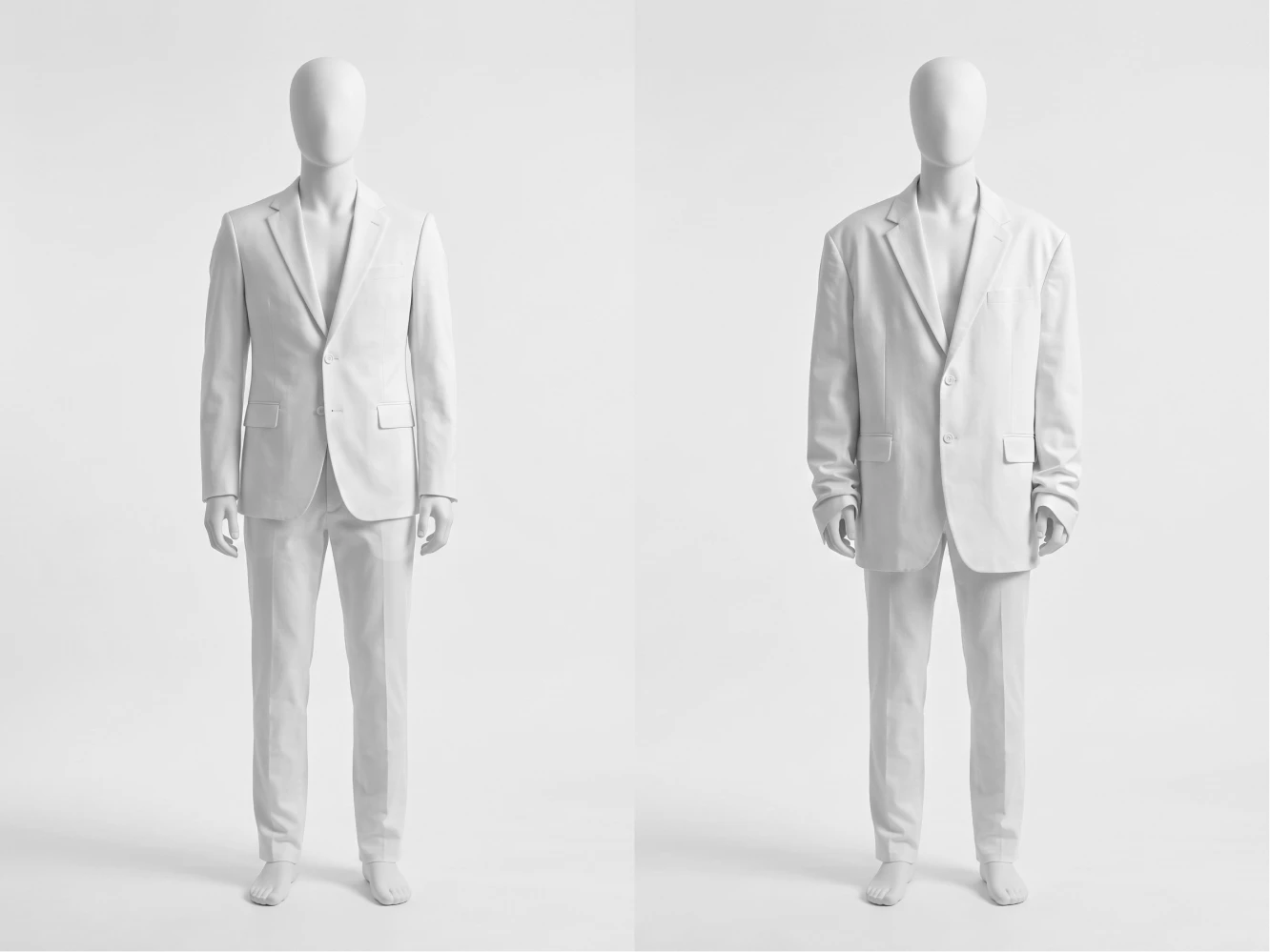
A clothing size measures lengths and circumferences, not the relationship between your shoulders, waist and hips, which is why the same jacket can look bought on one man and borrowed on another. That relationship is your body shape, and men have five: triangle, trapezoid, rectangle, inverted triangle and oval.
On this page
- Why does the same jacket look different on two men?
- The five men's shapes
- How do I tell which one I am?
- What is the difference between your shape and your line?
- Your body details still outrank your shape
- Why can't a photo measure your body shape?
- What does the body section of your analysis contain?
- Men's proportions and fit: common questions
Which one you are depends on where your body carries its width, read across the shoulders, the waist and the hips. This guide gives a mirror test and a tape test to tell yours, then shows what each shape changes, from the jacket to the rise of your trousers.
Why does the same jacket look different on two men?
Because a size is a set of measurements and a fit is a set of relationships.
A suit label carries exactly one relationship, and it carries it as an assumption. The size on the jacket is a chest measurement, and the trousers sold with it are cut a fixed amount smaller at the waist, a gap tailors call the drop. The industry standard is 6 inches, so a size 40 jacket comes with 34-inch trousers (Oliver Wicks on suit sizes). A man whose own chest and waist sit about 6 inches (15 cm) apart finds the suit was cut for him. The man next to him, with the same chest and a different waist, is wearing someone else's taper. Makers that cut the same suit on a slimmer and a roomier drop as well (Angelico's slim, custom and comfort drops are one example) do it because the standard gap fits only some builds.
Wearly Labs reads the body in two layers, and your page opens with shape because shape is the word you already have for what you can see. Shape says where your body carries its width, which tells you what your clothes have to balance. A garment that adds width in the right place on one man adds it in the wrong place on the next. That is half the story of the borrowed jacket. The other half is the layer underneath, which is where the cut verdicts are actually computed.
The five men's shapes
Triangle. Hips and waist wider than the shoulders, so the frame carries its width low. The balancing job is to put width back at the top, and to keep the lower half straight rather than narrow. Full breakdown: the men's triangle.
Trapezoid. Shoulders a little wider than the hips, a waist that comes in slightly, narrowing gradually. The taper is already there, so the job is preservation rather than correction. There are two ways to lose it: bury it under volume, a big coat or a boxy overshirt, or exaggerate it with a nipped waist until it reads as costume. Full breakdown: the men's trapezoid.
Rectangle. Shoulders, waist and hips close to one width, and the torso runs nearly straight. There is no taper to protect and none to fight, so your clothes either build a shoulder line and a middle, or repeat the column you already have. Full breakdown: the men's rectangle.
Inverted triangle. Shoulders and chest clearly wider than waist and hips, with a steep drop between them. Stop adding to the shoulder, and give the lower half enough room to answer it. Room, not flare. Full breakdown: the men's inverted triangle.
Oval. The middle is the widest of the three, with shoulders and hips narrower next to it. Clothes should hang from the shoulder rather than take their shape from the middle, which makes drape and vertical lines the working tools. Full breakdown: the men's oval.
How do I tell which one I am?
Start with a mirror, not a tape. Stand straight on in front of a full-length mirror in a fitted T-shirt, arms relaxed, and compare three widths: your shoulders at their widest point, your waist, and your hips at the fullest part of the seat. Then ask four questions, in this order, and stop at the first yes.
- Is your middle the widest of the three, and the first place weight goes when you gain it? Oval.
- Are your hips wider than your shoulders? Triangle.
- Are your shoulders clearly wider, with a steep drop to a narrow waist? Inverted triangle.
- Are your shoulders a little wider, narrowing gradually? Trapezoid.
If none of the four is a yes, your shoulders, waist and hips run close together, and you are a rectangle.
Each shape also gives itself away in a fitting room, which makes a quick cross-check.
| Shape | In the mirror | In the fitting room |
|---|---|---|
| Triangle | hips wider than the shoulders | a jacket that fits the chest is tight across the seat |
| Trapezoid | shoulders a little wider, gradual narrowing | an off-the-rack jacket fits the shoulder and needs only the waist taken in |
| Inverted triangle | shoulders clearly wider, steep drop | shirts pull across the upper back and balloon at the waist |
| Rectangle | shoulders, waist and hips close to one width | a belt has no waist to sit on |
| Oval | the middle is the widest point | a jacket that buttons comfortably is large everywhere else |
A tape settles the close calls, with the number suit makers already sell by. Measure your chest around its fullest part, under the arms, and your waist where your trousers sit, and take one from the other. That is your own drop, to set against the standard 6 inches. It reads chest against waist and never sees the hips, so it is a cross-check for four of the shapes and no help with the fifth.
| Shape | Your drop (chest minus waist) |
|---|---|
| Triangle | not the test: the drop never sees the hips |
| Trapezoid | close to the standard 6 inches |
| Inverted triangle | well above 6 inches |
| Rectangle | small |
| Oval | near zero, or below it |
That is the logic in longhand, and the analysis needs no tape for it. The questionnaire asks the mirror version: whether your shoulders or your hips are wider, whether your waist curves in clearly, slightly or runs fairly straight, and where weight goes first when you gain it. Fixed rules weigh those answers, and the two body photos, front and side, check them.
And you land on one shape. Never somewhere between two. A scoring system with fixed rules makes the call, and your page shows which of your answers pushed the result where it went. In the sample analysis, the real result of co-founder Filip Poláček, the cuts page puts it in his own answers: "You told us your shoulders are wider than your hips, that your waist curves in only slightly, and that weight settles evenly across your frame." That is a trapezoid, and the sentence is the reason.
What is the difference between your shape and your line?
Shape is the vocabulary you already have and the half you can act on standing in a shop, which is why your page leads with it.
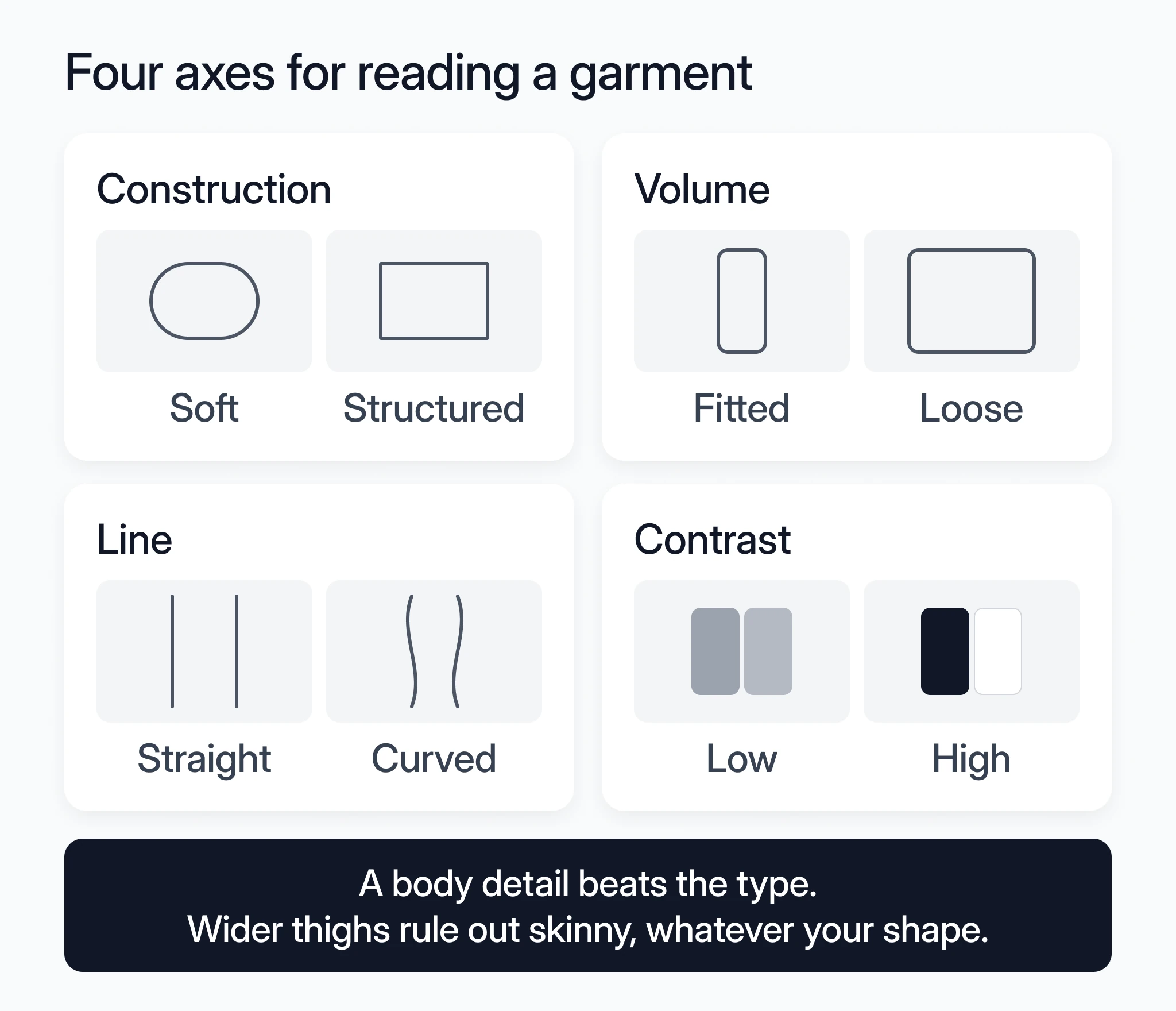
Underneath the shape sits your line. The Wearly Labs body type analysis reads it from your bone structure, the line of your shoulders and your facial features, and it judges whether your clothes should run sharp, medium or soft, structured or fluid. Your shape sets how much volume you can carry, your line how sharp the edges should be, and every cut verdict on your page weighs both: the line, inside the volume the shape allows.
Which is why two men on the same shape split on the same coat. Take two trapezoids at the same regular volume setting. The sharp line is sent to a constructed classic suit and its hard edge, the soft line to a soft textured one. Same shape, different jacket, and a shape label on its own could never have told them apart.
The sample analysis is the case in between. Filip is a trapezoid with a medium line, and his page marks the structured classic suit Wear, "Shoulder and body are cut the way you are built, so it closes without strain", and the soft textured suit Skip: "The rounded, soft seams blur a frame that reads better with a clean edge."
Neither half is derivable from the other. A trapezoid man can come back with a sharp line, a medium one or a soft one. Trapezoid implies no line, and no line implies a shape. What each line asks of a jacket has its own page: sharp, medium and soft.
Your body details still outrank your shape
Shape narrows the field. Your own proportions make the last call, and when they disagree with the shape profile, the proportions win. That is the order of operations, not an inconsistency.
The analysis reads these details from your answers: whether your torso or your legs run longer, and anything you write about your body in your own words. The overrides, in plain terms:
- Broader thighs rule out trousers with no thigh room, and rule out skinny.
- A stronger seat or wider hips rule out bottoms with no room over the curve and no stretch. They also rule out a low rise and a layer that ends at the hip.
- Broad shoulders rule out a sharp padded shoulder. The shoulder is already there. Adding to it is addition, not correction.
- Narrow shoulders make a padded shoulder better, not worse. This is the one place the standard advice is right.
- A shorter leg rules out a low rise and favors a high rise.
- A longer torso favors a high rise, arriving at the same place from the other direction.
- A fuller midsection rules out a skin-tight top and favors drape.
Read that list again and notice how much of it comes down to rise, the distance from the crotch seam up to the top of the waistband. Rise changes where your waist appears to sit, which moves the apparent length of your leg and your torso at the same time. It is worth choosing deliberately rather than accepting whatever a given cut happens to hand you.
Why can't a photo measure your body shape?
Your shape is decided from your answers and two body photos, weighed by fixed rules, because a photo alone cannot measure a body.
A photo of a clothed body cannot measure a circumference. A waist is a loop, and a camera gives you an outline in one plane, at one distance, in whatever the shirt is doing that day. A heavier shirt, a step closer, a wider lens: any of those changes the outline without changing the body underneath it. Ask a photo for a circumference and it returns a confident guess.
So your answers carry the body read, and the two body photos check it. Your face photos do real work on the color side, where an image genuinely holds the information: undertone, depth and contrast near your face, the subject of color analysis for men.
What does the body section of your analysis contain?
The body section opens with your shape and the evidence behind it, then runs cuts by category: shirts and tops, sweaters and sweatshirts, jackets and layers, trousers and shorts, suits and formal. Each garment gets Wear, Depends or Skip and one line of mechanical reasoning, and a Depends names its condition, such as "in a longer cut" or "with a hip-length top". Heavy tee: falls clean from the shoulder, nothing pulls at the waist. Skinny: no room over the thigh, so the trouser pulls across it and the leg line breaks. Then it goes further than most people expect, into materials, patterns, and hats and caps.
What it will not do is publish a fixed list of pieces every triangle or every oval must own. The analysis computes per person, and two men on the same shape can split on the same coat.
Men's proportions and fit: common questions
None of them. Off-the-rack suits are cut on a 6-inch drop from chest to waist, a gentle taper that sits closer to the trapezoid than to the other four, so a trapezoid man tends to find off-the-rack easier. That is a fact about how clothes are cut, not a ranking of bodies. Every shape has cuts that work and cuts that fight it.
No. The scoring system returns one shape and shows the answers that decided it, so you can see why you landed there.
Degree. Both are wider at the shoulder than at the hip, but a trapezoid narrows gradually and an inverted triangle steeply. A shop tells them apart fastest: a trapezoid's off-the-rack jacket fits the shoulder and needs only the waist taken in, while on an inverted triangle the jacket that fits the shoulder swims through the body.
No. Those three are somatotypes, a three-number rating of how a body is built rather than a comparison of widths. In the Heath-Carter method, which its own manual calls the most commonly used today, endomorphy is relative fatness, mesomorphy relative musculo-skeletal robustness and ectomorphy relative linearity (J.E.L. Carter's instruction manual). A shape compares the widths of your shoulders, waist and hips. One does not give you the other: a muscular build can come with a gradual taper or a steep one, and a slender man can be a rectangle or a triangle.
Less than your size does. The oval is the shape weight can make or unmake, because it is defined by the middle, and training the shoulders and back can steepen a trapezoid's gradual taper into an inverted triangle's steep one. Judge the mirror as you are now, not the sizes already in your wardrobe.
No. Height decides lengths, not shape: where a top, a jacket or a coat should end. A man at 172 cm and a man at 190 cm can land on the same shape and still be sent to different lengths of the same jacket.