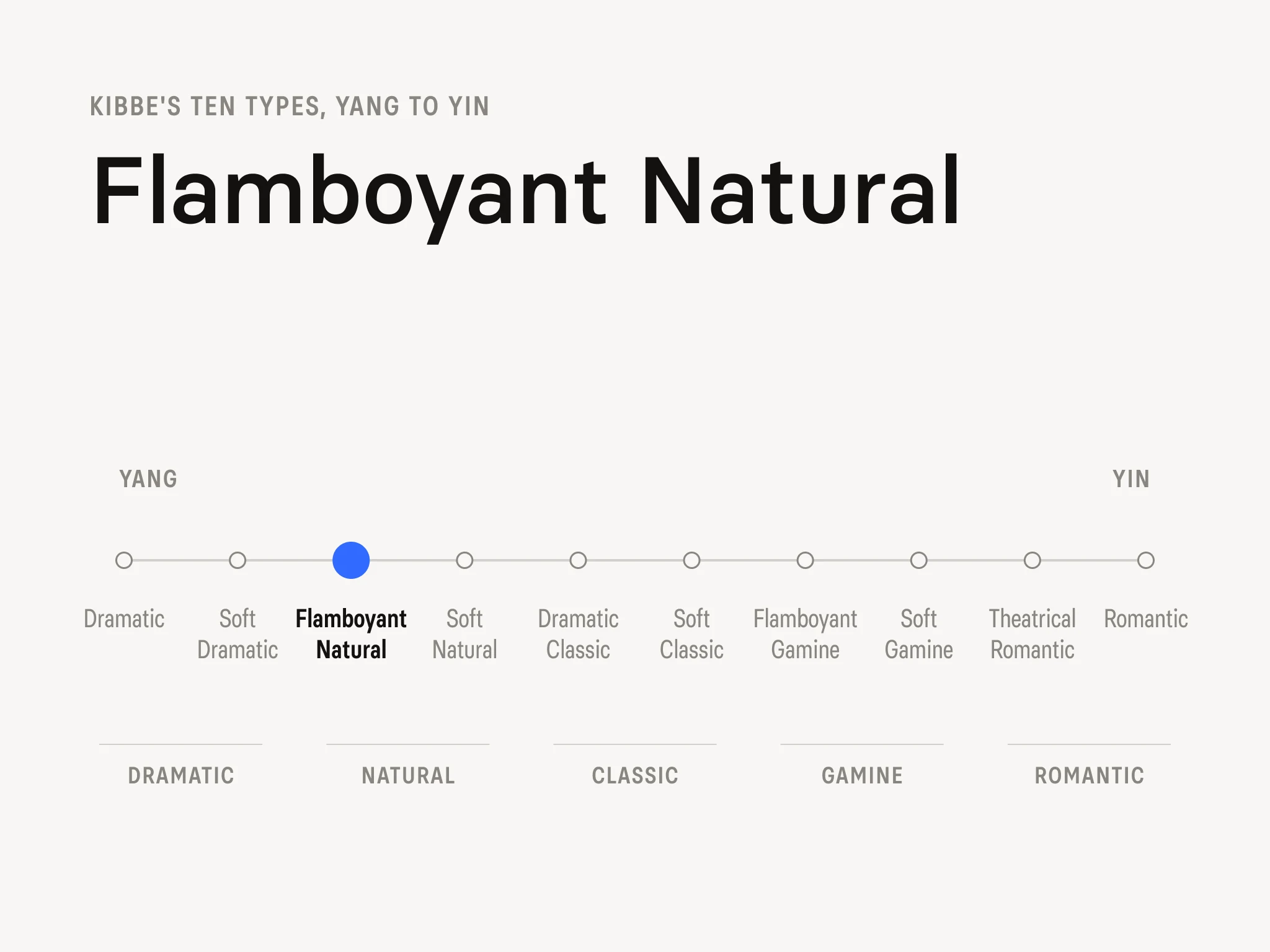
Flamboyant Natural is a Kibbe type for a broad or long frame with blunt edges, and it is yours if a stiff, sharply built jacket looks like scaffolding on you. Kibbe himself calls his types Image Identities. In Metamorphosis (1987) he sums it up as "strong Yang with blunt edges (not sharp)", a Natural with a Dramatic undercurrent. In our reading it asks for soft construction, regular to loose volume, a straight line with blunt edges and a lengthening vertical. The pieces that fail are the ones most people are told to buy: the stiff jacket, the narrow formal suit, a belt pulled tight.
On this page
- Kibbe Flamboyant Natural at a glance
- Am I a Flamboyant Natural?
- A Kibbe type is not a body shape
- What Flamboyant Natural asks of your clothes
- The cuts that work
- The cuts that fight you
- For men
- What Flamboyant Natural is mistaken for
- Your body details still outrank your type
- Kibbe Flamboyant Natural: common questions
Kibbe Flamboyant Natural at a glance
- Frame in Kibbe's 1987 outline: moderate to very tall, usually 5 feet 5 inches and over, broad and angular with blunt edges.
- What the clothes ask for, in our reading: soft construction, regular to loose volume, a straight line with blunt edges, a vertical that lengthens.
- Pieces that work: unconstructed jackets, visible texture, trousers with thigh room, long relaxed coats, clean oversized shirts.
- Pieces that fight you: a sharp, stiffly built shoulder, stiff flat cloth, skin tight cuts, a cinched waist, delicate detail.
- Most often mistaken for: Dramatic, which also lengthens but is structured where this type is soft.
Am I a Flamboyant Natural?
The question is about build rather than shape: how your clothes should be built, not where you carry your width. A Flamboyant Natural frame reads long, broad or both, with blunt edges rather than fine ones. Structure added on top looks redundant rather than flattering, and the clearest signal is a good jacket: a well made, stiffly built blazer sits on this frame like scaffolding around a building that did not need any. Kibbe body types, explained puts all ten types side by side.
Kibbe's own 1987 profile, which he calls a broad outline where "slight deviation here or there is always possible", reads like this:
- Height: moderate to very tall, usually 5 feet 5 inches and over.
- Bones: large, angular and blunt-edged, broad and square, with wide shoulders, long arms and legs, and large hands and feet.
- Body: straight and angular, "broad, not sharp", with arms and legs that tend toward musculature.
- Features: prominent and strong without being sharp or severe: broad, blunt and open.
- Not in the profile: a voluptuous body with a curvy bust and hipline, an hourglass figure, delicate features with small or sharp bones, an extremely petite frame, symmetry in body, bones or face, a sharp or extremely narrow bone structure.
His later wording is looser. In a 2022 interview with Bustle he described a Flamboyant Natural as someone who "is either tall, long, and broader, or she has curves", so the 1987 rule against curves is no longer absolute.
The changing room test takes two jackets in the same size and one belt:
- Put on a structured blazer with a squared, built-up shoulder that closes neatly at the waist. A yes looks like hard edges added to a frame that already has its width.
- Put on an unconstructed blazer in a textured cloth, long enough to reach the top of the thigh. A yes looks like clothing rather than costume.
- Pull a belt in at the natural waist. A yes looks like the body cut in two instead of the outfit finished.
Notice what the test leaves in: Kibbe's jacket for this type keeps "broad padded shoulders". The padding is fine; the sharp edge and the stiff build are what fail. The belt result matches his 1987 wording, that waist emphasis "is rarely helpful to you, even if your waist is small, because it destroys the strong, vertical line that is the core of your silhouette."
In our reading Flamboyant Natural sits at the lengthening end of the vertical axis, so long runs and long outerwear work in its favor.
A Kibbe type is not a body shape
Shape tells you where your width sits, and people already use the words: rectangle, trapezoid, oval. A Kibbe type answers a different question, how your clothes should be built.
Take two men who are both a men's rectangle, with shoulders, waist and hips close to one width. Give each a straight knee-length coat. The shape's own page reads that coat two ways: belted, as the long line with one deliberate break at the waist, or open, as a clean column.
For the one who is a Flamboyant Natural, the open column is the answer, because Kibbe says waist emphasis destroys the strong vertical line at the core of this silhouette. For the one who is a Soft Natural, who in our reading welcomes a marked waist, the belt is on axis. One shape, two different answers, and neither reading gives you the other.
Our analysis starts from the same question, but your page does not name a Kibbe type. It reads two things, your shape and your line (sharp, medium or soft), and gives every cut a verdict, Wear, Depends or Skip, with a reason. The full read is the body type analysis.
The pieces this article recommends are not right for every frame, and the verdicts say why. In the sample analysis, a men's Trapezoid with a medium line, the clean parka is a Skip because "a long, loose shell like this drowns your outline in extra cloth", and the chunky cable-knit sweater is a Skip because it "hangs off your shoulders". Rigid denim and flannel are Depends: one piece per outfit.
What Flamboyant Natural asks of your clothes
Kibbe describes his types in his own words. For Flamboyant Natural the silhouette is "boldly unconstructed", the lines "relaxed and sweeping", the shapes geometric "with soft edges (not sharp)", and the warning is plain: "Stiff tailoring and severe lines should be left by the wayside, for they will be extremely cold and stark on you." These four axes are our translation of that into something you can check a garment against.
Construction: soft. Unbuilt, unlined, unfussy. The garment should not impose a shape. Kibbe's jacket is "long, unconstructed, and loose", and his avoid list names "sharp, severe, or stiff silhouettes".
Volume: regular to loose. Normal through oversized. Room is the setting here. Kibbe wants trousers "roomy and full" and sweaters "long, roomy, and boldly cut".
Line: straight, with blunt edges. Long straight seams and a shape you can read, with the corners taken off. This is the axis people misread. Kibbe's lines are "elongated and straight", but his shapes have "rounded edges", and his avoid list names "sharply straight lines" and "sharp-edged geometrics". Straight is not the same as sharp: the straightness lives in the long seam and the clean outline, not in a hard corner or a built shoulder.
Vertical: lengthens. Long runs, long outerwear, long trouser lines. Kibbe's base for every outfit is "an elongated vertical line with strong shoulders", and he keeps the waist out of the way: "Waist should be elongated. A dropped waist does this best."
Construction is the primary axis for this type. A conflict there is a hard no, because stiffness is not a matter of degree on this profile.
The cuts that work
Each piece below is checked against the four axes, with the axis named.
The unconstructed jacket family. An unconstructed blazer, a chore jacket or an overshirt gives you a jacket shape without the internal architecture, which keeps construction soft. Kibbe's spec is precise enough to shop with: long, from the top of the thigh down and "never shorter", broad padded shoulders on a relaxed cut, large lapels or none, big roomy pockets, and "easy double-breasted styles (worn open)".
Texture you can see. Raw denim, flannel, heavy cotton and a chunky knit all pass on the line and construction axes, and texture is a positive on this profile rather than a tolerance. Kibbe's rule is that "a rough surface is always preferable to a flat surface", and his list runs to all leathers, suedes and plush fabrics, loosely woven cloth, and knits that are "thick, rough, bulky, heavy, or ultraplush".
Trousers with room through the thigh. Straight trousers with room, wide-leg trousers, high-rise straight and high-rise wide all feed the volume axis. Room through the thigh suits this type before any body detail is considered. Kibbe adds the details: deep pleats, full pockets, and "wide, soft cuffs".
Long relaxed outerwear. A straight knee-length coat cut generously, or a parka. Length feeds the vertical axis, and softness keeps construction on axis.
Clean oversized shirting. Depends on the cut: an oversized flannel shirt, camp collar shirt or heavy tee works while the shape stays readable and the edges stay straight, and fails once it turns shapeless. Keep the neck open: Kibbe asks for necklines that are "loose and open, always unconfined", open-notched collars among them.
Bold scale in the small things. Kibbe's accessories are "bold and angular with soft edges": chunky jewelry in irregular shapes, large bags, belts that are "original and unique". His prints follow the same rule, bold and vivid, with "a blended edge as opposed to a sharp edge".
The list is not a ceiling. A garment nobody put on a list can still be checked against the same four axes, which is why the axes are worth learning and the list is not worth memorizing. The final call is per person: two Flamboyant Naturals can need different answers on the same trouser once their proportions come in.
The cuts that fight you
A sharp, stiffly built shoulder. A structured blazer with a squared, built-up shoulder is the signature failure. It adds hard structure to a frame that is already broad and blunt, and it breaks the primary axis, which makes it a hard no rather than a near miss. Padding alone is not the fault: Kibbe wants shoulders "always broad and extended, but not particularly sharp".
Stiff, flat fabric. A hard, smooth finish or heavy interfacing. Kibbe's avoid list puts it in three words: "stiff, flat fabrics". A narrow formal suit is the common version, and it can fit correctly and still look wrong, because construction is where this type is decided.
Skin tight. Skinny trousers and leggings sit at the far end of the volume axis, which reads regular to loose. The specific loss is room through the thigh. Kibbe's avoid list names "sharply tailored and fitted pants" and "lightweight, clingy knits".
A cinched waist or a cropped length. A belt pulled tight, a fitted waist seam, a jacket or sweater that stops at the waist. Each one cuts the vertical in half. Kibbe's avoid lists name "hourglass silhouettes", "cropped, fitted jackets" and "cropped sweaters". A belt worn as an accent rather than pulled in is Depends, and the FAQ covers it.
Delicate detail. Small buttons, fine trims, small scale accessories and thin, shiny fabrics read as fragile against a frame that reads sturdy. Kibbe names "small, symmetrical detail" and "delicate, shiny fabrics". Heavy shine after dark is Depends: stiff satins, brocades and metallics are "excellent for evening, if the weight is kept to the heavy side", and daytime sheen should be in texture only, as in raw silk or shantung.
For men
Metamorphosis is addressed to women: the chapter speaks of "she", and all nine of Kibbe's Flamboyant Natural examples are women. In the same 2022 Bustle interview, Kibbe said the process works for men too. The four axes carry over to menswear unchanged. Only the vocabulary changes, and here it barely has to: Kibbe's trouser for this type is borrowed from menswear in the first place, "man-tailored styles that are slightly wide and relaxed in construction".
A men's Flamboyant Natural wardrobe is unconstructed jackets, oversized but clean shirts, chunky knits, raw denim and natural texture. That reads like a description of good casual menswear, and it is, but the reason it works is structural: every one of those pieces satisfies soft construction, generous volume and a straight line at once. Men's body shapes and fit shows how the five men's shapes are read.
What fails is a narrow formal suit, thin shiny cloth and small scale accessories. Standard menswear advice is written around slim tailoring, and it serves this type badly. If you have ever come out of a good tailor's fitting looking somehow smaller and stiffer than you went in, this is why.
Kibbe's version: stiff tailoring makes this frame "appear awkward and gawky, for you have too much broadness to be successfully encompassed by sleek and narrow clothing." The workaround is an unlined jacket with a broad shoulder that has no hard edge, and trousers with real room through the thigh, pleated if you like. A bigger size supplies neither.
What Flamboyant Natural is mistaken for
Set against the three types it is most often confused with, on the axes this series uses for every type. Three of the four lengthen; Soft Natural runs neutral to lengthening.
| Type | Construction and volume | Line |
|---|---|---|
| Flamboyant Natural | Soft, regular to loose | Straight, blunt edges |
| Dramatic | Structured, fitted to regular | Straight, sharp |
| Soft Dramatic | Soft, regular to loose | Rounded, draped |
| Soft Natural | Soft, regular | Between straight and rounded |
Read each row from the left: the type, how its clothes are built and how much room they take, then the shape of its lines.
The frequent misread is Dramatic, which Kibbe's 1987 balance words call "extreme Yang (sharp edges)". Both types lengthen and both want long straight lines, so the garments look similar in a photograph. Kibbe built the overlap in: he tells a Flamboyant Natural to read the Dramatic chapter as well as the Natural one, and to remember that "you are a Natural first and foremost". The Dramatic side is "an addition", not a substitution.
The two split on construction: Dramatic is structured, Flamboyant Natural is soft. That single axis flips the verdict on almost every jacket in the closet, which is why guessing between the two is expensive.
The second misread is Soft Natural, "soft Yang with a Yin undercurrent" in Kibbe's 1987 words. It has the same soft construction and the same pieces that fail, but different volume and different line. Flamboyant Natural runs regular to loose with a straight line. Soft Natural runs regular, with a line between straight and rounded, and in our reading it welcomes a marked waist where Flamboyant Natural keeps the waist long.
Kibbe's 1987 profiles split the bodies as well: his Soft Natural is up to 5 feet 7 inches and "slightly curvy, tends to an hourglass shape", the one figure his 1987 Flamboyant Natural does not have. If oversized reads as swamped on you rather than intentional, test Soft Natural.
The third is Soft Dramatic, "bold Yang with a pronounced Yin undercurrent" in Kibbe's 1987 words, the other tall type that carries volume. Kibbe's 2022 remark that a Flamboyant Natural can have curves makes the two easier to mix up. They split on line: Soft Dramatic is rounded and draped, Flamboyant Natural is straight. Fluid, draping cloth that works on a Soft Dramatic goes limp on this frame unless, in Kibbe's words for the Flamboyant Natural, it is "ultrathick and heavy".
And a self-inflicted one: reading soft as sloppy. The line axis is straight. Unconstructed is not the same as unfinished, and a clean oversized shirt and a shapeless one land on opposite sides of the verdict.
Your body details still outrank your type
The type profile is where you start. Specific body facts override it, and for this type they act mostly on the shoulder, the thigh and the rise:
- Shoulders. Broad shoulders rule out a sharp shoulder, which only confirms what the type says. Narrow shoulders make a sharper shoulder better rather than worse, so a Flamboyant Natural with narrow shoulders may suit one that the type profile alone would not allow.
- Thighs. Broader thighs turn the welcome for thigh room into a requirement and rule out trousers with none.
- Torso and legs. A longer torso favors a high rise. A shorter leg rules out a low rise.
- Curves. The clothing rules here, soft construction and a long waist, come from Kibbe's 1987 text, which ruled curves out for this type, and the FAQ has the detail.
That is the honest difference between this and a quiz that gives you a label and stops. The label tells you where to look. Your body decides.
Kibbe Flamboyant Natural: common questions
Yes, an unstructured one. A broad shoulder without a hard edge, unlined or lightly lined, cut with room through the thigh, in a cloth with texture rather than a hard finish. What fails is the narrow formal suit, and it fails on construction rather than on formality. Kibbe's jacket for this type is long, loose and unconstructed, and a double-breasted one is worn open.
No. Kibbe asks for broad, extended shoulders on this type and calls "relaxed cuts with broad padded shoulders" the best jackets; his 1987 checklist even says "All sweaters should have shoulder pads." What fails is a shoulder that is sharp and stiff, on a jacket that is severely tailored.
Usually 5 feet 5 inches and over. Kibbe's 1987 profile says "moderate to very tall", and a Flamboyant Natural is never extremely petite. The 2022 Bustle piece adds the other direction: above 5 feet 7 inches, it says, only Flamboyant Natural, Dramatic and Soft Dramatic remain, because, in Kibbe's words, "a curved line cannot be dominant over a certain height".
In Kibbe's later wording, yes. The 1987 book rules out a voluptuous body and an hourglass figure for this type, but in 2022 he told Bustle a Flamboyant Natural "is either tall, long, and broader, or she has curves". The clothing rules this article follows, soft construction and a long waist, are the 1987 ones.
No. Volume reads regular to loose, so oversized is available rather than mandatory, and the line axis still asks for clean straight edges. Oversized and clean passes. Oversized and shapeless does not.
Yes, as an accent rather than a cinch. Kibbe's belts for this type are "original and unique", sashes, ties, metallics and ropes, and wide belts with bold buckles, but he warns that waist emphasis "is rarely helpful to you". His two ways to handle the waist are a dropped waist and a top bloused over it, and both keep the vertical line whole.
Because they read as fragile on a frame that reads sturdy. Delicate detail and fine fabrics fight this type, and texture works for it; Kibbe's avoid list names "ultrasheer, flimsy, or clingy fabrics". Those two facts explain most of the closet, and they are usually easier to act on than any change of silhouette.
Volume and line. Flamboyant Natural runs looser, longer and straighter. Soft Natural stays at regular volume, sits between straight and rounded, and favors a soft shoulder. Both are decided on construction first.
His prime example in Metamorphosis is Shirley MacLaine, and his list adds Lynn Redgrave, Colleen Dewhurst, Eve Arden, Carly Simon, Lucie Arnaz, Linda Evans, Princess Diana and Farrah Fawcett. He warns that the list "is not meant to suggest that the women included always dress to their best advantage", so look at the frame, not the outfits. The 2022 Bustle piece adds Tracee Ellis Ross, Michelle Obama and Charlize Theron.