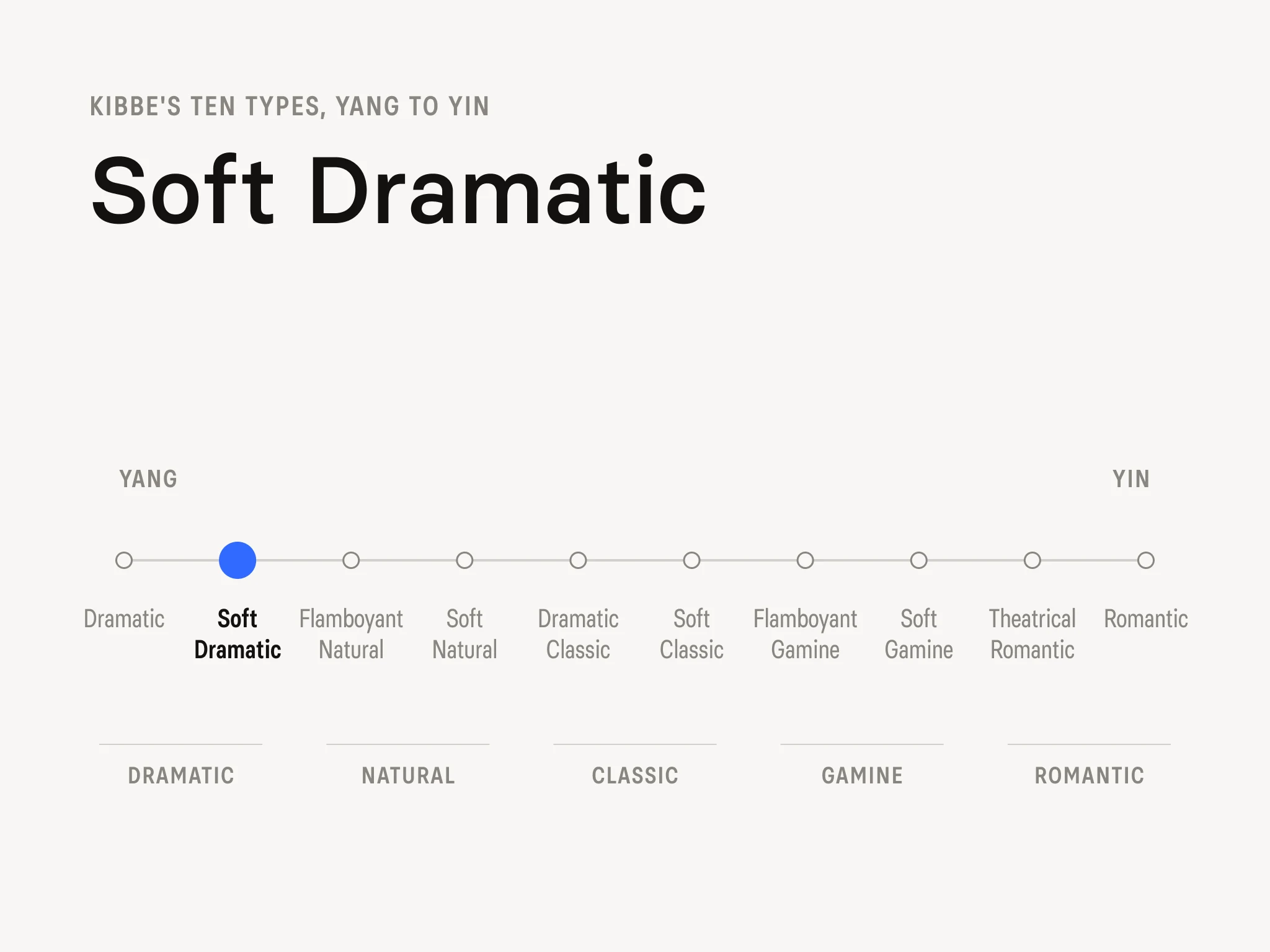
Soft Dramatic is the Kibbe type for a long, large-boned frame with full curves, and it is yours if a long draped jacket looks deliberate on you while small detail vanishes. Kibbe himself calls his types Image Identities. In Metamorphosis (1987) he defines it as "bold Yang with a pronounced Yin undercurrent", a Dramatic with a Romantic undercurrent, dressed in a "T" silhouette of broad shoulders over a long, draped vertical. The whole system is laid out in Kibbe body types, explained.
On this page
- Kibbe Soft Dramatic at a glance
- Am I a Soft Dramatic?
- A Kibbe type is not a body shape
- What Soft Dramatic asks of your clothes
- The cuts that work for Soft Dramatic
- The cuts that fight a Soft Dramatic
- Soft Dramatic vs Dramatic, Flamboyant Natural and Theatrical Romantic
- Where people get this wrong
- Soft Dramatic for men
- Your body details still outrank your type
- Kibbe Soft Dramatic: common questions
Kibbe Soft Dramatic at a glance
- Frame in Kibbe's 1987 outline: long and large-boned, fleshy through bust and hip, with full features, usually 5 feet 5 inches and over.
- What the clothes ask for, in our reading: soft construction, regular to loose volume, a rounded and draped line, a vertical that lengthens.
- Pieces that work: a long soft jacket with a strong shoulder, a bias midi, a belted long coat, draped knitwear, large jewelry.
- Pieces that fight: small delicate detail, cropped jackets, skin-tight trousers, a rigid slim suit, a tent with no drape.
- Most often mistaken for: Dramatic, which wants cloth that holds its shape where Soft Dramatic wants cloth that drapes.
Am I a Soft Dramatic?
Soft Dramatic names a type, not a shape. It answers how your clothes should be cut, not where your body carries its width. Kibbe offers his physical profile as "a broad outline" rather than a checklist:
- Height: "moderate to tall, usually 5 feet 5 inches and over".
- Body: "fleshy (unless ultrathin), particularly through the bust and hip area", with long legs and arms and, usually, "a moderate-sized waist".
- Bones: "large and angular": long limbs, large hands and feet, prominent or sharp facial bones.
- Features: "full, lush, sensual, and exotic", with large eyes, full lips and fleshy cheeks.
- What a Soft Dramatic will not have: a boyish figure, small hands and feet or a delicate bone structure, an overly petite frame with short limbs, small or delicate features, or symmetry in body or face.
The order of the mix matters. The frame is the Yang, the flesh and the features are the Yin, and in his words "Yang is definitely dominant; Yin is secondary." Treat the outline as where the system started. The publisher of David Kibbe's Power of Style (2025) describes it as an overhaul and update of his Image Identity system, and in 2022 Kibbe told Bustle: "Line is not about focusing on individual body parts. It's about the one long outline of the body."
Clothes tend to look either magnificent or slightly ridiculous on this frame, with very little in between, and that volatility is itself a signal. Kibbe names both ways it goes wrong: without the bold sweep you "appear oversized and awkward", and without the lavish, soft touches the look is "overwhelmed with starkness".
The changing room test takes three steps:
- Two jackets at the same size. Try a rigid slim suit jacket, then a long, softly built jacket with a broad shoulder in a cloth that drapes. A yes: the rigid one looks prim and faintly stingy, and the soft one looks deliberate.
- Something small, on purpose. Put on thin straps, a tiny print or fine ornament. A yes: it vanishes on you instead of reading as understated. Kibbe is blunt about it: "You are not the type for delicacy."
- One shake. Hold a garment up by the shoulders and shake it once. A yes: the cloth swings and settles into soft folds. Cloth that keeps the shape it had on the hanger is built for a Dramatic, whose fabrics, in Kibbe's words, have to "hold a defined shape".
Three yeses make Soft Dramatic the reading to test first. In our reading it sits at the lengthening end of the vertical axis, so long unbroken runs work in its favor.
A Kibbe type is not a body shape
Shape tells you where your width sits: hourglass, pear, rectangle. You already know those words, and you can use them in a fitting room without translating anything. A Kibbe type answers a different question, how your clothes should be built.
Take two women who both read as an hourglass, a shape whose page lists a cropped jacket and a belted coat among the cuts that work, because both acknowledge the waist. On a Soft Dramatic only the coat survives: it ties at the waist and still runs the full vertical, while "short, cropped jackets" are on Kibbe's avoid list. On a Theatrical Romantic the order flips, since Kibbe wants her jackets "short and nipped at the waist" and calls flouncy peplums best. Identical shape, opposite verdicts, and you cannot read one from the other.
Our analysis starts from the same question, but your page does not name a Kibbe type. It reads two things, your shape and your line (sharp, medium or soft), and gives every cut a verdict, Wear, Depends or Skip, with a reason. Drape is where those reasons get specific.
In the sample analysis, the real result of co-founder Filip Poláček, a men's Trapezoid with a medium line, silk blends are a Wear: "a smooth cloth with a gentle sheen". The unstructured blazer is a Depends, in a longer cut. The soft oversized draping overcoat is a Skip: "draping this oversized stands away from your body at every point." The full read is on the body type analysis page.
What Soft Dramatic asks of your clothes
Kibbe sums it up in one line: a "T" silhouette, "broad shoulders with an elongated vertical that is draped". The four axes below are our translation of that description into something you can check a garment against.
Construction: soft. No hard internal architecture. The garment follows the body rather than building a shape next to it. Kibbe's jackets are "lightly structured or unconstructed", and the shoulder is built up with pads, but "pads with soft edges are best".
Volume: regular to loose, with the scale at the shoulder. Room through the body, never tight. The width this type carries goes into the shoulder and the detail, which Kibbe wants "bold, oversized, and ornate", while his avoid list names "overly fitted, fussy silhouettes" and "wide, shapeless silhouettes" side by side. Loose works when drape carries it.
Line: rounded and draped. Curve rather than geometry. Fabric that falls, gathers and moves. His silhouette is built from "strong geometric outlines that are softened by narrowly draped and flowing lines", and on the draping he does not hedge: "It is a must!"
Vertical: lengthens. Long unbroken runs beat anything that chops the outfit into sections. Kibbe asks for "a head-to-toe 'ensemble' effect, never a mix-and-match look", down to stockings that blend with the hem and the shoe.
Volume is the primary axis for this type, so a fitted cut is a hard no rather than a compromise. A rigid slim suit can use gorgeous cloth and still fail twice: it is fitted where this type runs regular to loose, and structured where it is soft.
The cuts that work for Soft Dramatic
Each piece carries its verdict in the shorthand of our analysis, with the axis behind it.
Cloth that falls (Wear). A bias midi, a slip dress, a wrap dress. Kibbe's dresses are "elongated and draped, with broad shoulders", his skirts "straight, long (mid calf), and draped", and he calls "narrow, clingy shapes" basic. The line and construction axes are both satisfied by fabric behavior rather than by cut.
A long, soft jacket with a strong shoulder (Wear). Lightly structured or unconstructed, reaching to mid-thigh, in a cloth that drapes, with soft lapels. Width belongs at the shoulder. Stiffness is not welcome anywhere: Kibbe rules out "stiffly tailored jackets with sharp edges" and "traditional, blazer jackets" in the same breath.
Long outerwear with movement (Wear). A belted coat or a straight coat, long, and made in something that swings when you walk. Length feeds the vertical, movement feeds the line.
Sheen on cloth that drapes (Wear). Satin, silk and any cloth that catches light. Kibbe lists "shiny fabrics" for this type next to "soft and plush textures with a deep pile". Sheen is not unique to Soft Dramatic in his book, but here it has to come on cloth that drapes: a Dramatic's shiny fabrics, he writes, "should be very stiff".
Trousers that fall straight and long (Wear). Kibbe's are "straight, long, and draped", with deep pleats or softly draped cuffs. A fluid trouser with a deep pleat and a full-length hem is the version to look for. Wide, baggy legs and pegged ankles are both on his avoid list.
Knitwear that drapes (Wear). A fine merino or cashmere knit with a draped neckline, long enough to carry the line past the waist. Kibbe asks for "soft and clingy knits" and plush ones, and puts the scale into "oversized patterns or trim", not into the width of the sweater. A clingy knit is a Depends: it works in soft cloth that settles onto the body, and fails once it grips.
Big detail, big jewelry (Wear). Lavish trim, oversized bows, a deep cowl, a draped neckline that is either high or plunging. Prints that are "bold, wild, and ornate": splashy watercolors, oversized and abstract florals, animal prints. His jewelry advice fits in one sentence: "Jewelry is absolutely your best friend!"
The list is not a ceiling. Anything outside it can be checked against the same four axes, so the axes matter more than the list. And the last call is always per person: two Soft Dramatics can need opposite answers on the same coat once their proportions come in.
The cuts that fight a Soft Dramatic
Delicate detail (Skip). Small buttons, thin straps, fine ornament, tiny print. Scale is the issue. Detail sized for a small frame disappears against this one, which is why Kibbe's avoid lists carry "small, delicate detail" and "small, symmetrical prints".
Cropped lengths (Skip). A cropped jacket, a cropped cardigan, a denim trucker. All three cut the vertical at the hip, which throws away the axis that most reliably works for you. Kibbe names "short, cropped jackets" and "cropped sweaters" outright.
Skin tight (Skip). Skinny trousers and leggings sit at the fitted end of the volume axis, the primary one here. Kibbe's trousers are straight and draped, and he rules out pegged legs and "overly fitted and nipped styles". Cling is a different thing: soft cloth that settles onto the body is on profile, which is how he can ask for clingy knits and reject overly fitted ones in the same list.
Severe tailoring (Skip). A rigid slim suit is the classic failure, and it fails on construction and on volume rather than on shape. A strong shoulder is not the problem. A soft jacket with a strong shoulder is on profile. A stiff one is not.
Wide and shapeless (Skip). A boxy oversized blazer, a tent dress, baggy jeans, an oversized sweater with no drape. Kibbe puts "wide, shapeless silhouettes" on the avoid list and repeats the warning for skirts, blouses, sweaters, trousers and dresses. Width with no draped line to carry it reads as a sack on this frame.
Soft Dramatic vs Dramatic, Flamboyant Natural and Theatrical Romantic
Three types sit close enough to be mixed up with Soft Dramatic: Dramatic and Flamboyant Natural because all three are long and take a strong shoulder, Theatrical Romantic because both mix soft flesh with some sharpness. In Kibbe's 1987 outlines they split on the Yin/Yang balance first, then on the cloth.
| Type | Kibbe's balance | Cloth he asks for |
|---|---|---|
| Soft Dramatic | Bold Yang, Yin undercurrent | Light and draping |
| Dramatic | Extreme Yang | Holds a defined shape |
| Flamboyant Natural | Strong Yang, blunt edges | Rough surface, texture |
| Theatrical Romantic | Soft Yin, slight Yang | Light, drapable, sheer |
Read each row against the first: the balance column says who leads, the cloth column says what the clothes are made of. Height barely separates the first three, since Dramatic and Flamboyant Natural are, like Soft Dramatic, usually 5 feet 5 inches and over in Kibbe's outlines, while Theatrical Romantic is usually 5 feet 5 inches and under.
Against Dramatic, most of the ground is shared: Kibbe calls the Soft Dramatic "Dramatic with a Romantic undercurrent" and tells her, "Always bear in mind that you are a Dramatic first and foremost!" Both lengthen, both take a strong shoulder, both fail in cropped, fussy clothes. In our reading the split runs through three axes: Dramatic is structured, fitted to regular and straight, while Soft Dramatic is soft, regular to loose and rounded. If tailoring has to be softened before you like it on yourself, you are on the Soft Dramatic side, and the other side is the Dramatic article.
Against Flamboyant Natural the split is the line, and with it the cloth. Both are tall, Yang-led frames that carry a strong shoulder, and in our reading both are soft, regular to loose and lengthening. Kibbe dresses the Flamboyant Natural in "unconstructed silhouettes" and "relaxed, unstructured outlines" with texture, and puts "ultrasheer, flimsy, or clingy fabrics" on her avoid list. A Soft Dramatic is narrowly draped, in light cloth that often clings: fluid cloth that falls close to the body is hers, and a roomy, textured layer that skims past it is Flamboyant Natural's.
Against Theatrical Romantic the balance flips. Theatrical Romantic is Yin first, small-boned and usually 5 feet 5 inches and under, and Kibbe builds her silhouette around the waist, with long vertical lines that run over the waist on her avoid list. In our reading she is fitted with a neutral vertical, where Soft Dramatic runs regular to loose and lengthens. The Soft Dramatic's long draped jacket is exactly the line she avoids.
Where people get this wrong
The first mistake is hearing soft and reaching for shapeless. Soft construction means no hard internal architecture, and the line axis still asks for drape, which is a specific behavior of cloth. An oversized cotton tee is loose and soft and still misses, because nothing about it falls.
The second is letting the soft side take over. Dainty ruffles, small florals and a delicate, pretty outfit dress the Romantic half on its own. Kibbe's instruction is that the Romantic undercurrent "should be used in small doses": it is "not a substitution", it is "an addition". The bold frame comes first, the softness goes on top.
Soft Dramatic for men
Kibbe wrote Metamorphosis for women, and Strictly Kibbe, the private Facebook group where he is most active, did not admit men when MEL Magazine wrote about it in 2021. A year later Bustle reported that, in Kibbe's view, the same process works for men. What follows is our translation into menswear: the same four axes, a different garment vocabulary. For how shape works in menswear, see men's body shapes and fit.
A men's Soft Dramatic wardrobe is long, softly built jackets with a strong shoulder, shirts in a fluid cloth, plush and lustrous materials like cashmere, silk and velvet, and longer coats with movement. That combination is unusual in menswear, where the default advice is slim and minimal, which is how a man on this profile ends up with a beautiful wardrobe that does nothing for him. The shoulder can be strong and wide. What it cannot be is rigid.
What fails is skinny minimal cuts, small patterns, and the rigid slim suit. A tightly cut suit in a hard-finished cloth is the expensive mistake here. The fix is the same suit in something with drape and a softer build, with room through the body, a jacket that runs long and trousers that fall straight to a full break. Cloth does more of the work on this profile than any change of cut, which is Kibbe's point too: on this type, he writes, heavyweights "will be stiff and unbending".
Your body details still outrank your type
The type profile is a starting position, and specific body facts override it. On a Soft Dramatic they touch the four axes in five places.
- Shoulders (the scale). This type puts its width at the shoulder, with pads whose edges stay soft. Broad shoulders carry the "T" without help, so the pad can be light or absent. Narrower shoulders are where Kibbe's soft-edged pad earns its place.
- Bust and hip (the draped line). Kibbe puts the flesh "particularly through the bust and hip area". Draped cloth follows that curve instead of gripping it, which is why one body fails in a stiff slim cut and works in a bias cut.
- Waist (the belt). The outline allows a waist that is moderate and "can become thick", so a belt is optional. A coat that falls straight and draped works unbelted, and where a belt sits is decided by your waist, not by the type.
- Thighs (volume). Broader thighs rule out trousers with no thigh room. On this profile that rarely bites, because the trousers Kibbe asks for already fall straight and long, but it settles the argument about a tapered leg.
- Torso and legs (the vertical). A longer torso favors a high rise, and a shorter leg rules out a low rise. A low rise cuts the vertical at the hip, the same way a cropped jacket does.
That is the difference between this and a quiz that gives you a label and stops. Kibbe said much the same to Bustle: "Style is a journey. It's not, 'take a test and learn your type.'" The type narrows the field. Your body picks the winner.
Kibbe Soft Dramatic: common questions
Not necessarily. Kibbe's 1987 profile puts the flesh "particularly through the bust and hip area" with a waist that is usually "moderate-sized" and "can become thick", and it is his Romantic and Theatrical Romantic outlines that name an hourglass figure. What makes the type is a long, large-boned frame carrying soft flesh, whatever the tape measure says at the waist.
Usually 5 feet 5 inches and over. Kibbe's outline puts the Soft Dramatic at "moderate to tall, usually 5 feet 5 inches and over" and says she will not be "overly petite, or small in stature with short limbs". In 2022 Bustle reported that above 5 feet 7 inches only three types remain, Flamboyant Natural, Dramatic and Soft Dramatic, and quoted Kibbe on why: "A curved line cannot be dominant over a certain height, because once you get to a certain height, you have an automatic vertical."
Close, but no. Kibbe calls the Soft Dramatic "a Dramatic first and foremost", so the long vertical, the broad shoulder and the bold scale are shared. The Dramatic needs cloth that holds "a defined shape" and clean detail, the Soft Dramatic needs lightweight cloth that drapes and detail that is "flamboyant, lavish, and oversized". Fabric is where you notice it, but in our four axes the two also differ on construction and line.
Yes, softly built and cut with room. The failure is rigidity, not tailoring. A jacket with a soft shoulder pad, unstructured through the body and long through the skirt, satisfies the axes that a stiff slim suit breaks.
Yes, when they behave like Kibbe's trousers: straight, long and draped. Look for a soft denim with some drape, a straight leg to the shoe and no pegged ankle. Stiff rigid denim and baggy cuts are the two to skip, because his list rules out "heavy fabrics that create a stiff shape" and "wide, unconstructed, or baggy shapes". A cropped denim jacket fails for the same reason any cropped jacket does.
Because of scale. Delicate detail fights this type, and it usually shows up first in accessories and prints rather than in silhouette. Going up in scale is often the cheapest fix available.
No. Sheen is favored, not required. Kibbe lists shiny fabrics for several types, the Dramatic and the Theatrical Romantic among them. What is particular to the Soft Dramatic is the combination: shine on a cloth light enough to drape.
Sophia Loren is his "prime celebrity example" in Metamorphosis, and his list adds Ava Gardner, Raquel Welch, Maria Callas, Marlene Dietrich, Anne Bancroft, Diahann Carroll and Barbra Streisand, among others. He warns that the list is not meant to suggest these women "always dress to their best advantage", so look for what their builds share rather than copying their outfits.
No. Your page names your body shape and your line, sharp, medium or soft, never a Kibbe type. What it gives you instead is a verdict, Wear, Depends or Skip, with a reason for every cut, which is the part of this article that has to be decided per person anyway.