
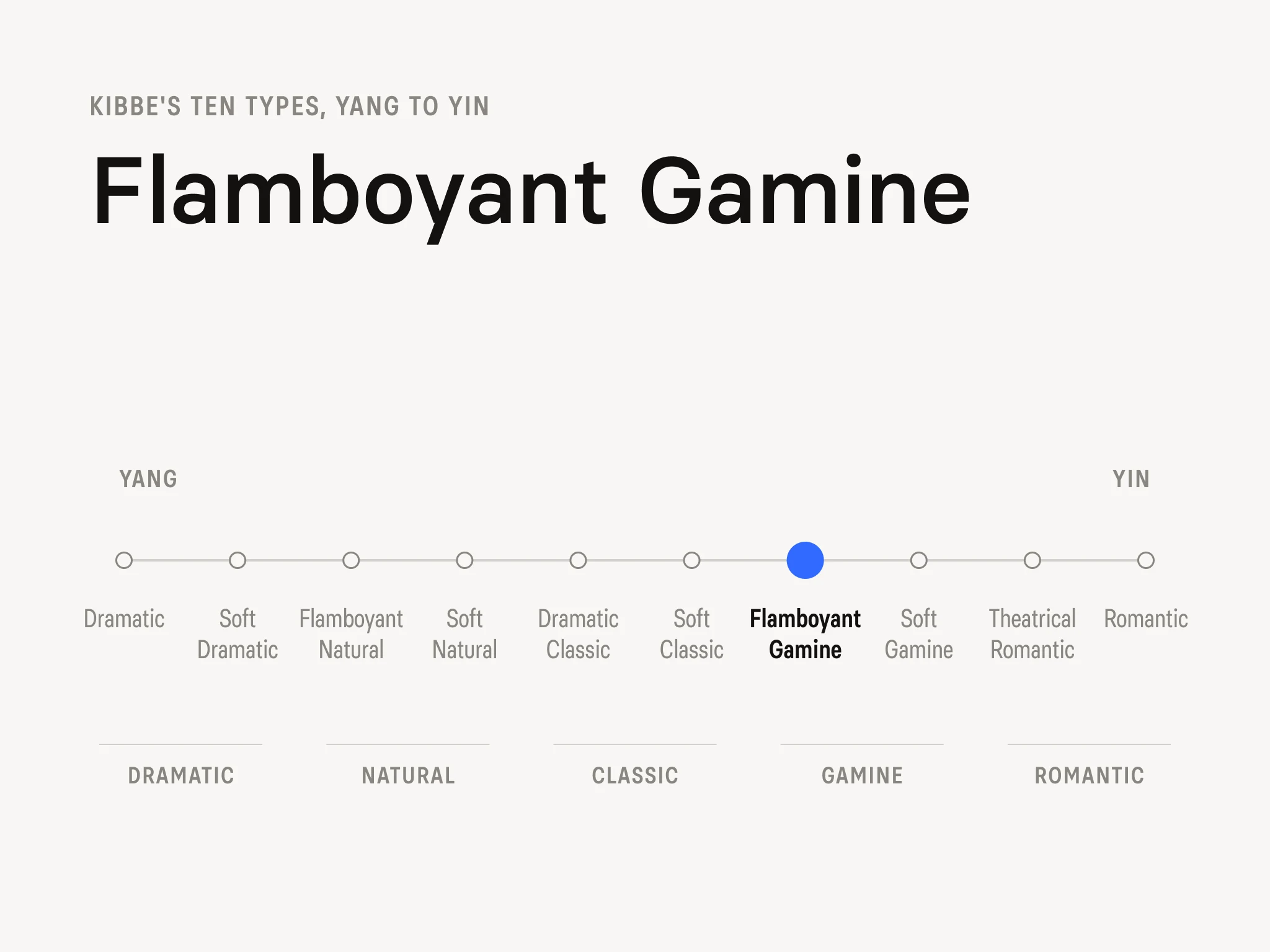
If your frame is small and angular, you like a cropped jacket and a break in the line, and a long draped coat looks like it is wearing you, you are probably a Flamboyant Gamine, the Kibbe type that mixes opposites with extra yang. Kibbe himself calls his types Image Identities. In Metamorphosis (1987) he describes a smallish, broadly angular frame with a "youthfully bold and brassy essence." The clothes that follow run on a broken line: short structured jackets, narrow bottoms, contrast and mixed prints. The whole system is laid out in Kibbe body types, explained.
On this page
- Kibbe Flamboyant Gamine at a glance
- Am I a Flamboyant Gamine?
- A Kibbe type is not a body shape
- What Flamboyant Gamine asks of your clothes
- The cuts that work
- The cuts that fight you
- For men
- Flamboyant Gamine next to its neighbors
- Where people get this wrong
- Your body details still outrank your type
- Kibbe Flamboyant Gamine: common questions
- Related reading
Kibbe Flamboyant Gamine at a glance
- Frame in Kibbe's 1987 outline: 5 feet 6 inches and under, broadly angular bones with square shoulders, straight lines through the bust and hips, a leggy look.
- What the clothes ask for, in our reading: structured construction, fitted to regular volume, a broken line, a vertical that shortens to neutral.
- Pieces that work: a jacket that stops at the hip, a statement cut, contrast layering and pattern mixing, crisp shirting, narrow short bottoms.
- Pieces that fight: long drape with nothing to break it, a long draped coat, oversized volume that hangs, long monochrome.
- Most often mistaken for: Flamboyant Natural, which wants the long relaxed sweep where Flamboyant Gamine breaks the line.
Am I a Flamboyant Gamine?
Flamboyant Gamine names a type rather than a shape, so the question is what your clothes should do, not where you carry your width. A Flamboyant Gamine frame reads as parts rather than one sweep. The eye lands on separate pieces, edges stay crisp, and a garment that runs uninterrupted from shoulder to hem looks like it is fighting the frame.
Kibbe's 1987 physical profile of the type:
- Height: 5 feet 6 inches and under. A Flamboyant Gamine will not be tall.
- Bones: broadly angular, with square shoulders.
- Body: straight lines through the bust and hips, a leggy look.
- Face: usually extremely large eyes.
- What it will not have: symmetry in body or face.
In his chapter on the type he puts it in one line, "Yang in shape (angular), Yin in size (your height)," and its title calls Flamboyant Gamine a "Gamine with a Dramatic undercurrent." He adds that a slight deviation "should not be worried over" as long as the overall balance holds.
His prime celebrity example is Liza Minnelli, and his list for the type adds Tina Turner, Twiggy, Patti LuPone and Debra Winger among others, with the note that it does not mean they always dress to their best advantage. Audrey Hepburn, who leads many online lists, is not on it, and Coco Chanel appears in the same book under Gamine, a separate type.
The changing room test takes three checks:
- Put on a cropped jacket that stops at the hip. A yes: the crop looks deliberate, as if the layer ends exactly where the silhouette wants a break.
- Put on a long draped coat or a slip dress that runs past the knee. A yes: the garment seems to be wearing you, one sweep with nothing to stop it.
- Add a break: tuck a crisp shirt into a high waistband, or layer a contrasting piece. A yes: the visible break looks right rather than fussy.
Three yeses make Flamboyant Gamine the reading to test first. In our reading, shortening is a setting on the vertical axis rather than your height in inches: it describes where hems and breaks should land.
A Kibbe type is not a body shape
Shape says where your width sits: inverted triangle, pear, hourglass, rectangle. These are terms people already carry around, and they still make sense in a changing room. A Kibbe type answers a different question, how your clothes should be built.
Two women can both read as an inverted triangle. On the one who is a Flamboyant Gamine, a cropped jacket is exactly right, ending the layer where the silhouette wants a break. On the one who is a Dramatic, the same jacket halves a vertical she cannot spare, and it is a flat no. Identical shape, reversed verdict, and neither can be read off the other.
Our analysis starts from the same question, but your page does not name a Kibbe type. It reads two things, your shape and your line (sharp, medium or soft), and gives every cut a verdict, Wear, Depends or Skip, with a reason. The three lines are sharp, medium and soft, and the full read is on body type analysis.
What Flamboyant Gamine asks of your clothes
There is no personality test underneath these axes. Kibbe describes his types in his own words, and these four axes are our translation of Flamboyant Gamine into something you can check a garment against. His own checklist for the type comes down to one instruction: "Make your foundation from skinny, narrow, and clingy silhouettes. On top of this, add irregular or asymmetric lines in a staccato, broken fashion."
Construction: structured. A garment that holds its own shape. Softness here goes floppy exactly where the type wants a defined edge.
Volume: fitted to regular. Close to the body or normally cut. Volume has some give here, but it never becomes the point.
Line: broken. The silhouette works in segments. Hems that stop, waistbands that show, layers that end somewhere visible.
Vertical: shortens to neutral. Cutting the line is allowed and often preferred. Stretching it is the risk.
Line is the primary axis, and a conflict on it is a hard no rather than a compromise. A garment can be perfect cloth in a perfect color and still fail because it runs one uninterrupted length.
The cuts that work
A jacket that stops at the hip (Wear). A cropped jacket, a bomber, a denim trucker. All three end the layer exactly where this type wants the break, which is why pieces that fail on the lengthening types land well here. Kibbe's checklist says it outright, "Jackets should be short and boxy," and gives the length: "from the bottom of the rib cage to the top of the hips."
A statement cut (Wear). A garment whose cut is the event rather than the backdrop: a strong crop, a hard geometric hem, a shoulder that announces itself. Understatement is not the safe choice here, it is the missed one. Kibbe makes the shoulder a rule: "Shoulders should always be defined."
Contrast layering and pattern mixing (Wear). Two halves that argue instead of matching, geometry against geometry. This is line work done with color, and it breaks the silhouette without a single seam. Kibbe's rule for it is the practical one: "Mix opposing prints together using color as the key to continuity." Two prints that share one color hold together.
Crisp shirting (Wear). An oxford shirt holds a flat front and a structured collar, and tucked into a high waistband it puts the break where the type wants it.
Narrow, short bottoms (Wear). A straight mini, skinny trousers, tapered trousers. Cropped lengths sit on axis here in a way they do not for most other types. Kibbe allows trousers "cropped as short as you want."
The list is not a ceiling. A piece that appears on no list can be checked against the same four axes, which is why the axes matter more than the list does. And the final call is per person, not per type. The same cropped jacket can pass on one Flamboyant Gamine and fail on another once their proportions come in.
The cuts that fight you
Long plus drape, unbroken (Skip). A slip dress or a full, flowing maxi combines the two things this type rejects in a single garment: uninterrupted length and cloth that flows through it. Either one alone is a question. Both together, with nothing to stop them, is the answer. Kibbe is more precise here than most guides: he allows a narrow bias-cut skirt to mid-calf, and a long draped line worn with a sharp separate, because that "breaks the vertical." Those are Depends: long, but broken. What he rules out is "All unbroken silhouettes."
A long draped coat (Skip). A soft knee-length coat hanging open is one continuous sweep with nothing to interrupt it. A parka does the same with more bulk.
Oversized volume that hangs (Skip). An oversized draping shirt or a long open cardigan that falls to the thigh misses volume and line at once. Boxy is not the problem: short boxy jackets are on Kibbe's own list. What he avoids is the oversized, unconstructed jacket, and he keeps bulky knits cropped or worn over something skinny.
Long monochrome (Skip). One color from neck to shoe removes every horizontal break in an outfit. On the lengthening types that is the goal. Here it deletes the point. "One long line of any color" is the first thing on Kibbe's color avoid list for the type, and he carries it down to the legs: stockings should break the line rather than blend with the hem and the shoe.
Romantic softness at scale (Skip). Large flowing ornament reads as blur against a line built on edges. Detail is welcome. Detail that melts is not. Kibbe asks for "a profusion of angular, sculpted detail" and rules out the ornate and the fussy.
For men
Kibbe built the system "working with women in my studio and salon in New York City," as he writes in Metamorphosis, and his checklists speak in skirts, blouses and dresses. The men's reading here is ours. We read the ten types the same way in menswear. Only the garment vocabulary changes.
A men's Flamboyant Gamine wardrobe is shorter jackets and cropped bombers, crisp shirts, contrast layering and pattern mixing. The rule most men need here is counterintuitive: the jacket that gets called too short by everyone else is usually the right one. A bomber and a denim trucker, which fail flatly on a long structured reading, both work here.
What fails is long draped coats and oversized monochrome. That takes out the long soft overcoat, the parka, and the head to toe single color outfit menswear so often defaults to. A cropped bomber over a crisp shirt, with a visible waistband and trousers in a different shade, does more for this frame than any amount of length.
The sample analysis, the real result of co-founder Filip Poláček, shows what the same jackets do on a frame that reads long. His page names a trapezoid shape and a medium line, and no Kibbe type. The bomber and the denim trucker come back as Depends, with the condition "in a longer cut," and the short fitted jacket is a Skip: "Cropped and fitted, every seam sits under strain across your chest." Same jackets, a different body, a different verdict, with the reason printed next to it.
Flamboyant Gamine next to its neighbors
Kibbe's 1987 outlines for the type and its three neighbors:
| Type | Balance | Height |
|---|---|---|
| Flamboyant Gamine | Opposites, extra yang | 5 ft 6 in and under |
| Soft Gamine | Opposites, extra yin | Under 5 ft 5 in |
| Flamboyant Natural | Strong yang, blunt edges | Usually 5 ft 5 in and over |
| Dramatic | Extreme, sharp yang | Usually 5 ft 5 in and over |
The same four types on the axes this series uses for every type, which are our reading and not Kibbe's wording:
| Type | Construction, volume | Line, vertical |
|---|---|---|
| Flamboyant Gamine | Structured, fitted to regular | Broken, shortens to neutral |
| Soft Gamine | Soft to structured, fitted | Broken, leans rounded, shortens to neutral |
| Flamboyant Natural | Soft, regular to loose | Straight, blunt edges, lengthens |
| Dramatic | Structured, fitted to regular | Straight and sharp, lengthens |
Read across a row: Flamboyant Gamine and Dramatic share structure and fit but part on the vertical, and Flamboyant Gamine and Soft Gamine share a broken line and part on rounding.
Where people get this wrong
The common misread is Flamboyant Natural. Both carry the word flamboyant, both want a garment with presence, and both look wrong in careful little outfits. The split is length and drape. Flamboyant Natural wants the long relaxed sweep. Flamboyant Gamine breaks the line and stays structured. If long draped pieces are the ones that make you look pulled together, you are probably reading the other type. Kibbe's own list for readers stuck between two types draws the same line in the body: Flamboyant Natural is "Taller" with "Longer bone structure," and Flamboyant Gamine is "Smaller" with "Less vertical line to the body."
The second misread treats gamine as a synonym for petite. Kibbe's own chapter argues against it: his cardinal guideline for the type is to discard every rule that restricts you for being "too short." Height still counts in his system, but his 1987 outlines for Romantic and Soft Classic also run to 5 feet 5 and 5 feet 6, so being short does not make you a gamine. In our reading shortening is about where hems land, not about how tall you are.
The third is Dramatic Classic, which shares the angular bones. Kibbe settles it on symmetry: Dramatic Classic bone structure is "Symmetrical, with slightly angular edges," and a Flamboyant Gamine will not be symmetrical in body or face.
Your body details still outrank your type
The type profile is a starting position, and specific body facts override it. On a Flamboyant Gamine the first one to bite is the type's own favorite move.
- Hips and seat. A stronger seat or wider hips rule out a layer that ends at the hip, so the cropped jacket the profile likes can be ruled out by the body underneath it. The same details rule out bottoms with no room over the curve and no stretch.
- Thighs. Broader thighs rule out trousers with no thigh room, so skinny cuts go conditional.
- Bust and shoulders. A fuller bust makes a crop and a stiff fitted top conditional, and this type is built on both. Broad shoulders rule out a sharp shoulder even when the statement cut wants one, while narrow shoulders make a sharp shoulder better rather than worse.
- Torso and legs. A longer torso favors a high rise, and a shorter leg rules out a low rise.
The label narrows the field. Your body makes the call.
Kibbe Flamboyant Gamine: common questions
Not short, but not tall either. Kibbe's 1987 profile gives 5 feet 6 inches and under, and his chapter on the type tells the reader: "You are not short, you are merely 'not tall.'" In a 2022 interview with Bustle he put Gamines at 5 feet 5 or shorter, "because they're compact." In our reading, shortening describes what the clothes do to the line, so the cuts on this page can be tested at any height.
Yes, when something breaks it. The thing that fails is long combined with drape and nothing to interrupt it. Kibbe's checklist allows a longer jacket "occasionally," and only over a very skinny bottom or a very short skirt, and his own example pairs "a long, boxy jacket" with "a short, straight skirt." A coat that keeps its structure and gets broken up by what is worn under it is judged on the same four axes rather than banned by name. The final call is per person.
Yes, because contrast does line work. A break in pattern or color segments the silhouette the same way a hem does, which is why contrast layering sits on this profile alongside cut.
Compare rounding and fit. Both are line led and both break the silhouette. Soft Gamine leans rounded in its details and stays strictly fitted. Flamboyant Gamine stays crisp and geometric and can carry regular volume. Kibbe's 1987 outlines draw the same split in the body: extra yang and straight lines through the bust and hips for Flamboyant Gamine, extra yin and a soft, curvy body for Soft Gamine. If hard geometry reads severe on you, test Soft Gamine first.