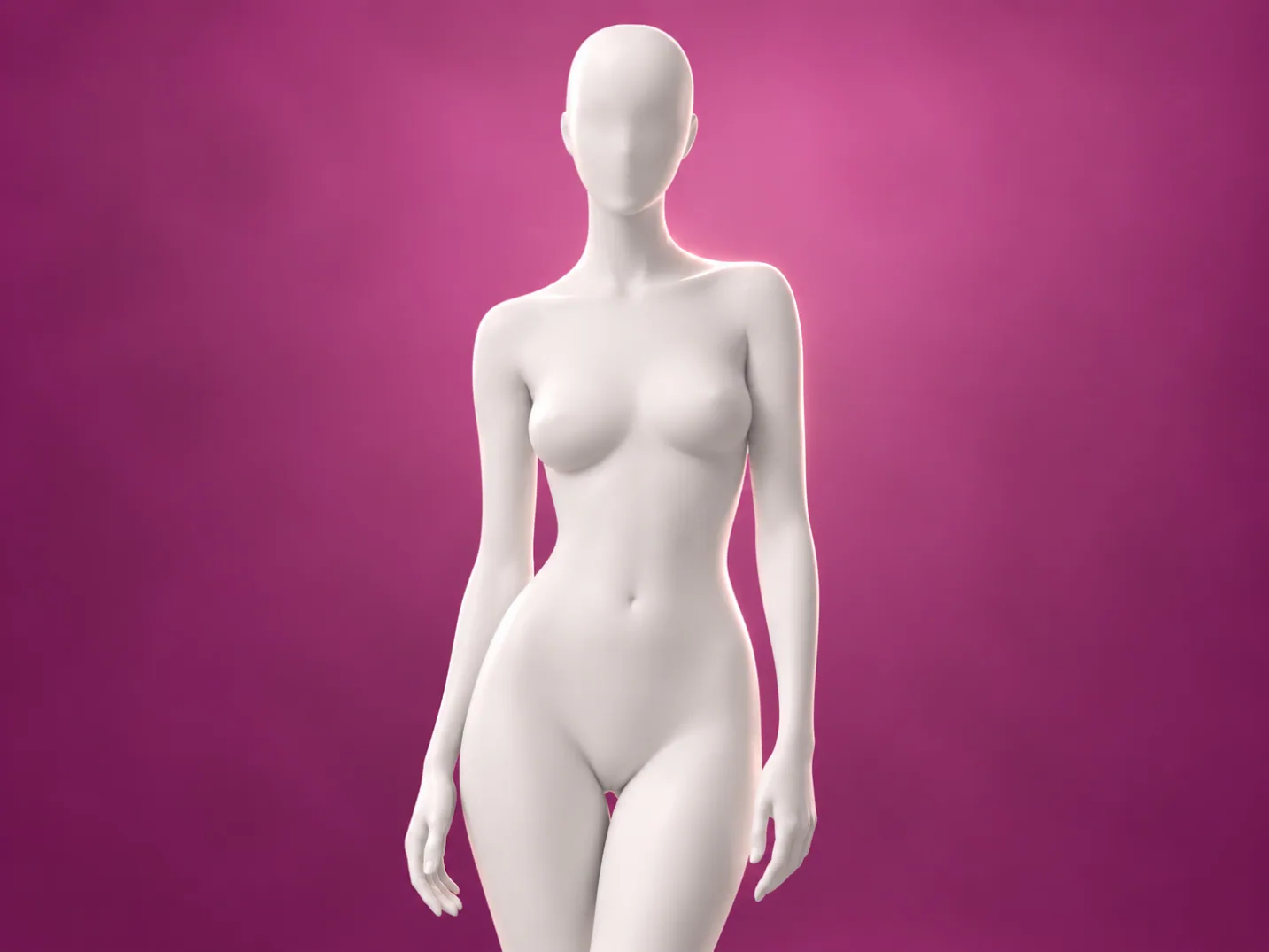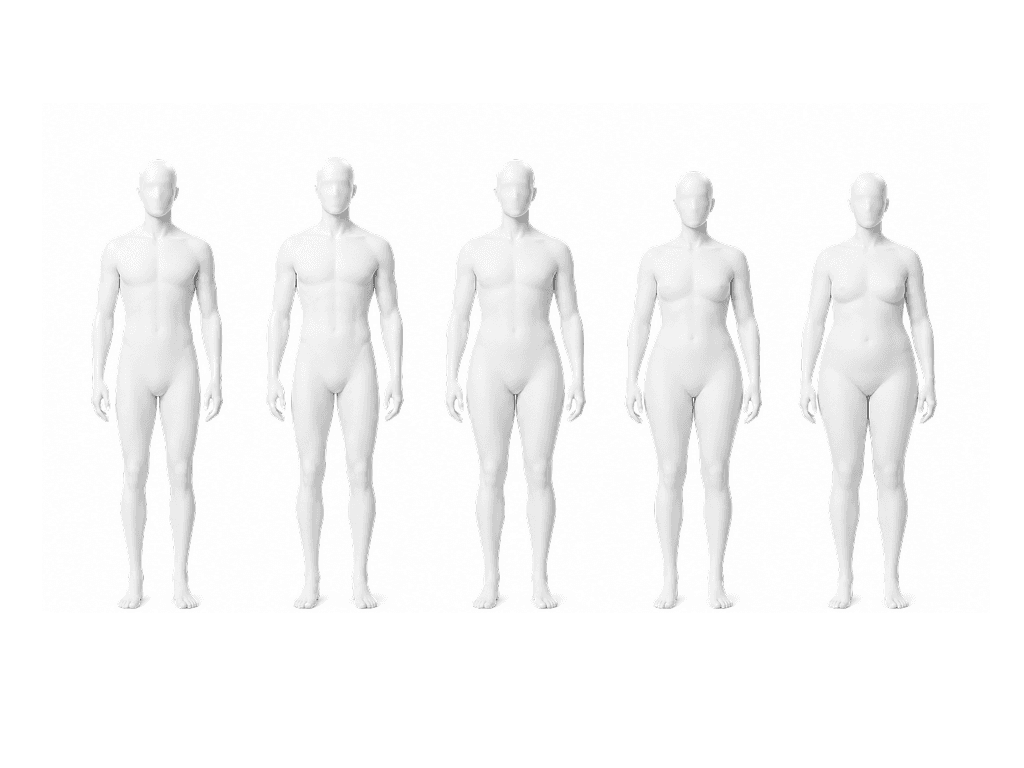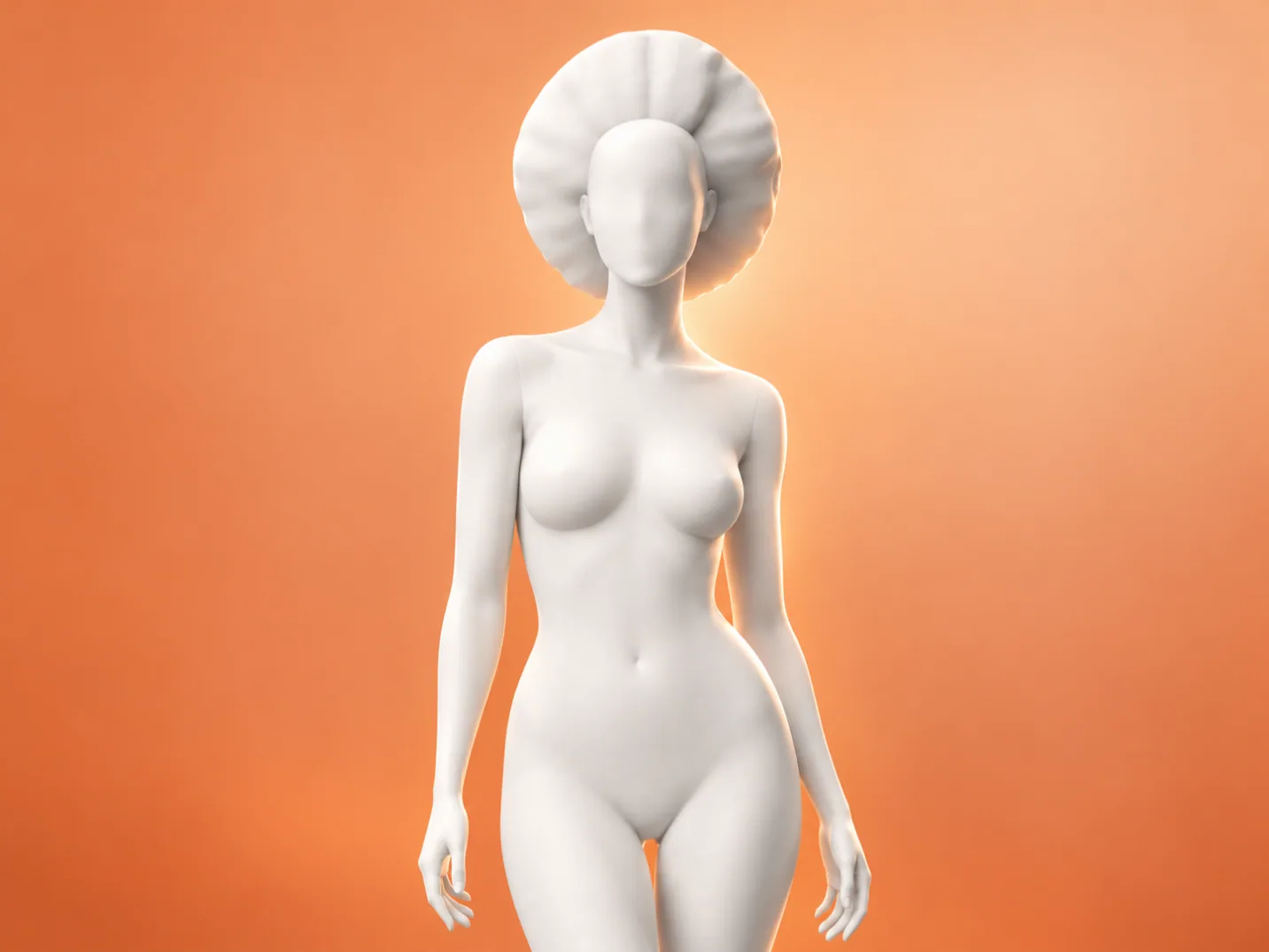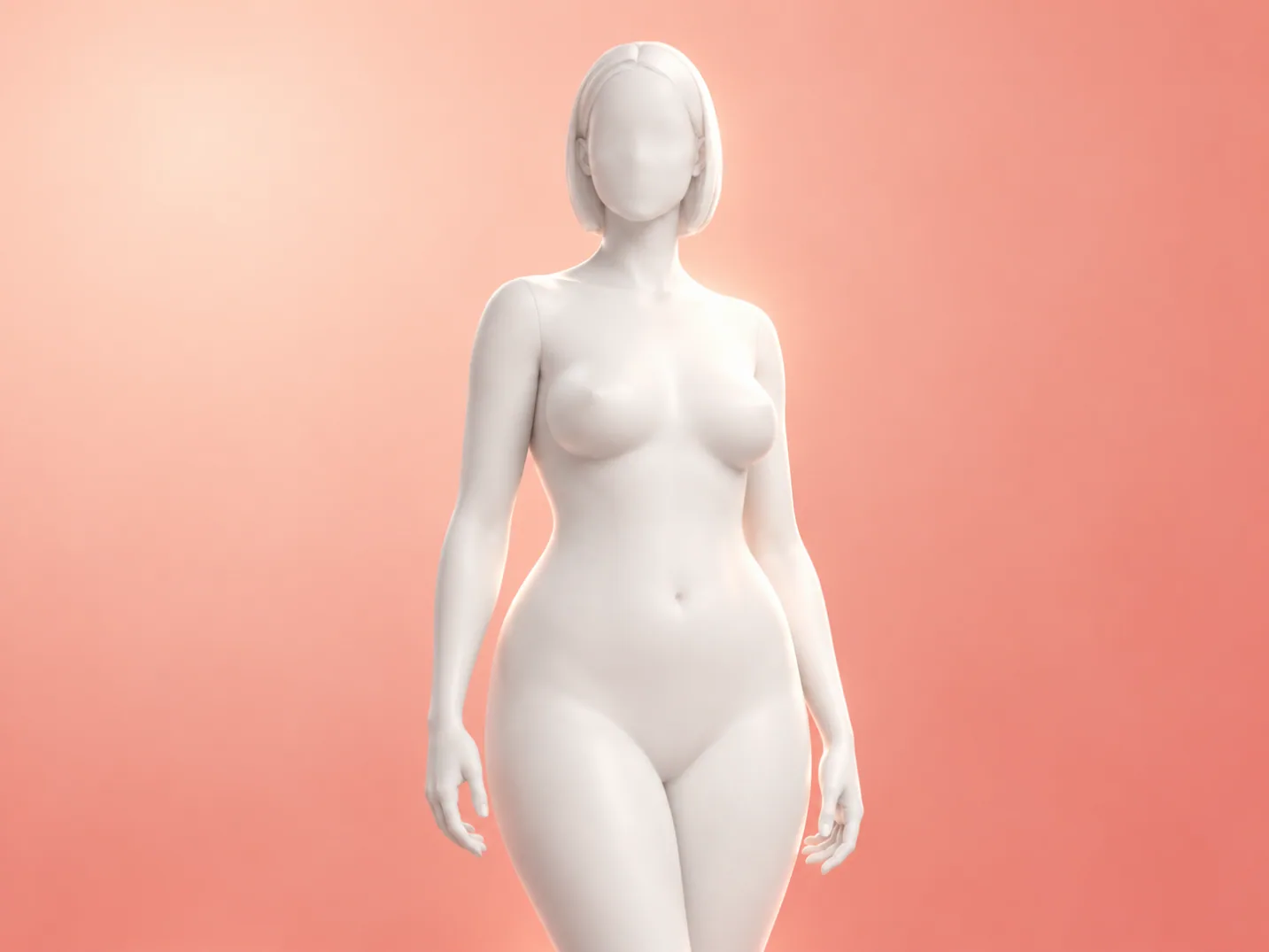
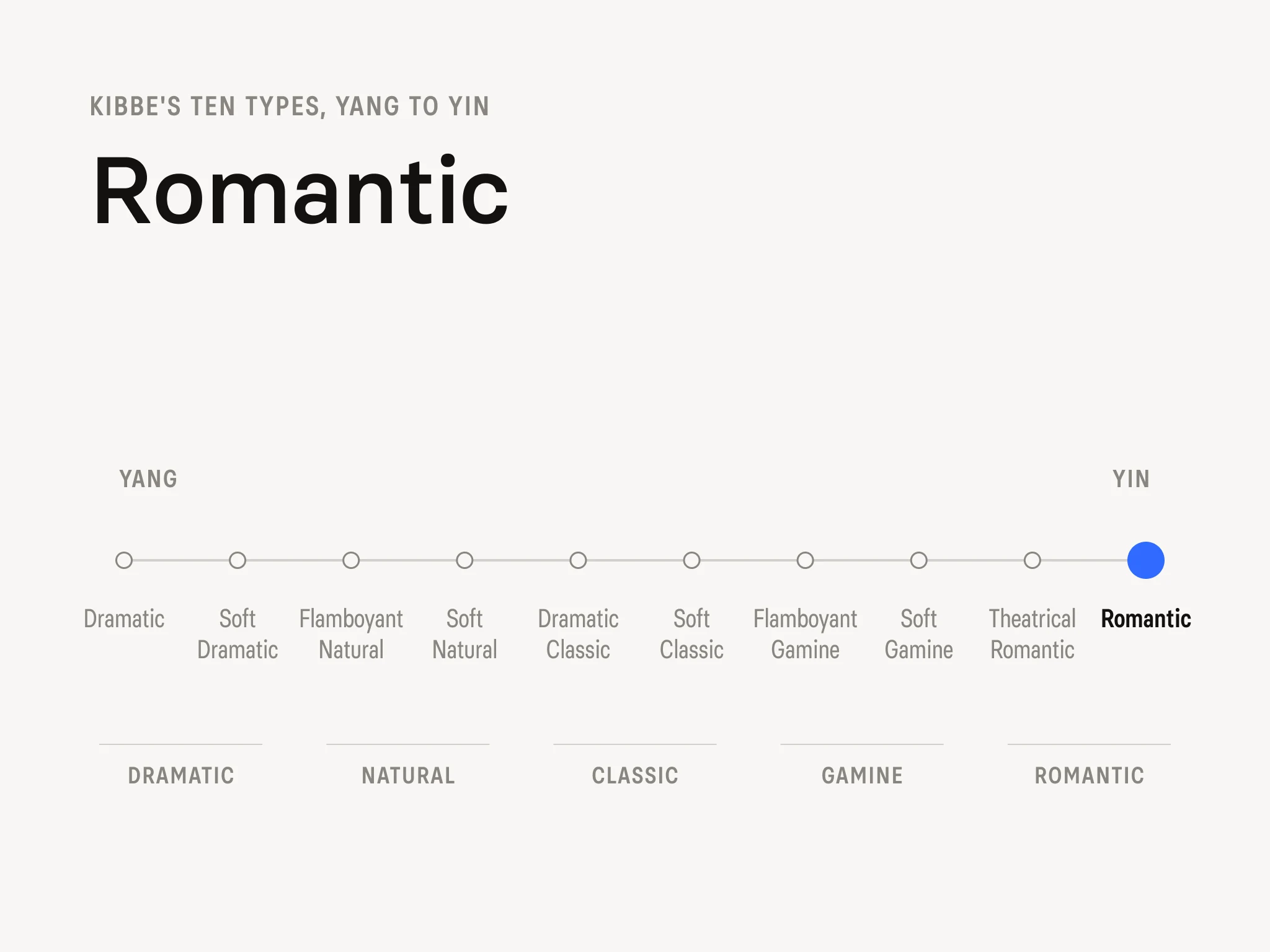
Romantic is the Kibbe type for a soft, curved frame: it is yours if fluid cloth and a marked waist look made for you, and stiff, square pieces sit on top of you. Kibbe himself calls his types Image Identities. In Metamorphosis (1987) David Kibbe puts it at "the extreme Yin edge" of his Yin/Yang scale, "a very soft and curvy body type" on delicate, rounded bones. In our reading that comes to soft construction, fitted to regular volume, a rounded line and a neutral vertical.
On this page
- Kibbe Romantic at a glance
- Am I a Romantic?
- A Kibbe type is not a body shape
- What Romantic asks of your clothes
- The cuts that work
- The cuts that fight you
- Kibbe's list next to our verdicts
- For men
- Where people get this wrong
- Romantic next to Theatrical Romantic, Soft Gamine and Soft Classic
- Your body details still outrank your type
- Kibbe Romantic: common questions
Kibbe Romantic at a glance
- Frame in Kibbe's 1987 outline: a soft, voluptuous hourglass on delicate, rounded bones, usually 5 feet 5 inches (about 165 cm) and under.
- What the clothes ask for, in our reading: soft construction, fitted to regular volume, a rounded line, a neutral vertical.
- Pieces that work: a wrap dress, a belted coat, soft tapered trousers, a soft-shoulder fitted blazer, a bias midi shaped at the waist.
- Pieces that fight: a sharp shoulder, stiff cloth, hard straight lines, oversized volume, coarse workwear cloth.
- Most often mistaken for: Theatrical Romantic, which wants a crisp padded shoulder where Romantic wants a rounded one.
Am I a Romantic?
Romantic describes a type, not a shape, so this asks what your clothes should do rather than where you carry your width. A Romantic frame reads curved, and the curve is the whole story. There is no angle to build an outfit on, so clothes that impose geometry sit on top of the body rather than with it. For all ten types side by side, see Kibbe body types, explained.
Kibbe's physical profile of the type in Metamorphosis reads like this:
- Height: moderate to petite, "usually 5 feet 5 inches and under".
- Body: "soft and voluptuous", an hourglass with a curvy bust and hips and "a small waist (in proportion to the curves)", and fleshy arms and legs.
- Bones: "delicate and smallish" but usually to the wide side, with rounded or sloped shoulders and small hands and feet.
- Face: "lush, full, and sensual (rounded)", with large, luminous eyes, full lips and fleshy cheeks.
- Not expected: extreme height, a large bone structure or large hands and feet, a straight or boyish figure, angular or sharp features, a prominent nose or angular chin, and symmetry.
Two of his own notes are worth more than the list. A frame that is slightly wide can feel large-boned, and he calls that "actually deceiving", because short limbs and small hands and feet offset the width. And a Romantic "may tend to understate her curvaceousness", so ask a friend before you rule yourself out.
That is the 1987 text, written for women. David Kibbe's Power of Style (2025) is billed by its publisher as an overhaul and update of the Image Identity system, so read the 1987 profile as the original, not his last word.
The changing room test takes three garments, one question each:
- Drape. Put on a bias midi or a slip dress. A yes: it looks cut for you and falls with the curve instead of hanging from it.
- Shoulder. Put on a blazer with sharp, square shoulders. A yes: it looks like a costume with a shoulder in it.
- Waist. Tie a supple belt over a soft top, then take it off. A yes: the marked waist looks right and the loose version looks unfinished. Kibbe calls waist definition "essential, always".
Three yeses make Romantic the reading to test first. In our reading Romantic sits at neutral on the vertical axis: the clothes do not need to lengthen you or cut you short.
A Kibbe type is not a body shape
Shape says where you carry your width, as in an hourglass, a pear or a rectangle. A Kibbe type answers a different question: how your clothes should be built.
Take two women who both read hourglass, with the same waist and the same step out to bust and hip. A knit dress with real ease through the hip suits a Romantic, whose volume runs fitted to regular. In our four axes a Theatrical Romantic is fitted only, so the same ease sits outside that type. The shape is the same and the answer changes, and neither can be worked out from the other.
Our analysis starts from the same question, but your page does not name a Kibbe type. It reads two things, your shape and your line (sharp, medium or soft), and gives every cut a verdict, Wear, Depends or Skip, with a reason. The full read is the body type analysis.
What Romantic asks of your clothes
Kibbe's own checklist for Romantic ranks its rules. "Shape is the key to your look!" comes first, with every shape "rounded with soft edges". Line and silhouette come "second only to shape", soft and flowing, and "waist definition is essential, always, as is lots of gentle draping everywhere." Fabric and detail follow.
The four axes below are our translation of Romantic into something you can check a garment against.
Construction: soft. Cloth that gives. A garment can be shaped and even tailored, but it cannot be rigid, and a hard, square shoulder is out of bounds. Kibbe's fabric list runs from challis, crepe and jersey to charmeuse, velvet, angora and chiffon.
Volume: fitted to regular. Close to the body or normally cut, with room over the curve where the body needs it.
Line: rounded. Curved seams and curved hems. Hard straight lines and geometry-first cuts read as imposed rather than worn.
Vertical: neutral. Nothing needs lengthening and nothing needs shortening.
Volume and line are the primary axes here, which is why oversized volume and hard straight lines both fail outright rather than costing a little. Stiff cloth and a sharp shoulder fail on construction and end in a Skip as well.
The cuts that work
Drape (Depends). A bias midi or a slip dress falls with the body, so the cloth itself meets the construction axis, which makes fluid cloth more than a style preference. In our reading both are a Depends rather than a plain Wear, and the condition printed beside them is "Shaped at the waist". A sash or a supple belt gives the drape the waist Kibbe calls essential.
Wrap lines (Wear). A wrap dress, a wrap top, a wrap skirt. The closure does the shaping instead of a stiff seam, so waist emphasis and a rounded line arrive together.
Room over the curve (Wear). A knit dress with give, or a skirt with real ease through the hip. Fitted here means following the body, not gripping it, which keeps volume inside fitted to regular. Kibbe's own version of the straight skirt is a tulip shape, "full and gathered at the waist and tapered at the hemline".
A coat with a waist (Wear). A belted coat keeps the shape through the middle. A straight coat hanging open drops a rectangle over a frame that has no corners, and Kibbe rules out long, straight jackets by name.
A jacket, built soft (Wear). Kibbe's 1987 list rules out the tailored blazer and asks for a jacket "fitted at the waist", with a peplum or a belt, a lapel that is "curved, rounded, or shawl-collared" or no lapel at all, and "rounded pads" in the shoulder. In most shops the nearest thing is a soft-shoulder fitted blazer with a rounded lapel, a Wear in our reading, or a collarless bouclé jacket. Under it, a fitted fine-gauge knit: his knit list asks for "clingy, draped knits" and cowl necks, and rules out turtlenecks and long pullovers.
Trousers that taper (Wear). Soft pull-on trousers that taper, or a barrel leg with a curved seam, both a Wear in our reading. Kibbe asks for trousers that are "soft, draped", with "gathers at the waist and a tapered or pegged bottom", and rules out straight or tailored ones.
The list is not a ceiling. A piece that appears on no list can be checked against the same four axes, which is why the axes matter more than the list does. And the final call is per person, not per type. The same soft tapered trouser can pass on one Romantic and fail on another: it is cut at a mid rise, and a longer torso or a shorter leg calls for a high one.
The cuts that fight you
None of these pieces is bad clothing, but each one argues with the frame instead of following it.
A sharp shoulder (Skip). A blazer with square, built-up shoulders builds an angle onto a frame made of curves. It is the clearest no on the profile, and no fabric upgrade rescues it. The pad itself is not the problem: Kibbe asks Romantic for "rounded pads" and rules out "square shoulder pads".
Stiff cloth (Skip). A rigid pencil skirt has no give over the curve, and a stiff stand collar is rejected on Romantic, Theatrical Romantic, Soft Classic and Soft Gamine alike. The construction axis is decided by the hand of the cloth, not the label. Kibbe's fabric avoid list opens the same way: "Stiff fabrics. Heavyweight fabrics. Rough textures."
Hard straight lines (Skip). Rigid straight cuts and geometry-first shapes, a shirt dress among them, give the eye a corner where the body has none. This is a line failure, not a fit failure, so sizing up never fixes it. Kibbe's checklist says it in six words: "All straight lines. All sharp edges."
Oversized volume (Skip). An oversized sweater, an oversized shirt, a boxy oversized blazer. Room over the curve is welcome, but room instead of a shape is not. "Oversized sweaters" are on Kibbe's knit avoid list, and "all unconstructed, boxy, or horizontal lines" on his silhouette one.
Coarse workwear cloth (Skip). A chore jacket, a denim trucker, a parka. Dry, heavy and squared off, they fail on texture and shape at once.
Kibbe's list next to our verdicts
The same pieces, read by Kibbe's 1987 checklist and by our four axes for Romantic, before any body detail comes in (women's library):
| Piece | Kibbe's 1987 list | Our reading |
|---|---|---|
| Wrap dress | Asked for | Wear |
| Soft blouse, ruffled neckline | Asked for | Wear |
| Bias-cut midi skirt | Asked for | Depends |
| Soft tapered trousers | Asked for | Wear |
| Soft-shoulder fitted blazer | Tailored blazer ruled out | Wear |
| A-line midi skirt | Ruled out | Wear |
| Shirt dress | Ruled out | Skip |
| Square padded-shoulder blazer | Ruled out | Skip |
| Oversized sweater | Ruled out | Skip |
| Rigid pencil skirt | Ruled out | Skip |
Read each row left to right: what Kibbe's 1987 checklist says, then what our four axes make of it. He asks for dresses with "waist emphasis" and "swirling or flouncy skirts" and blouses in "soft, draped styles", and he names "A-lines", "square shoulder pads" and "oversized sweaters" among the things to avoid. The bias midi is a Depends because its condition is a waist: shaped at the waist, it passes.
Most rows agree. Where they part, the reason is what each one reads. Kibbe names garments, and our rules read what a garment does. A soft-shoulder blazer nipped at the waist does what his jacket asks, so it passes under a name he rules out, and an A-line midi in soft cloth with a marked waist passes all four of our axes, although his list refuses the shape.
For men
We read the ten types the same way in menswear. Only the garment vocabulary changes. Metamorphosis itself is written to women ("You are a woman descended from another era", it tells the Romantic), so the men's version here is our translation. For how shape works there, see men's body shapes and fit.
A men's Romantic wardrobe is soft knits, fluid trousers, rounded lapels with no sharp shoulder, and fine textures throughout. The shoulder is the decision point. Two jackets can be the same cloth and the same length, and the one with an unconstructed shoulder and a soft rolled lapel works while the padded one fails.
What fails is rigid tailoring, angular boxy silhouettes and coarse workwear fabrics. That removes the stiff suit with a built shoulder, and the chore jacket, the denim trucker and the parka on cloth and shape together. Fluid trousers beat a dry rigid chino here, and a fine knit beats a crisp heavy shirt. Texture is doing as much work as cut on this profile.
The men's rectangle page lists a padded-shoulder blazer and a denim trucker among the cuts that give a straight frame some articulation, and both fail a Romantic. A Romantic who reads rectangle takes the tapered trousers from that list and leaves those two off it.
The verdict belongs to the person, not to the jacket. In the sample analysis, the real result of our co-founder Filip Poláček, a men's trapezoid with a medium line, the padded-shoulder blazer that fails a Romantic is a Depends, "In a longer cut", with the reason "Padded shoulders extend your own line without adding strain at the back." His soft textured suit, which a Romantic can wear shaped at the waist, goes the other way, a Skip: "The rounded, soft seams blur a frame that reads better with a clean edge."
Where people get this wrong
The common misread is the word romantic. People take it as a mandate for frills and judge the type by its trim. Kibbe ranks it the other way: shape first, line second, and detail only later in his checklist.
He does ask for detail, "soft, intricate, ornate, and feminine", and he rules out "all minimal or 'no detail' looks". But the detail he rejects is crisp detail, "perky bows, tiny ruffles", and anything "little-girlish". A ruffled dress in stiff fabric fails on both counts. In our four axes detail is not an axis at all: a plain bias skirt in a plain color satisfies all four, and the trim is yours to add.
The second misread is Soft Classic. Both are soft, rounded and neutral on the vertical, and both refuse a hard shoulder. The split shows up in straightness: on Soft Classic a straight line is one axis missed, so an otherwise soft piece passes with a condition, while on Romantic the line is a primary axis, so a straight piece is a Skip.
A shirt dress is the quickest test. In our reading it is a Depends on Soft Classic, worn shaped at the waist, and a Skip on Romantic. If a belted shirt dress looks composed on you rather than stiff, test Soft Classic first.
Romantic next to Theatrical Romantic, Soft Gamine and Soft Classic
Three types sit close enough to be mixed up with Romantic. In Kibbe's 1987 profiles the difference starts in the body, and the table gives the two plainest facts, balance and height.
| Type | Yin/Yang balance | Height |
|---|---|---|
| Romantic | Extreme, soft Yin | 5 ft 5 in and under |
| Theatrical Romantic | Soft Yin, slight Yang | 5 ft 5 in and under |
| Soft Gamine | Opposites, extra Yin | Under 5 ft 5 in |
| Soft Classic | Balanced, Yin influence | Up to 5 ft 6 in |
Height separates them only a little, so read the body. What sets each one apart from Romantic, in Kibbe's words:
- [Theatrical Romantic](/blog/kibbe-theatrical-romantic): "trim and smallish", with "a waspish waist" and small bones with "slightly sharp edges".
- [Soft Gamine](/blog/kibbe-soft-gamine): next to a Romantic "smaller" and "more delicate boned", with slightly angular shoulders and jawline and a body "very curvy, but trimmer and more taut".
- [Soft Classic](/blog/kibbe-soft-classic): symmetrical, with "evenly proportioned bust, waist, and hips". Kibbe says a Soft Classic will not have "a true hourglass figure, with a waspish waist".
The clothes follow the body. Kibbe gives Theatrical Romantic "sharp shoulders, with shoulder pads a must", and Romantic "rounded pads". By his 1987 lists, then, the shop test is two jackets with the same nipped waist, one with a crisp padded shoulder and one with a rounded, softly padded one. If the crisp one looks finished on you rather than hard, test Theatrical Romantic.
Your body details still outrank your type
This is the part a quiz cannot do. The type profile is a starting position, and specific body facts override it. On a Romantic they matter in five places, because the profile asks for room over the curve, a marked waist and a shoulder with no corner.
- Seat and hips. A stronger seat or wider hips rule out bottoms with no room over the curve and no stretch, which puts the rigid pencil skirt out twice. They also rule out a low rise and any top or jacket that ends at the hip.
- Thighs. Broader thighs rule out trousers with no thigh room, so the narrowest cuts of the soft tapered trouser drop off the list.
- Bust. A fuller bust rules out a crop and a stiff fitted top, which leaves the wrap top and the draped knit as the pieces that give over the bust.
- Shoulders. Broad shoulders rule out a sharp shoulder, which only hardens a no this type already has. Narrow shoulders are the one detail that argues for a sharp shoulder, and on this type it still loses: a body detail can take a piece off your list, but it cannot put back one the type has already refused.
- Torso and legs. A longer torso or a shorter leg calls for a high rise, which takes the mid and low rises off the list, the mid-rise cut of the tapered trouser included.
The label narrows the field. Your body makes the call.
Kibbe Romantic: common questions
No. Kibbe's 1987 version does ask for soft, ornate detail and rules out a "no detail" look, but it ranks detail after shape, line and fabric, and it rejects crisp detail such as "perky bows, tiny ruffles". In our four axes detail is optional: soft cloth, a curved line, room over the curve and a marked waist can all be met in a plain garment.
Yes, built soft and nipped at the waist. Kibbe's list rules out the tailored blazer by name and asks for a jacket fitted at the waist, with a curved or shawl lapel and rounded pads. In our reading a soft-shoulder fitted blazer is a Wear and a blazer with square, padded shoulders is a Skip, and that verdict comes from construction and line together.
Yes, in a soft cut that is not straight. Jeans are not in Kibbe's 1987 checklist, so this is our reading: a full-length stretch bootcut is a Depends, worn shaped at the waist. Rigid jeans, mom jeans and the denim trucker fail on stiff cloth, and even a curvy-fit stretch jean with a straight leg is a Skip, because on this profile the straight line is the failure, not the fabric.
Usually 5 feet 5 inches (about 165 cm) and under, in Kibbe's 1987 profile, which describes the type as moderate to petite and says a Romantic will not be extremely tall. He adds that a deviation "should not be worried over if it does not upset your Yin/Yang balance". In our reading Romantic sits at neutral on the vertical axis, so the clothes have no length to add and none to take away.
No. Kibbe's Romantic profile is an hourglass, but so is his Theatrical Romantic, and an hourglass reading alone does not tell you whether your clothes should be soft and rounded or crisp and fitted. The hourglass body shape says where you carry your width. A Kibbe type says how your clothes should be built.
Compare the shoulder first, then the volume. Kibbe gives Theatrical Romantic small bones with slightly sharp edges and sharp, padded shoulders, and Romantic rounded or sloped shoulders and rounded pads. In our four axes Theatrical Romantic is fitted only, while Romantic runs fitted to regular and leans on drape. If a close cut feels correct and a roomier, flowing one feels shapeless on you, test Theatrical Romantic first.
His prime example in Metamorphosis is Marilyn Monroe, and his list adds Jessica Lange, Elizabeth Taylor, Jean Simmons, Emma Samms, Arlene Dahl, Madonna, Bernadette Peters, Susan Sarandon, Dolly Parton and Gina Lollobrigida. He warns that the list is not meant to suggest these women "always dress to their best advantage", and asks you to look for what ties them together instead.