Yes, skinny jeans are back, on the runway first. Prada opened the men's spring/summer 2027 season in June 2026 with nothing but narrow cropped trousers, Dior, Saint Laurent and Celine followed in Paris, and the runway search engine Tagwalk counted far more narrow trousers than the season before. In the shops the return is slower: the last hard sales data had skinny losing ground, and Google searches for skinny jeans spiked in spring 2026 and then fell back to the year before.
On this page
So the cut is available again, and nobody will think you missed the memo. Whether it works on you is a separate question, and it has an answer that does not change with the season. It depends on where your frame carries its width, how your body wants cloth to behave, and the shade of blue next to your skin. This article goes through the cut's history, the data, what the new version looks like, how to wear it, and how to tell whether it is yours.
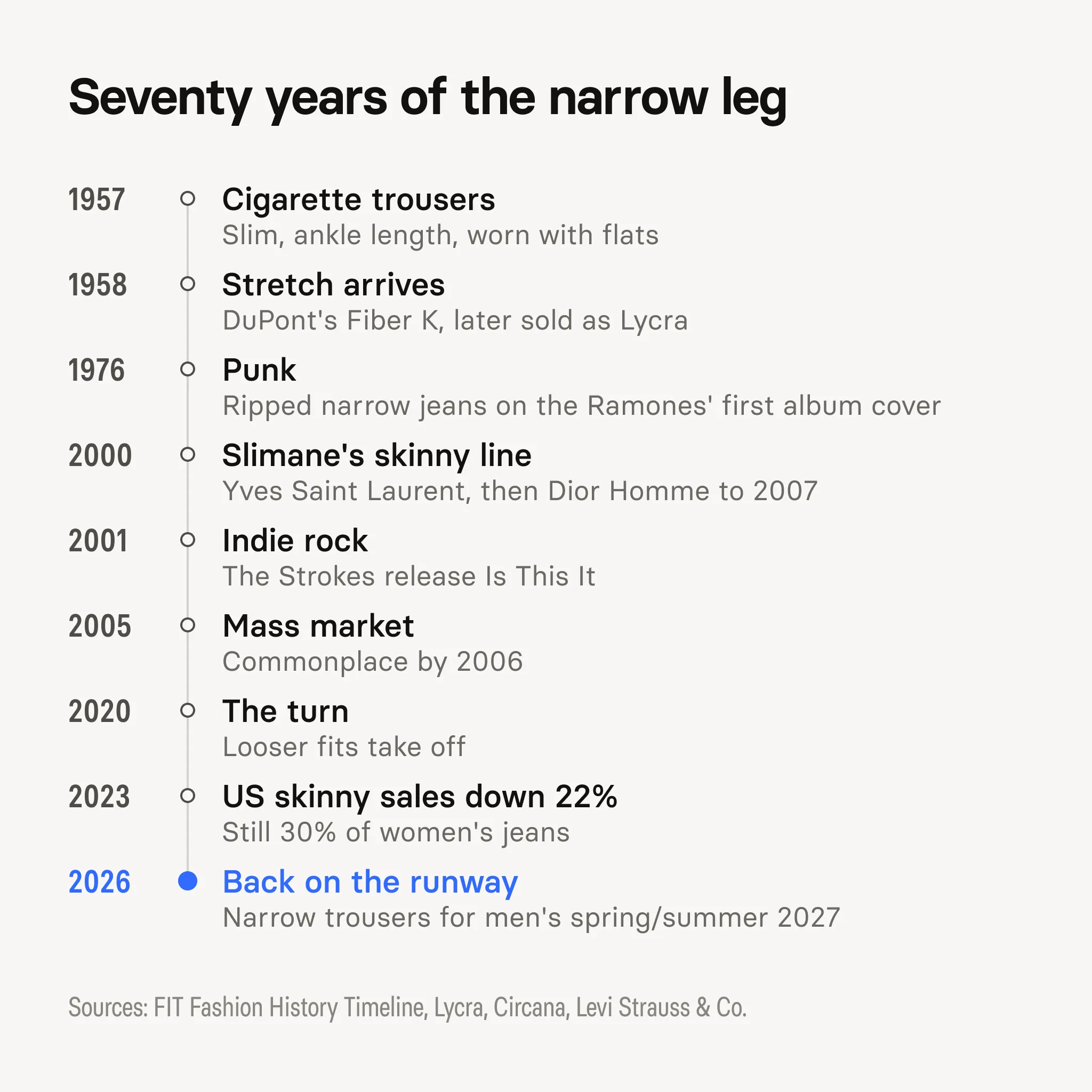
Seventy years of the narrow leg
The skinny jean is a recent name for an old idea: a trouser that follows the leg to the ankle. It has come and gone several times, and each time it arrived with a different crowd.
The 1950s cigarette trouser. Slim, ankle-length trousers with a flat front were a 1950s look for women. Audrey Hepburn wore black trousers with flat shoes in Paris scenes of Funny Face (1957), and cigarette pants and ballet flats became two of her signature pieces. The trouser was narrow, but it was tailored cloth, not denim, and it had no stretch. Its fit came from the pattern.
Stretch, from 1958. The fiber that made the 2010s skinny jean possible was invented in 1958, when DuPont chemist Joseph Shivers developed what the company first called Fiber K, later sold as Lycra. It was first used in intimate apparel in the 1960s. Decades later, a few percent of it woven into denim let a jean cling to the leg and still let its wearer sit down.
Punk, 1976. The Ramones' debut album came out on April 23, 1976, with a cover by Roberta Bayley) of four men against a brick wall in leather jackets and ripped, faded, narrow jeans. It became one of the most imitated album covers in music, and the narrow, worn-out jean became part of the uniform.
Slimane and indie rock, 2000 to 2007. The modern skinny silhouette has a designer's name on it. Hedi Slimane's Black Tie collection for Yves Saint Laurent, autumn/winter 2000-01, introduced his skinny aesthetic, and he carried it into Dior Homme, which he led from 2000 to 2007. At the same moment The Strokes released Is This It (first out on July 30, 2001), an album BBC Radio 1's Zane Lowe credited with shifting taste toward "skinny jeans and guitars." The Fashion History Timeline at FIT describes the look of The Strokes and The Libertines as intertwined with fashion through Slimane at Dior Homme. For men, a jean that narrow had been a subculture's choice. Within a few years it was the default.
The mass market, 2005 to the late 2010s. FIT dates the women's skinny jean as a mainstream product to 2005, "commonplace by 2006." Stretch denim made one cut fit a huge range of bodies, at least on the hanger, and the skinny became the jean of the decade for women and men alike. Chip Bergh, then chief executive of Levi Strauss & Co., put it plainly in 2021: "The last real denim cycle was driven by skinny jeans. And that cycle lasted about 10 years."
The turn. Straight, wide and mom jeans came back in the late 2010s, and the pandemic sped up the move to comfortable clothes. Bergh said Levi's saw sales of looser styles rise after it launched two new fits early in 2020, a flared, wide-bottom pair and a high-rise loose pair. In the same interview he added: "I don't think skinny jeans are ever going to go away completely."
The runway is narrow. The checkout is not, yet.
There are two sets of numbers on skinny jeans in 2026, and they point in different directions.
The runway numbers are steep. Tagwalk, the runway search engine, counted skinny trousers, jeans and fabric trousers together, in the men's spring/summer 2027 collections up 497 percent on the previous season, as Galaxus reported in October 2026. The same piece calls the return "more symbolic than commercial." The shows behind the number: Prada in Milan showed exclusively skinny cropped pants, in leather, sheer nylon and white denim. Dior under Jonathan Anderson styled men in slim, sharp denim, Demna's 2026 pre-collection for Gucci had painted-on, low-slung black trousers and slim denim, and Michael Rider's debut at Celine paired razor-slim trousers with boxy blazers. Rider's first menswear-only show for Celine also had balloon trousers, wide-leg slacks and straight jeans, so even the designers leading the change did not go all the way.
Shoppers moved a little. On Lyst, demand for men's slim and skinny trousers and jeans rose 25 percent month-over-month in June 2026, right after the shows. But Google Trends data compiled by The Data Fashion Brief shows search interest in skinny jeans jumping sharply in spring and falling back to the previous year's level by early October 2026. Over the same year, searches for straight jeans grew 130 percent.
Sales had been going the other way. The most detailed public figures are Circana's, from US retail tracking. In the first nine months of 2023, women's jeans sales fell 3 percent, and $8 of every $10 lost came from skinny jeans, whose sales dropped 22 percent. Skinny still made up 30 percent of women's jeans sales, more than any single looser fit. Bootcut, wide leg and flare together reached 23 percent, 13 points more than in 2019, and 42 percent at designer and contemporary brands.
| Label | Share of US women's jeans sales, in percent |
|---|---|
| Skinny, 2023 | 30% |
| Bootcut, wide, flare, 2019 | 10% |
| Bootcut, wide, flare, 2023 | 23% |
| Same three, designer, 2023 | 42% |
Source: Circana, Maria Rugolo, The future of skinny jeans, October 26, 2023. Data: September 2023. 2023 figures are January to September. The 2019 share is the 2023 share minus the 13 points Circana gives for the change since 2019. Designer means designer and contemporary brands, by sales dollars.
Read together, the numbers say this: in 2023 skinny was shrinking but still the biggest single fit, the looser cuts grew fastest at the expensive end of the market, and in 2026 the expensive end has started to turn back. Mr Porter ran the question as a formal style debate on October 6, 2026: "Celebrate the return of skinny jeans or stick to looser cuts?" Both sides had a case, which is how you know it is a trend and not yet a uniform.
The new skinny is a different cut
The 2026 version is not the 2012 jean taken out of storage. The changes are in the cloth and the leg.
- Less stretch. The 2010s skinny was often more legging than jean. The new one is closer to slim rigid or low-stretch denim, which holds its own shape instead of taking the shape of the leg. Denimology sums up the new version as "not ultra-tight, legging-like."
- A hybrid leg. The narrow jean now often borrows from the straight jean or the cigarette trouser. Grazia describes a leg that widens "ever so slightly past the knees" toward a straight or flared look. The thigh is close, the knee is a touch looser, and the hem is narrow without gripping the ankle.
- A shorter length. Prada's trousers were cropped. An ankle-length leg that ends above the shoe reads deliberate, and a long leg that stacks in folds above the shoe reads like 2012.
- A higher or more varied rise. The low-rise skinny of the mid-2000s is one option among several. Mid and high rises are common again, and the rise matters as much as the leg (more on that below).
- Volume on top. Celine's razor-slim trousers came with boxy blazers. The narrow leg is now half of an outfit whose other half has room in it.
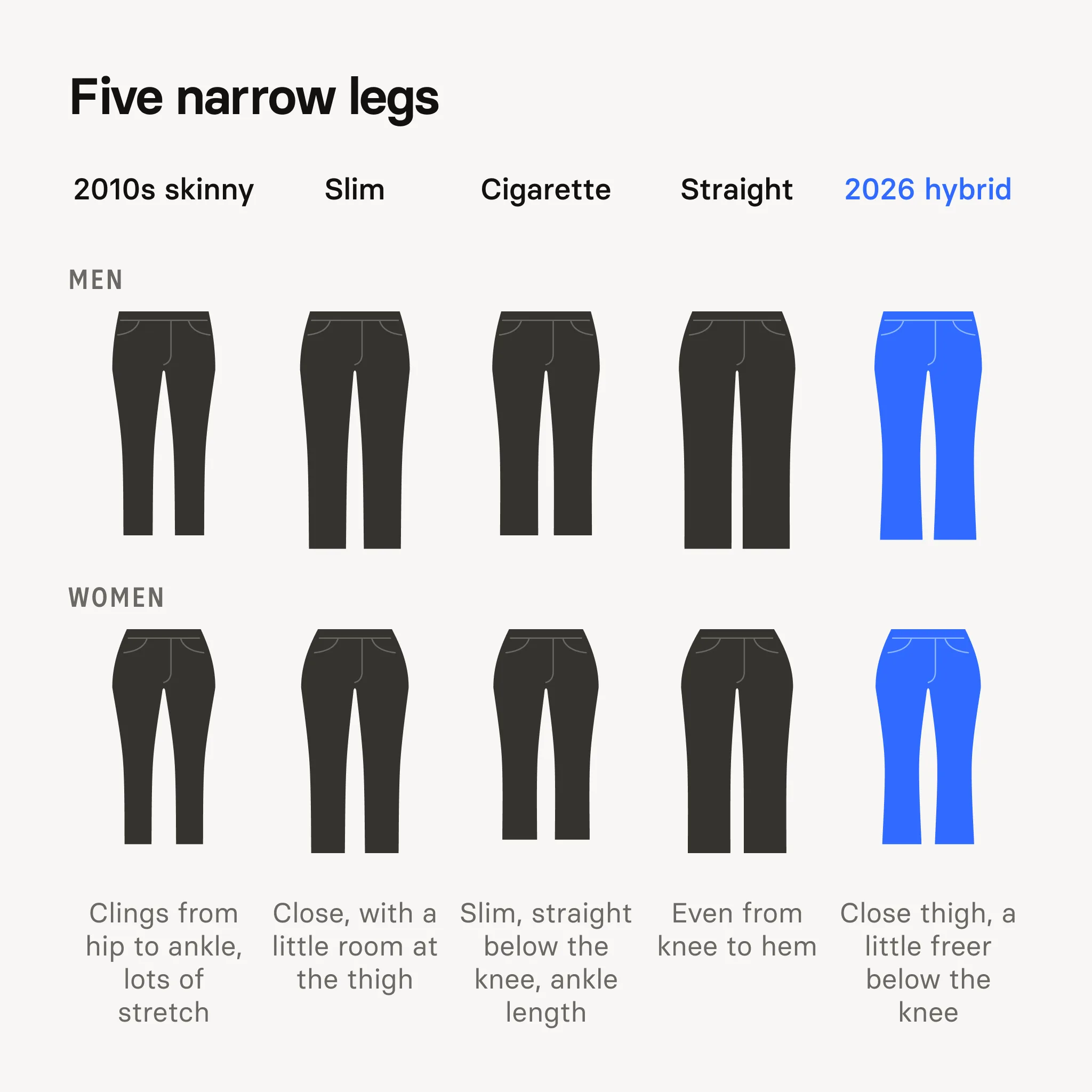
Four narrow cuts get confused, and they are worth naming. A skinny is close from the hip to the ankle, with the narrowest hem. A slim has a little more room through the thigh and a hem a bit wider. A cigarette is slim and straight below the knee and ends at the ankle, the 1950s shape. A straight drops from the thigh to the hem with almost no taper. Every jeans cut, explained puts these four next to the rest, from bootcut to barrel, with the measurements that define each one.
What a narrow leg does to proportions
Every cut moves visual weight around the body. A narrow leg moves it up.
When the leg narrows to the ankle, the outline of the lower half shrinks, and the eye goes to whatever has width: shoulders, chest, hips, the top. A skinny jean does not add or remove anything from a body. It decides where the outfit's width comes from, and it hands that job to the top half and the shoe.
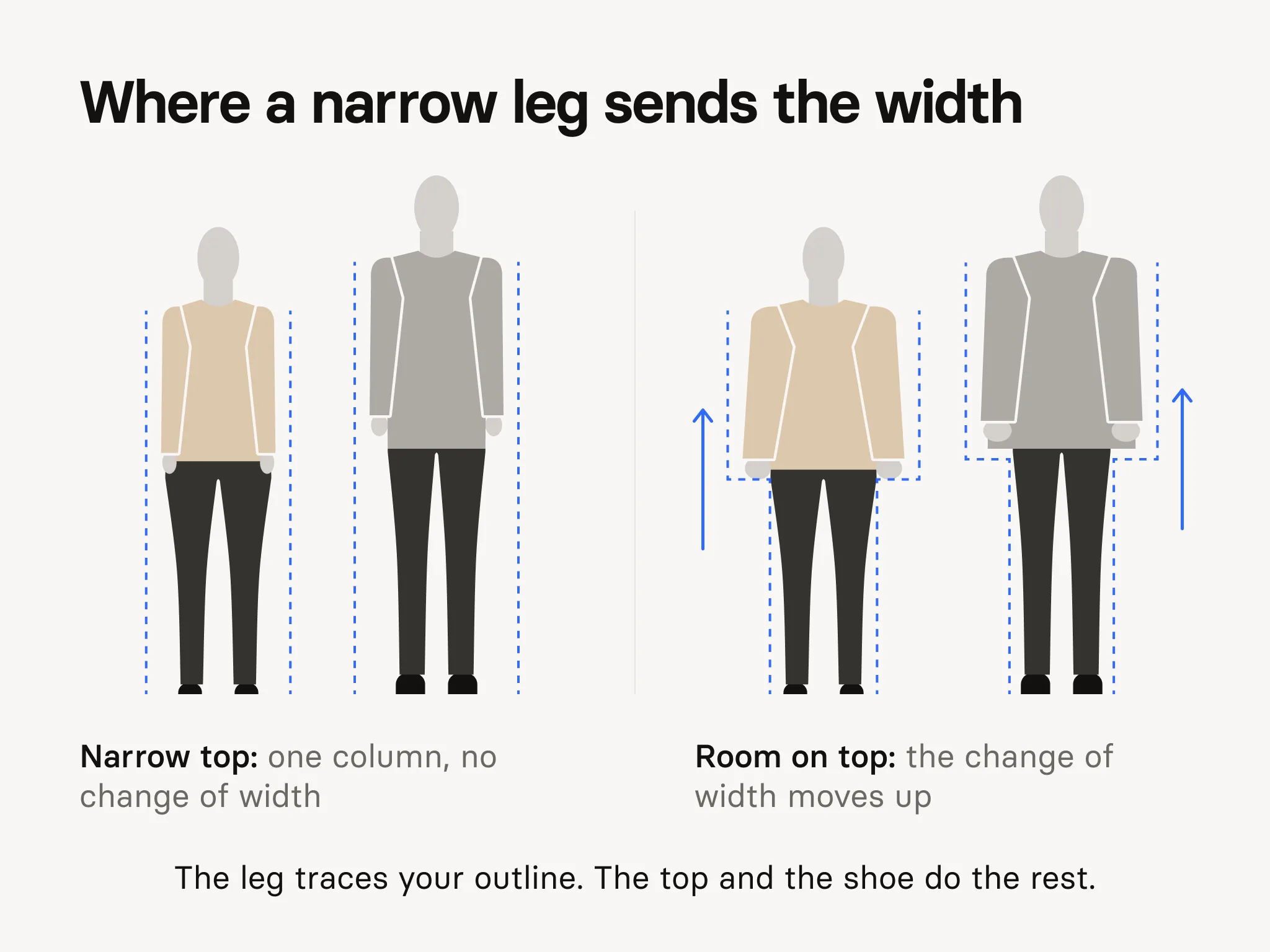
That has three consequences you can test in a mirror:
- The widest point of your lower half becomes the widest point of the leg. A close cut traces the hip and the thigh exactly. On a frame whose width sits at the hip, the leg then narrows from that point to the ankle, which makes the narrowing the main event.
- The top has to supply the change in width. If the leg holds one narrow line, the outfit needs its contrast elsewhere: a jacket with structure, a knit with volume, a coat with length. A narrow leg under a narrow top is a single column.
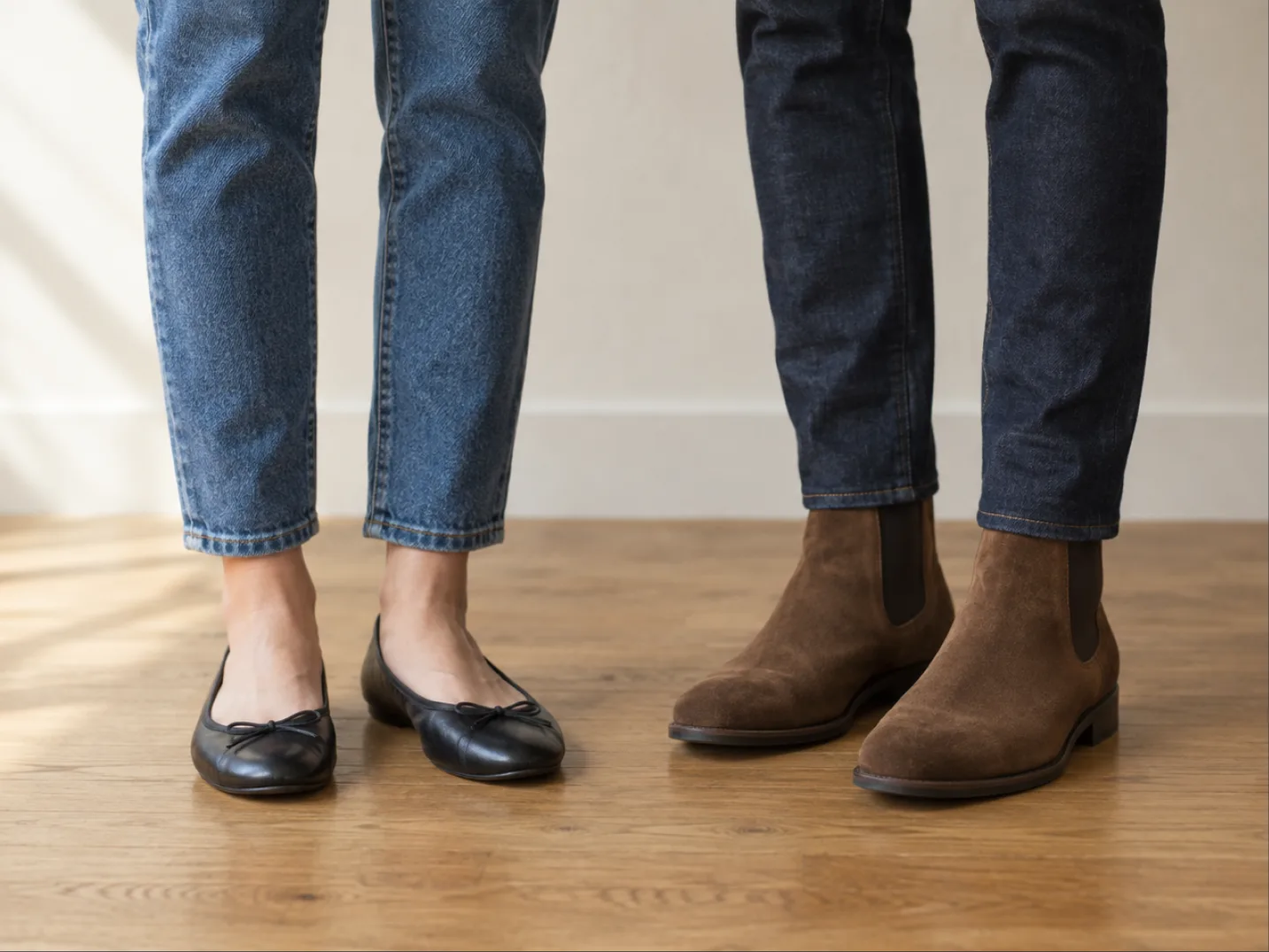
- The shoe ends the line. A narrow hem exposes the shoe completely. A heavy boot makes a clear full stop. A slim flat continues the line of the leg. A chunky sneaker under a skinny ankle reads as a separate object.
None of this makes a skinny jean right or wrong on a body. It makes it a decision about where the width goes, and some frames make that decision easier than others.
Where the skinny leg lands, shape by shape
On Wearly Labs, every cut gets a verdict per body shape, with the reason. The skinny leg is on the list of cuts that fight the frame on eight of the ten shape pages, three for women and five for men. On the hourglass and apple pages it appears on neither list. These are each shape's opening positions, in the words of the shape pages:
| Shape | Skinny | Reason on the page | Leg on the Wear list instead |
|---|---|---|---|
| Pear | Skip | "Cut skin-tight from waist to ankle, so your thigh sets the size and the waistband gapes above it." | Light flare, high-rise wide |
| Rectangle | Skip | "Holds one narrow width from hip to ankle, so the outfit gets no change of width from the leg and has to find all of it above." | Light flare, high-rise straight |
| Inverted triangle, women | Skip | "Narrows the leg under a wide top, so the gap between the two ends of the outline grows instead of closing." | High-rise wide, light flare |
| Triangle, men | Skip | "Cut close from the hip down, so the cloth wraps the seat and the leg narrows from your widest point instead of falling past it." | Tapered denim |
| Trapezoid, men | Skip | "Cut close from seat to ankle, it grips the thigh and narrows hard toward the hem, an abrupt change on a frame whose whole property is a gradual one." | Straight denim |
| Inverted triangle, men | Skip | "Grips the leg under a broad chest, so the V of your torso carries on down to a point at the ankle." | Straight denim, wide-leg |
| Oval, men | Skip | "The waistband has to close under the fullest part of the middle, and the narrow leg gives it nothing to brace against, so the whole trouser walks downward through the day." | Straight denim |
The men's rectangle page makes the same point as the women's: one narrow width from hip to ankle gives a frame without a taper no change of width anywhere. The pattern across the table is consistent. A skinny leg asks the body to be the shape of the outfit, and the jeans that replace it all have room somewhere: through the seat, at the hem, or in a straight line down from the thigh.
A shape is only half of a verdict. Your line, how your body wants cloth to behave, decides the other half. A sharp line carries crisp, structured cloth, and a rigid slim jean can look clean on it. A soft line asks for drape and give, and a close jean in stiff denim stands away from the body instead of following it. A medium line sits between the two and does best in cloth that is neither rigid nor clinging. Body details count too. On the pear page, the answer to whether you have to give up skinny jeans is yes as far as the shape goes, because a leg with no ease over the seat and thigh relies on stretch, and stretch doing that work bags at the knee and seat by the afternoon.
How to wear skinny jeans in autumn 2026
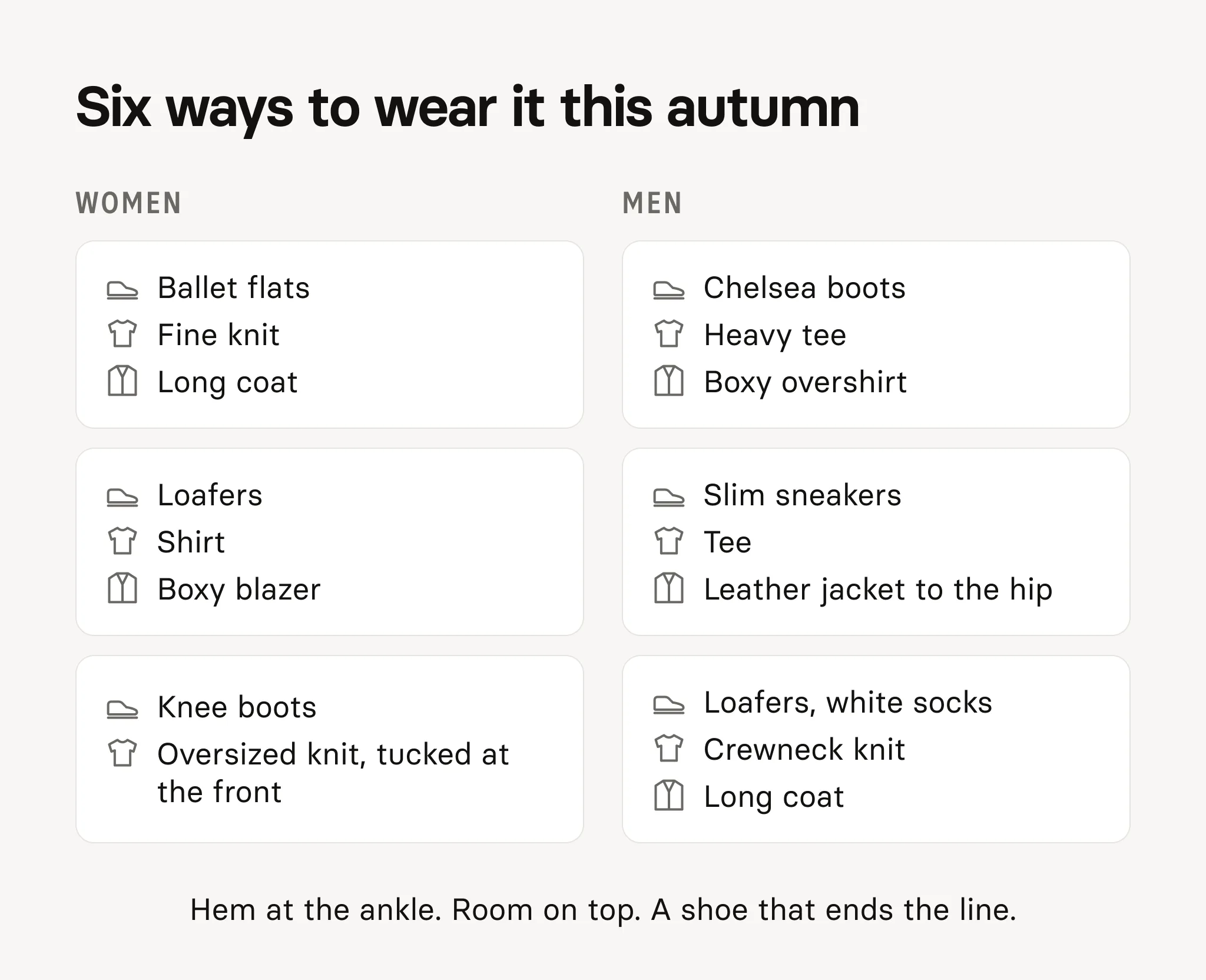
If the cut works on your frame, or you want to wear it anyway, the 2026 version looks right when it is styled in contrast: narrow below, room above, and a shoe that finishes the line.
For women
- Ballet flats and a long coat. The pairing of the season: Who What Wear expects skinny jeans with ballet flats to be one of autumn's most-worn combinations. Keep the jean at ankle length so the flat shows. A coat to the knee or below gives the outfit its length.
- An oversized knit, tucked at the front. The volume sits on top, the tuck marks where the top ends, and the leg stays clean.
- A boxy blazer and a loafer. The Celine proportion: a jacket with a square shoulder over a narrow leg. Works for an office that allows denim.
- A knee-high boot over the jean. The narrow leg disappears into the boot, which turns the outfit into a long column of one color below the knee.
For men
- A boxy overshirt and a Chelsea boot. Width at the shoulder, a narrow leg, and a boot that closes the hem. A medium-wash jean keeps it casual.
- A heavy tee, a leather jacket and a plain sneaker. The 2001 outfit, updated: the jacket should end at the hip, and the sneaker should be slim, not a chunky runner.
- A loafer, white socks and a crewneck knit. A cropped leg shows the sock, so the sock becomes part of the outfit instead of an accident.
- A long coat in a dark color. A knee-length overcoat over a narrow jean gives the vertical line most outfits lack. It is the most forgiving way to wear the cut.
For both, the same three rules hold. Let the hem end at or just above the ankle bone. Give the top half room. Pick a shoe whose shape continues or clearly ends the leg. The rule of thirds behind every good outfit explains why the tuck and the jacket length matter as much as the jean.
Mistakes that make it look like 2012
- Too much stretch. A jean that is mostly elastane wrinkles across the thigh and bags at the knee by the end of the day. Look for denim that holds its own shape. Why the best jeans come from a small corner of Japan explains rigid, raw and sanforized denim.
- Stacking at the ankle. A narrow leg that is too long folds into rings above the shoe. Have it shortened to the ankle, a routine job for any tailor. The tailor is the cheapest upgrade explains what else is worth fixing.
- A narrow top over a narrow leg. A fitted tee tucked into a skinny jean, with a slim shoe, has no change of width anywhere. One piece needs room.
- The wrong rise. A low rise on a long torso shortens the leg, and a high rise on a short torso crowds the chest. Rise is set by your proportions, not by the trend.
- A chunky sneaker. A bulky sole under a narrow ankle splits the outfit in two. A slim sneaker, a boot or a flat keeps the line together.
- Distressing everywhere. Rips at the knee and fading at the thigh point at the exact places the jean is tightest.

Your frame decides, not the season
The skinny jean has now been in fashion, out of it, and back, and it will go around again. What will not change in that time are the three things that decide whether it works on you: your proportions, your line and your colors.
Your proportions say how much room a jean needs and where. Your line says whether it should be crisp, between, or soft. Your colors say which blue belongs near your face and which below the waist. Denim is not one color: the analysis judges light denim and medium denim as two of its 50 colors, and no season gets a Skip on either. Medium denim is a Wear anywhere for Bright Spring, True Summer, Soft Summer, Soft Autumn and True Autumn. Light denim is a Wear anywhere for Light Spring and Light Summer, and below the waist for most other seasons. For a skinny jean, the shade matters less than for a denim jacket, since it sits below the waist, but it still sets the contrast with everything above it.
A body type analysis gives you your shape and line, and a color analysis your palette. Wearly Labs does both in one analysis, with a verdict and its reason for every cut and color, so the next trend arrives as a question with an answer instead of a guess. Trends are temporary, your colors aren't has the two-question filter for every other trend that comes after this one.
Style: common questions
On the runway, yes: Prada, Dior, Saint Laurent and Celine showed narrow trousers for men's spring/summer 2027, and Tagwalk counted 497 percent more skinny trousers than the season before. In shops the return is slower, and Google searches for skinny jeans fell back to the previous year's level by October 2026. The cut is available and current again without being the default it was in the 2010s.
The new version has less stretch, so the denim holds its own shape instead of clinging like a legging. The leg is often a hybrid, close at the thigh and slightly freer below the knee, closer to a slim or cigarette cut, and it usually ends at the ankle. It is styled with volume on top, such as a boxy blazer or an oversized knit.
It depends on where your frame carries its width and how your body wants cloth to behave, not on size. On Wearly Labs' shape pages, the skinny leg is a Skip for the women's pear, rectangle and inverted triangle and for all five men's shapes, because a narrow leg makes the body's own outline the shape of the outfit. A rigid slim jean suits a sharp line better than a soft one, which asks for drape.
Ballet flats, loafers and Chelsea boots, because they either continue the narrow line of the leg or close it cleanly. Keep the hem at the ankle so the shoe shows. A chunky sneaker under a narrow ankle splits the outfit in two.
Straight, wide and mom jeans returned in the late 2010s, and the pandemic sped up the move to looser, more comfortable clothes. By 2023 US skinny sales were down 22 percent in a year, according to Circana, though skinny was still 30 percent of women's jeans sales. Levi's former chief executive Chip Bergh described the skinny cycle as lasting about ten years.
The narrow trouser goes back to 1950s cigarette pants and 1970s punk, but the modern skinny silhouette is usually traced to Hedi Slimane, whose collections for Yves Saint Laurent in 2000 and Dior Homme from 2000 to 2007 made it the menswear shape of the decade. Bands such as The Strokes and The Libertines spread it at the same time, and stretch denim took it to the mass market from around 2005.