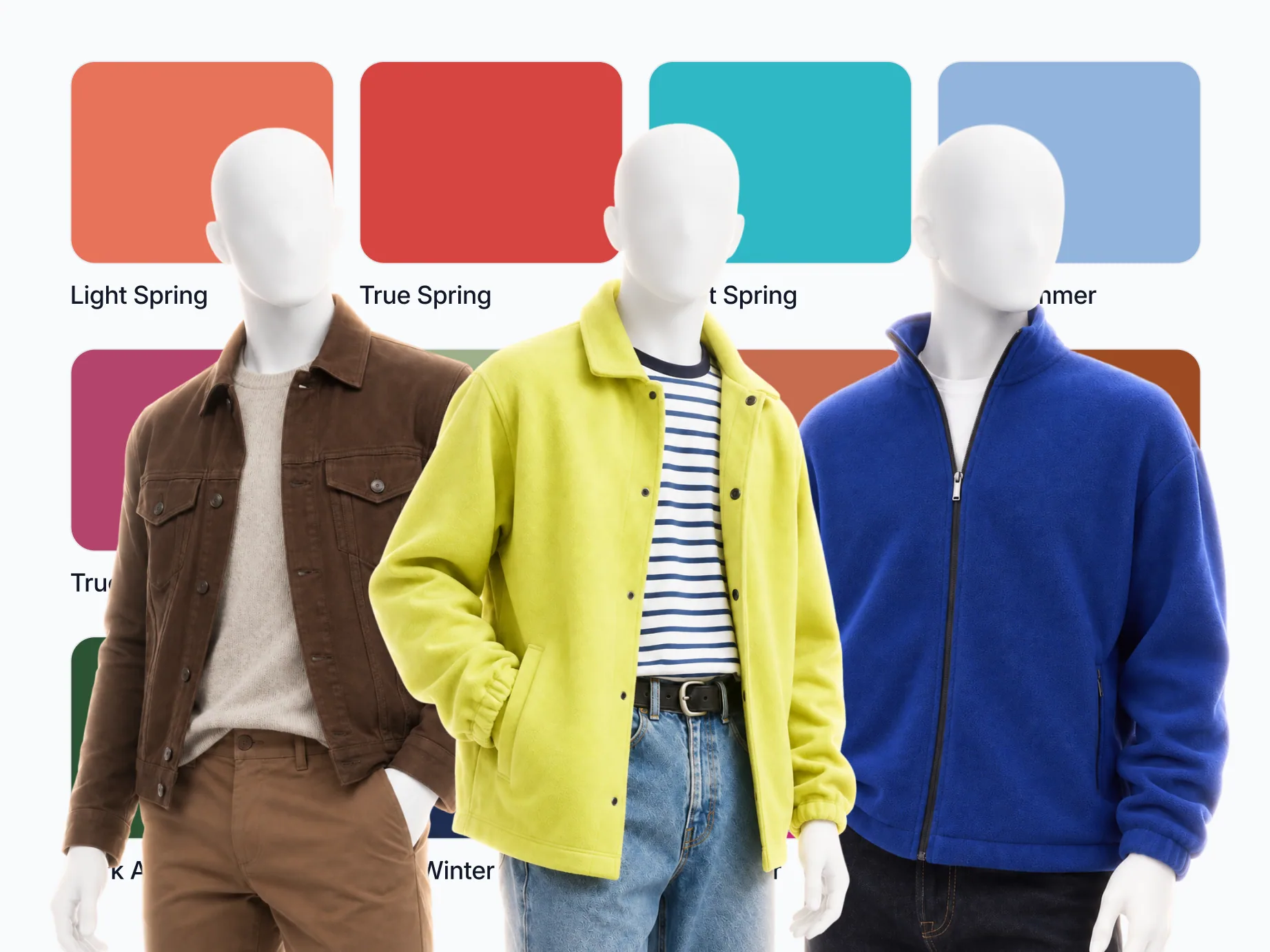
The best shirt colors for your skin tone follow your undertone first: warm skin takes ivory, camel and warm colors such as coral, rust or olive, and cool skin takes soft or pure white and cool blues, pinks and greens. Then how light or deep, how clear or muted and how contrasted your coloring is decides which of those colors are yours and how dark the shirt can go.
On this page
- Which shirt color suits my skin tone?
- Should my white shirt be ivory, soft white, or pure white?
- Blue, and how far down the scale to go
- Which white and which blue does each season wear?
- Why does the same shirt look different on me and on my friend?
- Which pink, red, green or purple shirt suits which season?
- The three shirts that cover most of your week
- Men's style: common questions
- Related reading
A white shirt is usually bought by default, not chosen on purpose, and white is not one color. The system has three whites, and the wrong one drains your face in every photo you appear in. So this article goes in order: white first, then blue, then everything else.
Which shirt color suits my skin tone?
Four readings decide it, and each one maps to something you can check at a window or in a fitting room.
Your undertone, warm or cool, picks your white and sets the temperature of every other color you buy. Your value, meaning how light or deep your natural coloring is, sets how dark the shirt can go before it starts wearing you. Your chroma, meaning how clear or muted your coloring is, decides whether the shirt should be clean and saturated or soft and dusty. Your contrast, the gap between your hair and your skin, decides how far the shirt is allowed to sit from your face.
Stacked, the four readings place you in one of the twelve seasons of seasonal color analysis, and the rest of this article names every shirt color by the seasons that wear it at the collar.
Practical order: fix your white, fix one blue, then add one color. Three well chosen shirts cover more of your week than a rack of near misses. If you have never checked your undertone, find it at home first, because it is the reading men get wrong most often.
Should my white shirt be ivory, soft white, or pure white?
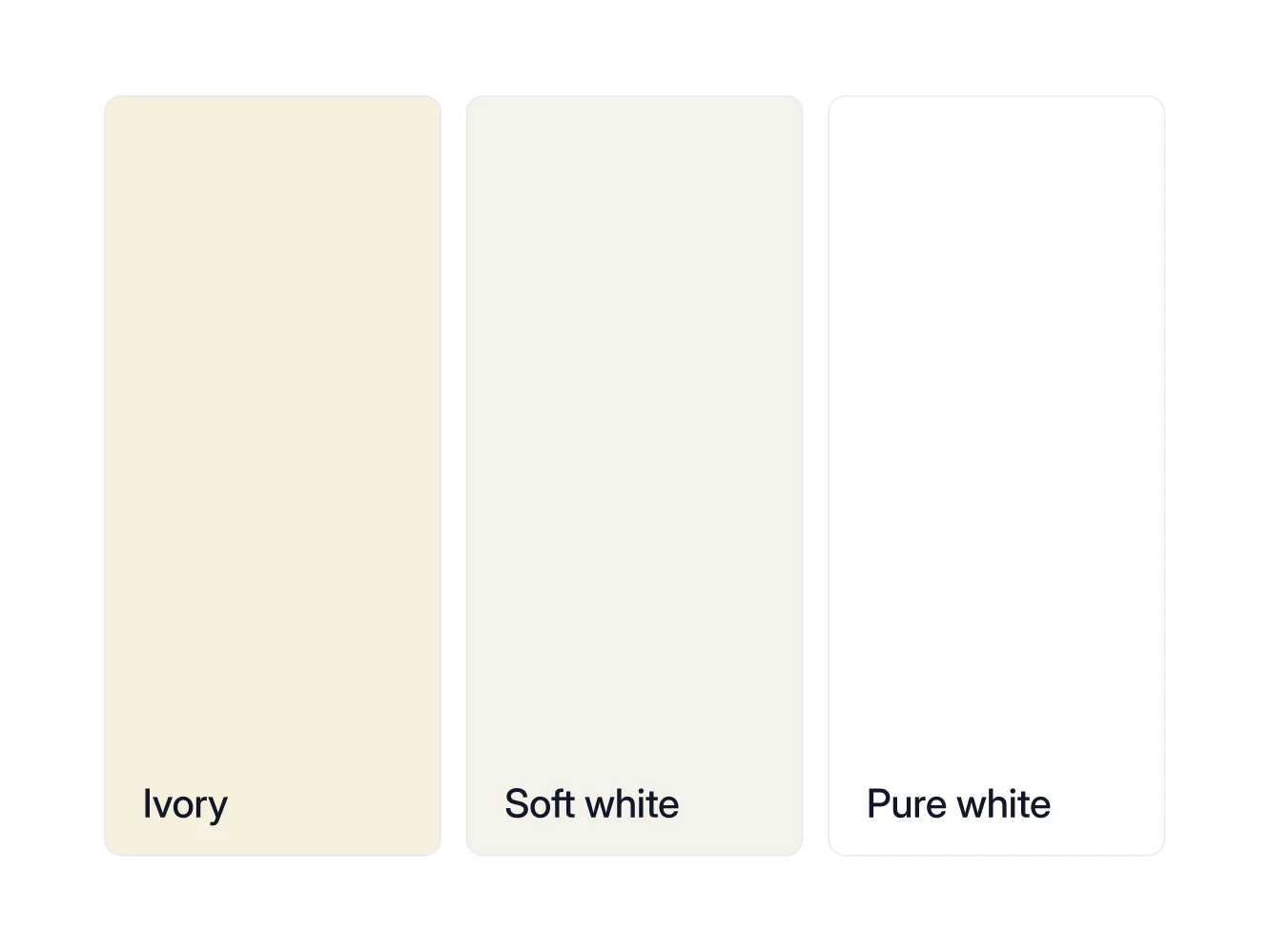
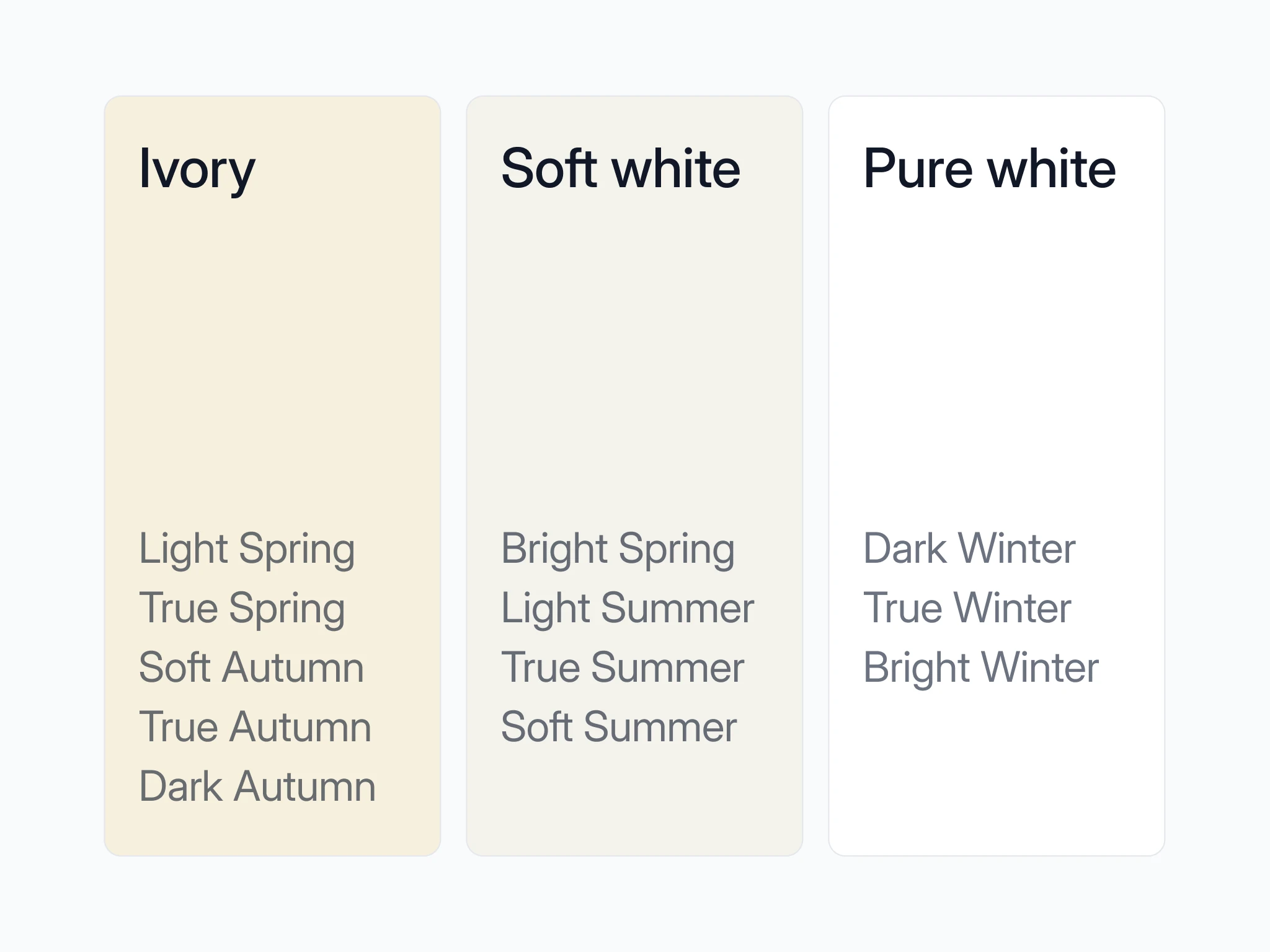
There are three whites in the system and each one belongs to a specific group of seasons. Some guides call two of them Dark Autumn and Dark Winter; here they are Deep Autumn and Deep Winter.
Ivory belongs to Light Spring, True Spring, Soft Autumn, True Autumn, and Deep Autumn. Warm coloring next to optic white looks bleached, and the shirt wins. Ivory gives your face somewhere to sit.
Soft white belongs to Bright Spring, Light Summer, True Summer, and Soft Summer, and Light Spring can wear it as well as ivory. It is white without the glare. On low-contrast coloring in particular, a hard white manufactures a contrast you do not have, and your features go quiet behind it.
Pure white belongs to True Winter, Bright Winter, and Deep Winter. This is the crisp optic white that every shirt maker sells to every man, and it is genuinely correct for three seasons out of twelve.
Test it like this. Hold the shirt under your chin in daylight, then look at your under-eyes and your jawline instead of at the shirt. The wrong white shows up there first, as shadow or as a gray cast. The right one makes your face look like it has had more sleep than it has.
Blue, and how far down the scale to go
Blue is the second shirt, and it is the one men over-buy at the wrong depth. Here is the whole ladder, palest first, with the seasons that wear each blue at the collar.
| Blue | Worn at the collar by | What it is |
|---|---|---|
| Ice blue | Light Summer, True Winter, Bright Winter | Very pale and cool |
| Light denim | Light Spring, Light Summer | The lightest everyday blue |
| Periwinkle (light forget-me-not) | Light Spring, the three Summers | Soft blue leaning violet |
| Dusty blue | The three Summers | The soft mid blue |
| Medium denim | Bright Spring, True Summer, Soft Summer, Soft Autumn, True Autumn | The everyday blue shirt |
| Soft navy | Light Spring, Bright Spring, the three Summers | Navy softer than midnight blue |
| Royal blue | True Summer, the three Winters | Saturated, takes over low contrast |
| Midnight blue | Deep Autumn, the three Winters | The deepest blue |
| Turquoise | The three Springs, Bright Winter | Blue with warmth in it |
| Warm aquamarine | The three Springs | The warmest blue here |
The springs' own blues are the warm ones. Turquoise and warm aquamarine are core colors for all three, and for True Spring they are the only blues that reach the collar at all.
Now the part that trips autumn men: their blues are few. Soft Autumn and True Autumn wear medium denim at the collar and no paler blue, and Deep Autumn's one blue shirt is midnight blue. Ice blue, light denim and royal blue never reach the collar of any autumn, so an autumn man's second shirt is often camel or olive rather than another pale blue oxford.
The sample analysis, the real result of co-founder Filip Poláček, shows how this reads for one Deep Autumn. Every one of his 50 colors gets a verdict, Wear, Depends or Skip, with a reason, and Depends means below the waist or as an accent only. Ivory is a Wear and his white: "it carries enough warmth to sit at the collar, while pure white and soft white are lighter loads better kept to trousers and shoes." Midnight blue is a Wear because "its weight and quiet tone match the depth you carry", and one of his six outfits is a midnight blue shirt with charcoal trousers. Medium denim is a Depends, "a faded cool blue that reads too light beside your depth", and royal blue is a Skip: "It cools your skin down."
Which white and which blue does each season wear?
Find your season and read across. A color listed here is a Wear at the collar in a Wearly Labs analysis, so anything not listed is a Depends or a Skip for a shirt. Each season name links to its full palette. If you do not know your season yet, the three whites test in the twelve color seasons for men narrows it down.
| Season | White shirt | Blue shirts |
|---|---|---|
| Light Spring | ivory or soft white | light denim, periwinkle, soft navy, turquoise, warm aquamarine |
| True Spring | ivory | turquoise, warm aquamarine |
| Bright Spring | soft white | medium denim, soft navy, turquoise, warm aquamarine |
| Light Summer | soft white | ice blue, light denim, periwinkle, dusty blue, soft navy |
| True Summer | soft white | periwinkle, dusty blue, medium denim, soft navy, royal blue |
| Soft Summer | soft white | periwinkle, dusty blue, medium denim, soft navy |
| Soft Autumn | ivory | medium denim |
| True Autumn | ivory | medium denim |
| Deep Autumn | ivory | midnight blue |
| Deep Winter | pure white | royal blue, midnight blue |
| True Winter | pure white | ice blue, royal blue, midnight blue |
| Bright Winter | pure white | ice blue, royal blue, midnight blue, turquoise |
Why does the same shirt look different on me and on my friend?
Because a shirt is judged against the face above it, not on the hanger.
Two men buy the same mid blue oxford. One has low contrast, so the shirt sits close to his own coloring and the outfit reads as one calm piece. The other has high contrast between dark hair and light skin, so the same shirt lands as a flat middle note between them, and he looks slightly unfinished without being able to say why. He returns it and buys a size down, because fit is the only variable he has a word for.
Same shirt, different job. Contrast is the axis most men have never heard of, and it is the one doing this.
Menswear writing has used it for a while. Alan Flusser's Dressing the Man (2002) sorts men by the contrast between their hair and skin and, as The Rake sums it up, advises echoing that contrast in the clothes that frame the face: a white or very light shirt under a dark suit for a high-contrast man, a chambray shirt with a navy blazer for medium contrast, and a finely patterned gingham or houndstooth shirt for low contrast.
Which pink, red, green or purple shirt suits which season?
Once white and blue are handled, everything else is a color decision rather than a uniform decision, and you take it from your own palette. A pink shirt is not a risk when it is your pink, and green is the most underused shirt color in menswear: every one of the twelve palettes has a green it wears at the collar.
| Shirt color | Worn at the collar by |
|---|---|
| Warm pink | Light Spring, Bright Spring |
| Soft pink | Light Summer, True Summer |
| Dusty pink | The three Summers |
| Raspberry, fuchsia | True Summer, the three Winters |
| Coral | The three Springs |
| Peach | Light Spring, Bright Spring, Soft Autumn |
| Tomato red, orange, golden yellow | True Spring, Bright Spring, True Autumn |
| Sharp red (the cool red) | True Summer, the three Winters |
| Lemon | Bright Winter |
| Mint | Light Summer, Soft Summer |
| Sage | Soft Summer, Soft Autumn |
| Leaf green | The three Springs, Soft Autumn |
| Emerald | Bright Spring, True Summer, the three Winters |
| Olive | The three Autumns |
| Forest green | True Autumn, Deep Autumn, Deep Winter |
| Khaki | True Spring, Soft Autumn, True Autumn |
| Terracotta | True Spring, Soft Autumn, True Autumn, Deep Autumn |
| Rust | The three Autumns, muted on Soft Autumn |
| Mustard | The three Autumns |
| Chocolate | True Spring, Soft Autumn, True Autumn, Deep Autumn |
| Espresso | Bright Spring, True Autumn, Deep Autumn |
| Wine (burgundy) | Deep Autumn on its warm edge, Deep Winter |
| Lavender | The three Summers |
| Mauve | True Summer, Soft Summer |
| Deep purple | True Summer, the three Winters |
| Plum | Deep Winter |
The three shirts that cover most of your week
One white, in your version of white. One blue, at your depth, which for an autumn means medium denim, or midnight blue on Deep Autumn. One color from your core palette that goes near your face when the day matters. That is coverage. Everything after it is variation.
Fabric changes the reading, so use it. A colored oxford is woven with white yarn running one way, which is where its flecked, checkered look comes from (Figaret's guide to weaves), so the same dye reads a step softer than on a solid poplin. Chambray works the same way, an indigo warp over a white or ecru weft, and a brushed flannel softens the surface further. That helps if your season is on the muted side. A smooth poplin keeps the color clean, which helps if your season is a bright one. Same color, two different chroma readings, and it costs you nothing to pick the right weave. Your full palette and the rest of the grid are laid out in the twelve color seasons for men.
Men's style: common questions
No. Skin tone usually means depth, from fair to dark, and undertone is the warm or cool cast underneath it. Both count, and depth alone does not pick a shirt: two men with equally deep coloring can be a Deep Autumn, whose shirts are ivory, rust and midnight blue, or a Deep Winter, whose shirts are pure white, royal blue and emerald.
No. A pale blue (ice blue, light denim, periwinkle or dusty blue) is a Wear at the collar for six of the twelve seasons: Light Spring, the three Summers, True Winter and Bright Winter. For True Spring, Bright Spring, the three Autumns and Deep Winter, the pale blues go below the waist, into an accent, or nowhere. Each of those six has a blue of its own in the table above.
Only for the three Winters. Black is a Wear for True Winter, Bright Winter and Deep Winter, the collar included. The other nine seasons get it as a Depends, which means trousers and shoes rather than a shirt.
Yes, and it matters more. A tee sits closer to your face than a collared shirt and there is no jacket between it and your jaw. Buy your white, not the default white.
Judge the ground color first, then the gap between the two colors. A wide gap adds contrast to the outfit. If your own contrast is low, keep the gap narrow and the pattern small.
No. It means the two colors you are allowed get chosen properly instead of by accident. Which white and which blue is the entire decision, and it is the one this article answers.
Your face. The suit sits further away and has more room to be a neutral. The shirt is the piece touching your jaw, so it gets judged against your skin first.