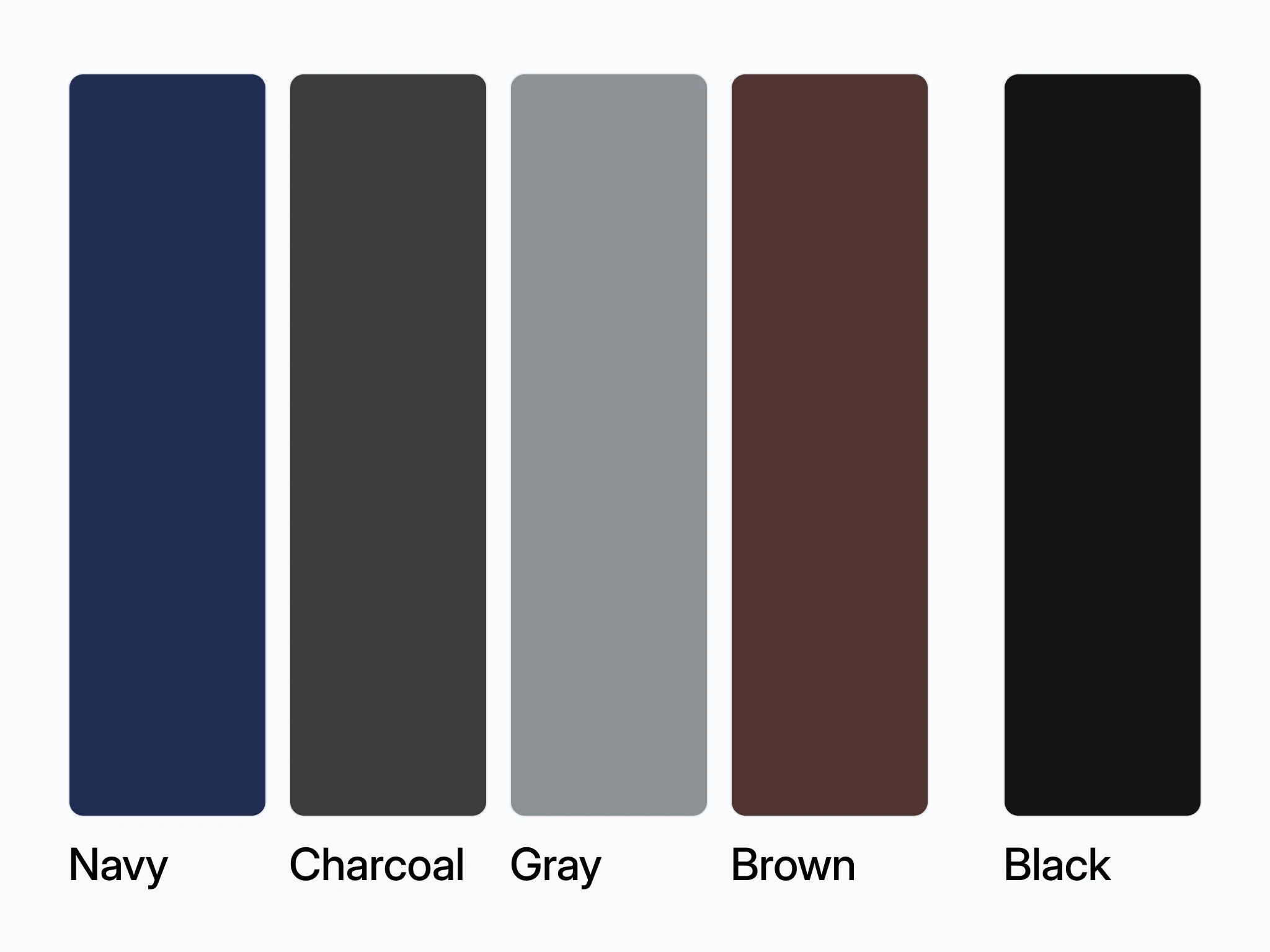
The suit color that suits you is a neutral at your own depth and in your own undertone, not the darkest one on the rack. Cool, high-contrast coloring carries midnight blue, charcoal and black; warm and deep coloring carries espresso, chocolate and olive; and lighter or softer coloring looks better in soft navy, gray, camel or warm greige than in any of the classic dark suits.
On this page
- What suit color actually suits me?
- Suit colors for all 12 color seasons
- Navy: the question is which navy
- Is charcoal better than black?
- Gray, and the depth most men skip
- Which seasons should wear a brown suit?
- Should I own a black suit?
- Does the shirt change which suit works?
- Men's style: common questions
- Related reading
A suit is the largest single block of color a man wears. It sits directly under his face all day and there is no styling your way around it. Which is why the standard advice, navy first and charcoal second, is only half right for most men: of the twelve color seasons, it fits three all the way, and three get neither half. Here is what each suit color does, and who it does it for.
What suit color actually suits me?
Three readings, in this order.
Depth decides how dark the suit should be. It is how light or deep your skin, hair and eyes are overall, and since most suit advice starts at the dark end, it is the reading men get wrong, almost always by going darker than their own coloring. Undertone, whether your skin leans golden or rosy, decides whether your dark neutral is a blue-black one or a brown one. Contrast, the gap between your hair, your skin and your eyes, decides how far your shirt should sit from your suit.
A fourth reading, chroma, meaning how clear or muted your coloring is, changes the cloth more than the color. Muted coloring is easier in a matte cloth such as flannel than in anything with a sheen, and clear coloring can take a crisp, smooth worsted.
The shop test takes a minute. Shop lighting shifts color, so take the jacket to a window and put it on over a shirt in your own white. Then look in a mirror from three steps back. If your face is the first thing you see, the depth is right. If you see the lapels first, the suit is darker than you are. If you have never checked your undertone, do that at home first.
Suit colors for all 12 color seasons
A Wearly Labs analysis gives each of its 50 colors a verdict, Wear, Depends or Skip, with a reason, and Depends means below the waist or as an accent only. A suit is one color from collar to hem, so only a Wear works as a whole suit. A Depends color can still be your odd trousers.
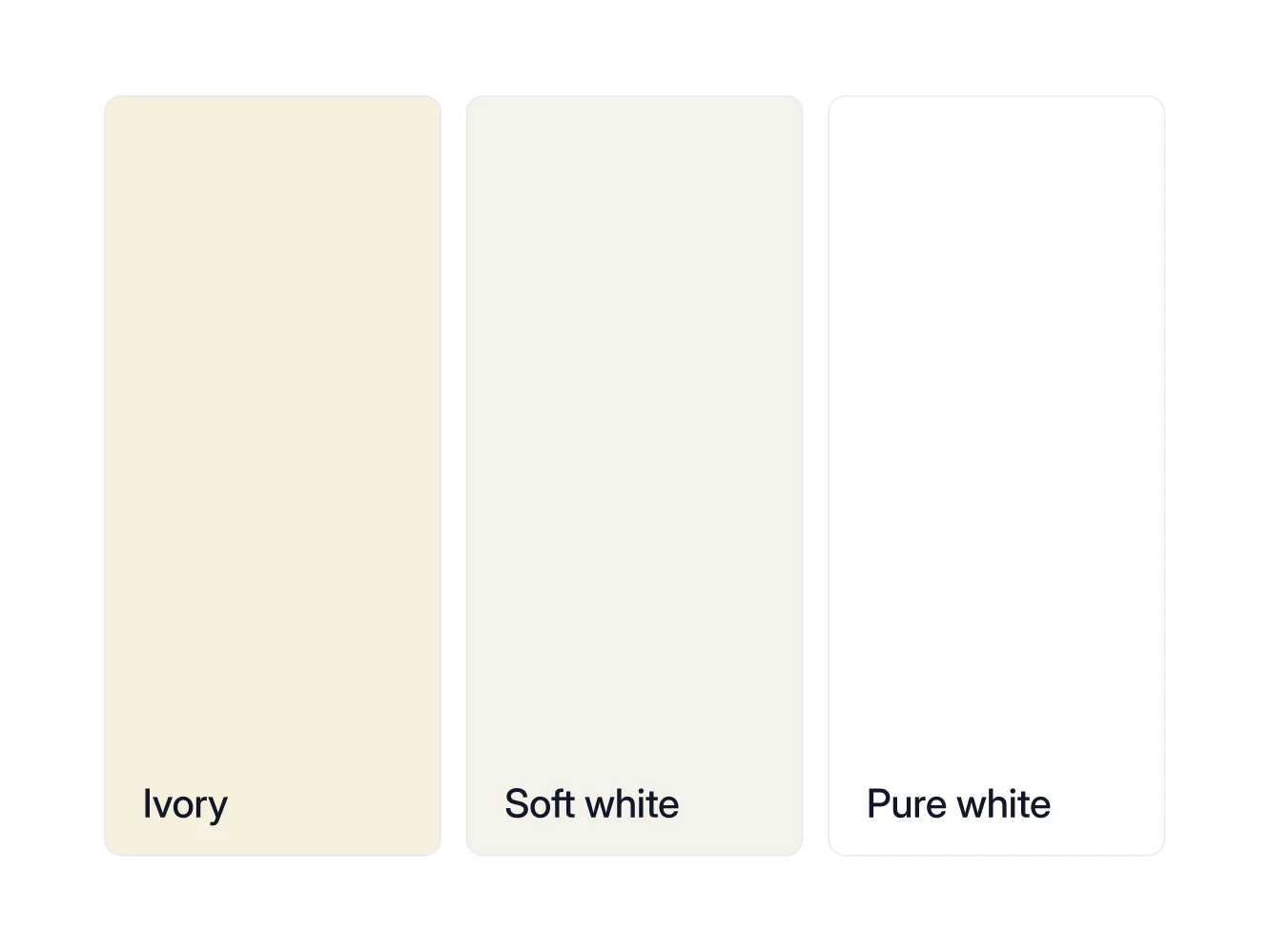
Some guides call two of the twelve seasons Dark Autumn and Dark Winter; here they are Deep Autumn and Deep Winter. Here is each season's Wear list, limited to the colors suits usually come in, with the white shirt that goes under it.
| Season | Suit colors that are a Wear | Your white shirt |
|---|---|---|
| Light Spring | Soft navy, camel, latte, warm greige | Ivory or soft white |
| True Spring | Camel, khaki, latte, chocolate | Ivory |
| Bright Spring | Soft navy, camel, espresso | Soft white |
| Light Summer | Soft navy, light gray, warm greige | Soft white |
| True Summer | Soft navy, mid gray, light gray, warm greige | Soft white |
| Soft Summer | Soft navy, mid gray, light gray, warm greige | Soft white |
| Soft Autumn | Camel, khaki, olive, chocolate, warm greige, latte | Ivory |
| True Autumn | Chocolate, espresso, olive, camel, khaki, warm greige | Ivory |
| Deep Autumn | Midnight blue, espresso, chocolate, olive, camel | Ivory |
| Deep Winter | Midnight blue, charcoal, mid gray, black | Pure white |
| True Winter | Midnight blue, charcoal, mid gray, black | Pure white |
| Bright Winter | Midnight blue, charcoal, black | Pure white |
Read down the table and the standard advice comes apart. Navy, in one of its two versions, is a Wear for nine of the twelve seasons. Charcoal and black are a Wear for three, and it is the same three.
Navy: the question is which navy
Navy is the safe answer because it is a wide category, not because it is universal. Two navies are in play and they are not interchangeable.
Midnight blue is the deep, cool one. It is a core color for True Winter and Deep Winter, and it is the best dark suit either of them can buy. It carries depth without putting up the flat wall that black creates behind a face. Bright Winter wears it too, and so does one warm season: Deep Autumn, which has the depth to hold it and counts it among its neutrals.
Soft navy is the lighter, quieter one. It suits the summers. Light Summer, True Summer, and Soft Summer all sit cool and soft, and a midnight blue suit outweighs them. Soft navy gives them the same authority at their own volume. Light Spring and Bright Spring wear it as well, and for Light Spring it is the darkest neutral on the whole palette.
That leaves three seasons with no navy suit at all: True Spring, Soft Autumn, and True Autumn. For them midnight blue is a Skip or trousers only, and soft navy is at most an accent. Owning a navy suit is not a mistake. Owning only a navy suit, when you are one of those three, is.
Is charcoal better than black?
As an everyday suit, yes. Menswear writers rank it above black: Gentleman's Gazette keeps the black suit for a few occasions, funerals first, and calls navy or charcoal "much more versatile and indeed more elegant in many situations." Against your face, the difference is smaller than the rack suggests. In the palettes of the twelve seasons, charcoal and black are a Wear for the same three seasons, the winters, and a Depends for the other nine.
It is the wrong depth for Light Spring, Light Summer, Soft Summer, and Soft Autumn. Those four are light or markedly muted or both. A charcoal suit hangs a weight under a face that has none of its own, and the man wearing it looks tired. He then blames the fit, gets it taken in, and looks tired in a slimmer suit.
Two seasons surprise people. Bright Spring has the contrast for charcoal and Deep Autumn has the depth, and charcoal still stays below the waist on both: on Bright Spring because charcoal is a muted dark and the palette is clear, on Deep Autumn because charcoal is cool.
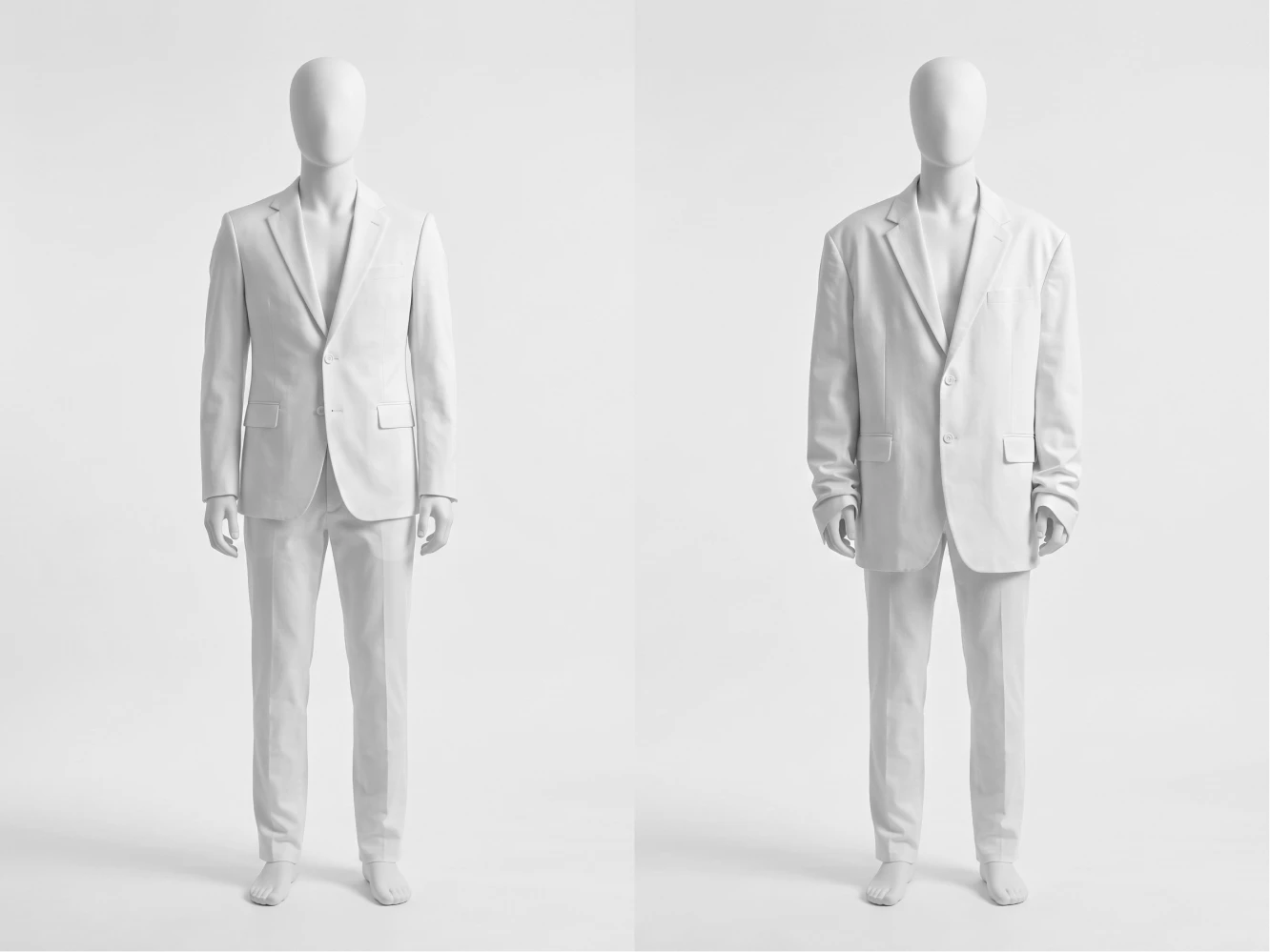
The sample analysis, the real result of co-founder Filip Poláček, shows that split on one Deep Autumn. Midnight blue is a Wear for him. Charcoal is a Depends, "a steady neutral that anchors the lower half rather than the face," and his date night outfit puts it exactly there: a wine shirt with charcoal trousers and chocolate boots. Of the two suits a man is told to buy first, he gets one whole and the other as trousers. The cut is a verdict of its own on the same page: a structured classic suit is a Wear for his shape, because "shoulder and body are cut the way you are built, so it closes without strain," and a double-breasted suit is a Skip. Which cuts follow from which shape is in the guide to men's body shapes.
Gray, and the depth most men skip
Mid gray and light gray sit outside the default navy-and-charcoal advice, and they are the right answer for a lot of men.
Light gray belongs to the summers, Light Summer first, with True Summer and Soft Summer close behind. Paired with a soft white shirt it keeps the whole outfit inside one narrow band of depth, which is exactly what low contrast wants. Light Spring is warm-neutral and wants the same depth at a different temperature, so warm greige or latte instead.
Mid gray is the true middle. It serves True Summer and Soft Summer, and on Deep Winter and True Winter it is the lighter partner to charcoal. Soft Autumn wants the same middle depth on the warm side, which means warm greige or khaki, in a matte cloth. On medium, muted coloring, mid gray is the suit where nothing in the frame is louder than the face.
If you are between two suits and cannot decide, buy the lighter one. Too dark is the less forgiving error.
Which seasons should wear a brown suit?
Brown gets skipped more often than it deserves. A dark brown suit is a Wear for five of the twelve seasons: chocolate for True Spring, Soft Autumn, True Autumn and Deep Autumn, and espresso for Bright Spring, True Autumn and Deep Autumn.
Chocolate is a core color for True Autumn and Deep Autumn and a neutral for True Spring. Espresso is a core color for Deep Autumn and one of True Autumn's neutrals. Both do what a man actually wants from black tailoring, which is depth and a clean line, without turning his face gray.
Camel is core for Soft Autumn and a Wear for all three springs, which lean warm at a lighter depth. A camel suit gets written off as warm weather only. That is a habit, not a rule.
Olive and khaki are the other warm suit neutrals. Olive is core for True Autumn and Deep Autumn and a Wear for Soft Autumn. Khaki is core for Soft Autumn and True Autumn and a Wear for True Spring, while on Deep Autumn it is too light for the jacket and goes to the trousers. An olive suit is a real option for a warm man who needs tailoring but not a business uniform.
Should I own a black suit?
Probably not as your first suit, and for most men not at all.
Black is a Wear for three of the twelve seasons, the three winters, and a core color for Deep Winter. If you are a winter, black tailoring is genuinely yours, and you should own it.
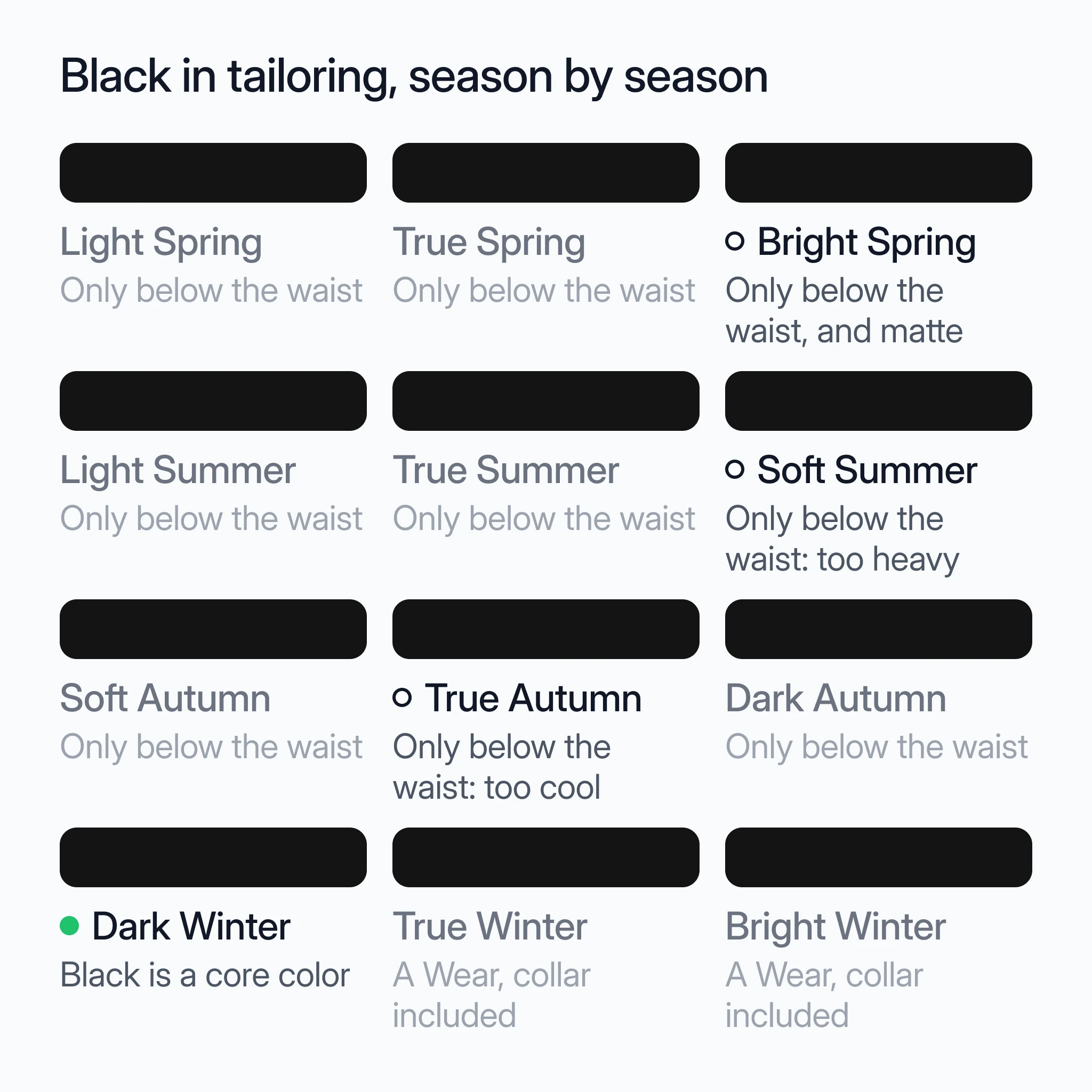
For the other nine, black is a Depends: below the waist or as an accent only. Black trousers, yes. A black jacket under the chin, no. The reason changes by season. For True Autumn it is a straight temperature clash, because the palette is fully warm and black is the deepest cool neutral there is. For Soft Summer the problem is weight, because the coloring is markedly muted and low contrast, and black manufactures a contrast the man does not have. For Bright Spring, black stays on the palette with a spec: below the waist and matte.
Each of the nine has a dark neutral of its own that is a Wear, jacket included. Black is easy to find and easy to default to, which is not the same as it suiting you.
| Season | Verdict on black | Dark neutral that is a Wear |
|---|---|---|
| Light Spring | Depends | Soft navy |
| True Spring | Depends | Chocolate |
| Bright Spring | Depends | Soft navy, espresso |
| Light Summer | Depends | Soft navy |
| True Summer | Depends | Soft navy |
| Soft Summer | Depends | Soft navy |
| Soft Autumn | Depends | Chocolate, olive |
| True Autumn | Depends | Chocolate, espresso |
| Deep Autumn | Depends | Midnight blue, espresso |
Does the shirt change which suit works?
Yes, and it is the cheapest lever you have. The suit sets the depth. The shirt sets the contrast between the suit and your face.
If you are a winter, cool and high contrast, a pure white shirt against midnight blue simply repeats what your coloring already does. Deep Autumn is high contrast too, and gets the same effect from ivory. If your contrast is low, that hard pairing is a jump your face cannot match, and the outfit starts talking over you. Soft white or a dusty blue closes the gap on the summers, and ivory does it on Light Spring and Soft Autumn. Which white is yours is covered in the shirt colors guide.
Menswear has dressed by contrast for a while. Alan Flusser's Dressing the Man sorts men by the contrast between their hair and skin, and as The Rake sums it up, a high-contrast man does well in a dark suit with a white or very light shirt, while a medium-contrast man could wear a mid gray suit with a lavender-and-white striped shirt.
The metal follows your undertone and never changes with the season of the year: gold or brass on warm coloring, silver or steel on cool. Watch, buckle, ring. Shoes sit below the waist, so in the season palettes black shoes are open to everyone. With a brown, olive or camel suit, a dark brown shoe matches its temperature better.
Men's style: common questions
Yes, inside the dress code. A funeral asks for a dark suit, and Gentleman's Gazette names black, navy and charcoal gray as the conventional ones, so take the one your palette allows: any of the three for a winter, midnight blue for Deep Autumn. If none of them is a Wear for you, or the family has asked for black, wear the dark suit anyway and put your correct white next to it so your face keeps some color.
Yes. Take it from your row of the table, and if you are a winter, make it midnight blue or charcoal rather than black, which menswear keeps for fewer occasions. Buy it at your own depth rather than the deepest on the rack, and in your undertone. That single choice does more for how it looks than the tailoring does.
Black tie is a uniform with its own rules and nobody is auditing a dinner jacket against your undertone. The classic dinner jacket comes in two colors: black is the norm, and midnight blue is the alternative, a color that took off in evening wear in the 1930s and, under incandescent light, looks "blacker than black," as Gentleman's Gazette's black tie guide puts it. If midnight blue is a Wear on your row, it is the one to pick. Everything outside a stated dress code is open to all of this.
Judge the color you see from three steps back. A gray suit with a subtle check still reads as one depth, and that depth is the thing that has to match you. Find yours in the twelve color seasons for men.
Skin depth alone does not decide it. Pale skin with fair or red hair is low contrast, the case Gentleman's Gazette has in mind when it warns that black can wash out fair-skinned or fair-haired men, and soft navy, light gray or camel does better there. Dark hair against pale skin raises the contrast, and deep skin with dark hair and eyes carries real depth, but neither settles the color: the same depth can be a Deep Winter in black or a Deep Autumn in espresso, and the undertone decides which.
Yes. Color reads the same on anyone, so the table and the shirt whites hold. What changes is the cut, and a Wearly Labs analysis keeps separate cut libraries for women and men.