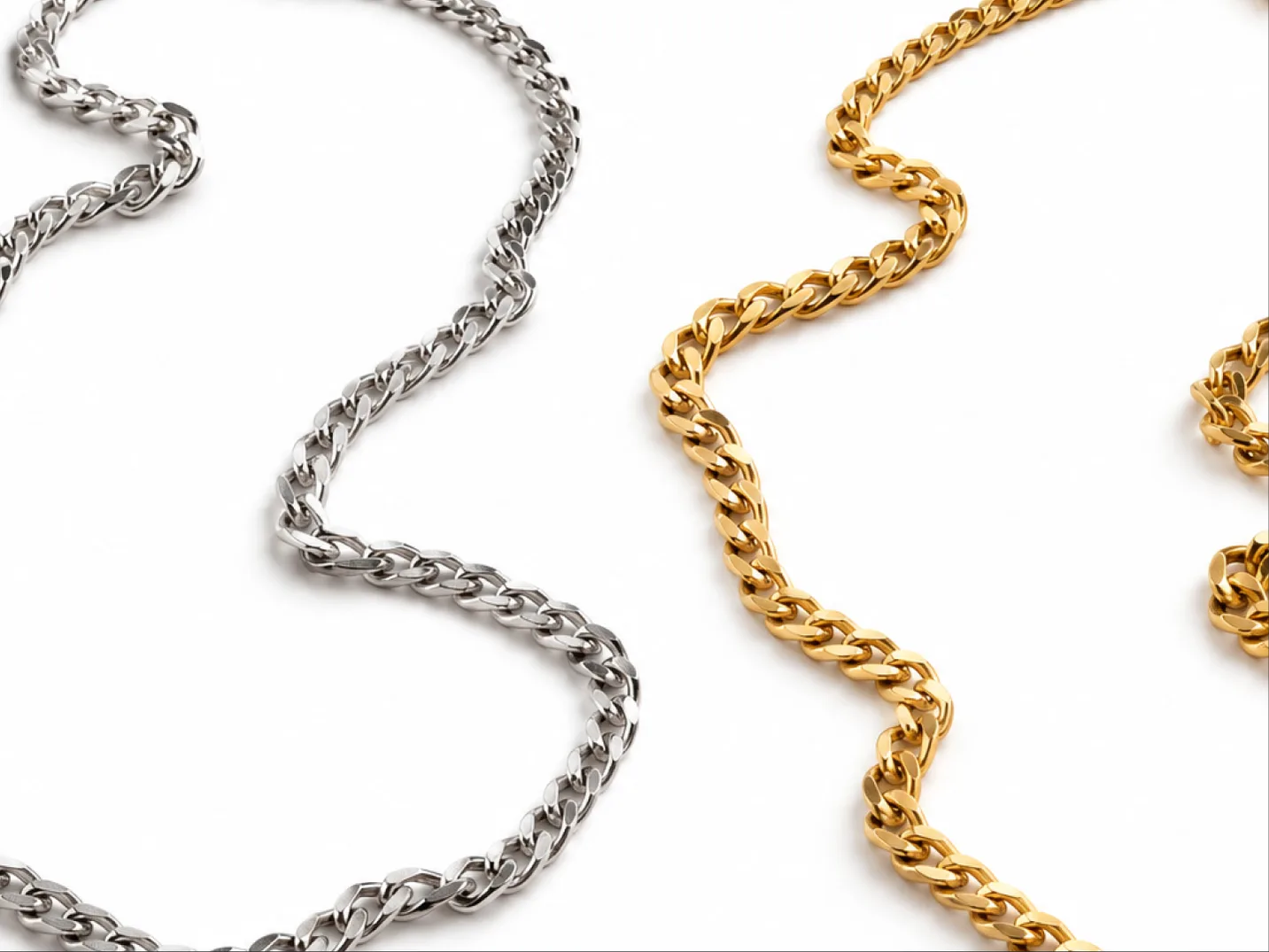
Gold jewelry suits a warm undertone and silver suits a cool one. If your skin has a golden or peachy cast, yellow gold, brass and bronze look like part of you. If it has a pink or bluish cast, silver, white gold and platinum do. If you are neutral, both work and one works slightly better, and the finish, polished or brushed, decides as much as the metal.
On this page
- Why a metal behaves like a color
- What the stamp inside a ring tells you
- Twelve seasons, two metals, many finishes
- The home test, step by step
- Rose gold, white gold, platinum and steel: where the in-betweens go
- Watches, rings, buckles and frames: the metal men wear
- When mixing metals works
- The mistakes that make the right metal look wrong
- Your metal is one line of a palette
- Gold or silver: common questions
That is the whole rule, and it holds for a wedding band, a watch case, a belt buckle and the frames of your glasses as much as for earrings. What follows is why it works, how to test it at home in ten minutes, what each of the 12 color seasons does with it, and where the in-between metals go: rose gold, white gold, platinum, steel and the dark metals.
Why a metal behaves like a color
A metal at your collar is a color at your collar, with one extra property: it shines. Yellow gold is a warm yellow. Silver, steel and platinum are cool, light grays. Put either next to your face and it does what any color does there. It repeats the cast under your skin, which makes the skin look even and clear, or it argues with it, which makes the skin look sallow, gray or flushed.
That cast is your undertone, the fixed color under the surface that does not change when you tan. Our guide to finding your undertone at home runs three tests for it, and the jewelry test is one of them. This article goes further with that one test, because metal is the part of an outfit people wear every day and rarely question.
The shine adds a second dimension. A mirror polish reflects light the way a clear, saturated color does. A brushed or antiqued finish scatters it, the way a muted, grayed color does. So the metal answers your undertone, and the finish answers your chroma, which is how clear or how soft your coloring is. Albert Munsell, who built his color system on hue, value and chroma, defined chroma as the quality "by which we distinguish a strong color from a weak one" in A Color Notation. A strong, clear coloring carries a strong shine. A soft one looks calmer in a soft finish.
What the stamp inside a ring tells you
Before testing, it helps to know what you are holding, because "gold" covers a range of alloys and the other metals in them set the shade.
Karat measures how much of a piece is gold, in parts of 24. The World Gold Council puts it plainly: 24 karat is pure gold with no other metals, 18 karat is 75 percent gold, 14 karat 58.3 percent and 9 karat 37.5 percent. In the UK the Hallmarking Act sets the same steps as parts per thousand, which is why a British ring is stamped 375, 585 or 750. Silver works the same way: 925, the sterling standard, means 925 parts of silver in every thousand.
| Label | Precious metal per 1,000 parts of the alloy |
|---|---|
| 24 karat gold | 999.9 |
| 22 karat gold | 917.0 |
| 18 karat gold | 750.0 |
| 14 karat gold | 583.0 |
| 10 karat gold | 417.0 |
| 9 karat gold | 375.0 |
| Sterling silver | 925.0 |
Sources: World Gold Council, Gold jewelry: color, carat and purity; Hallmarking Act 1973, Schedule 2, standards of fineness; The Assay Office, Silver assay and hallmarking explained. Data: 2026. Gold figures are the World Gold Council's gold content per karat; 24 karat is given as 999.9 fine. Sterling silver is the 925 standard of the UK Hallmarking Act.
The takeaway from the chart: below 18 karat, most of a gold piece is something else, and that something else decides its color. The World Gold Council's guide says white gold is made by alloying gold with white metals such as palladium or silver and is usually plated with rhodium for a brighter surface, and that copper is what gives rose gold its pink. So white gold behaves like silver at your face, and rose gold behaves like a warm pink. The guide also notes that 14 karat is the most popular gold in the US, which is worth knowing when you compare a shop's "gold" with the one in your drawer.
Twelve seasons, two metals, many finishes
In the 12 seasons as Wearly Labs reads them, the metal follows the undertone without exception. The six warm seasons, the Springs and the Autumns, wear gold. The six cool seasons, the Summers and the Winters, wear silver. What changes inside each half is the finish and how far the other metal is allowed in.
The table below is the metal note each season gets in a Wearly Labs analysis, written in the same terms as the season pages. The analysis gives every color one of three verdicts, Wear, Depends or Skip, and the metal works the same way: one leads, the rest pass with a condition or stay out.
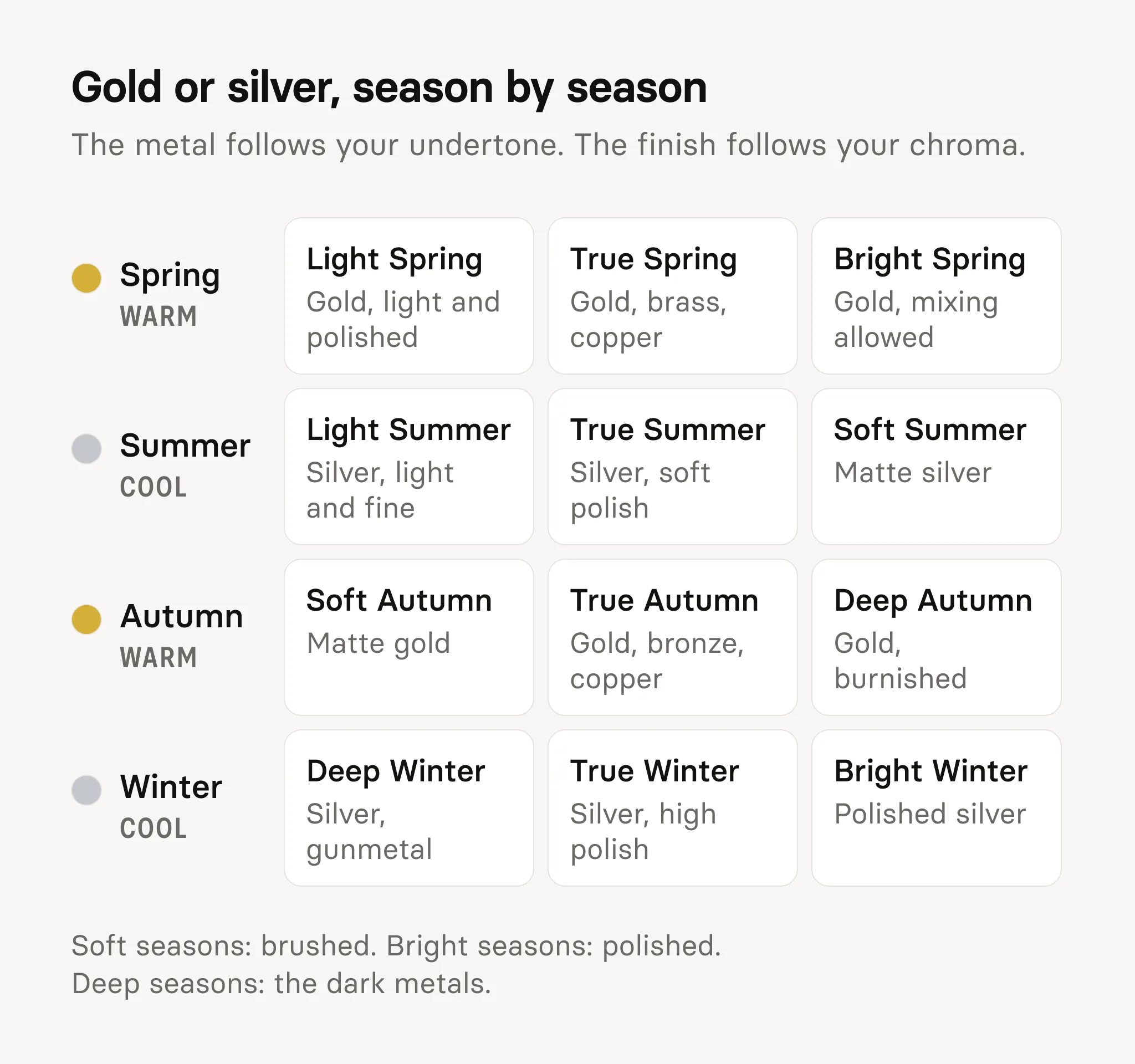
| Season | Your metal | The finish and its cousins | The other metal |
|---|---|---|---|
| Light Spring | Gold | Pale yellow gold, rose gold, a bright polish | Silver reads cold; a thin two-tone piece at most |
| True Spring | Gold | Polished yellow gold, brass and copper, mixed freely | Silver and pewter go gray against your warmth |
| Bright Spring | Gold, mixing allowed | Polished rather than brushed | Silver on the same wrist is fine; dull antique finishes are not |
| Light Summer | Silver | Polished silver, white gold, platinum, kept light and fine | Rose gold in a small piece; yellow gold and copper look heavy |
| True Summer | Silver | Silver, white gold and platinum with a soft polish, pewter | Yellow gold and copper argue with your coolness |
| Soft Summer | Matte silver | Brushed or oxidized silver, pewter | Rose gold in a muted finish passes; bright yellow gold does not |
| Soft Autumn | Matte gold | Brushed gold, antique gold, warm bronze | Copper passes; bright polished silver looks cold |
| True Autumn | Gold | Bronze, copper and brass, antique or polished | Silver and platinum go gray against your warmth |
| Deep Autumn | Gold | Bronze, copper, brass, antique or burnished gold | Icy, mirror-bright silver reads cold; antiqued silver or dark gunmetal in a single piece |
| Deep Winter | Silver | Polished silver, white gold, platinum, gunmetal, black metal | Gold only in a single small piece; copper and brass are out |
| True Winter | Silver | A high polish: bright silver, white gold, platinum, chrome | Yellow gold and copper fight your coolness; a black metal passes |
| Bright Winter | Polished silver | Mirror silver, white gold, platinum, chrome | One mixed silver-and-gold piece; brushed and antique finishes go dull |
Three patterns run through the table, and each one follows from a single axis of your coloring.
The Soft seasons take the matte finish. Soft Summer and Soft Autumn are the two seasons whose coloring is muted above all, so a hard mirror shine reads on them like a clear, bright color, the one quality their palettes leave out. Brushed, antiqued and oxidized finishes match the grayed colors those seasons wear.
The Bright seasons take the polish. Bright Spring and Bright Winter run on clarity, and a dull finish takes the edge off the whole outfit. They are also the two seasons with the most room for the other metal: Bright Spring is the one season whose metal is gold with mixing allowed outright, and Bright Winter can carry a single mixed silver-and-gold piece.
The Deep seasons take the dark metals. Deep Autumn reaches for bronze, burnished gold and antique brass, and Deep Winter for gunmetal and black metal next to its silver. Depth in the coloring carries depth in the metal.
The Light seasons sit at the other end: fine, light pieces, pale yellow gold or rose gold for Light Spring, light polished silver and white gold for Light Summer. Heavy yellow gold looks brassy against cool, light skin.
The home test, step by step
The jewelry test in our undertone guide is a quick read. This is the longer version, the one worth running before you spend money on a watch or a ring. It takes about ten minutes and works the same for men and women.
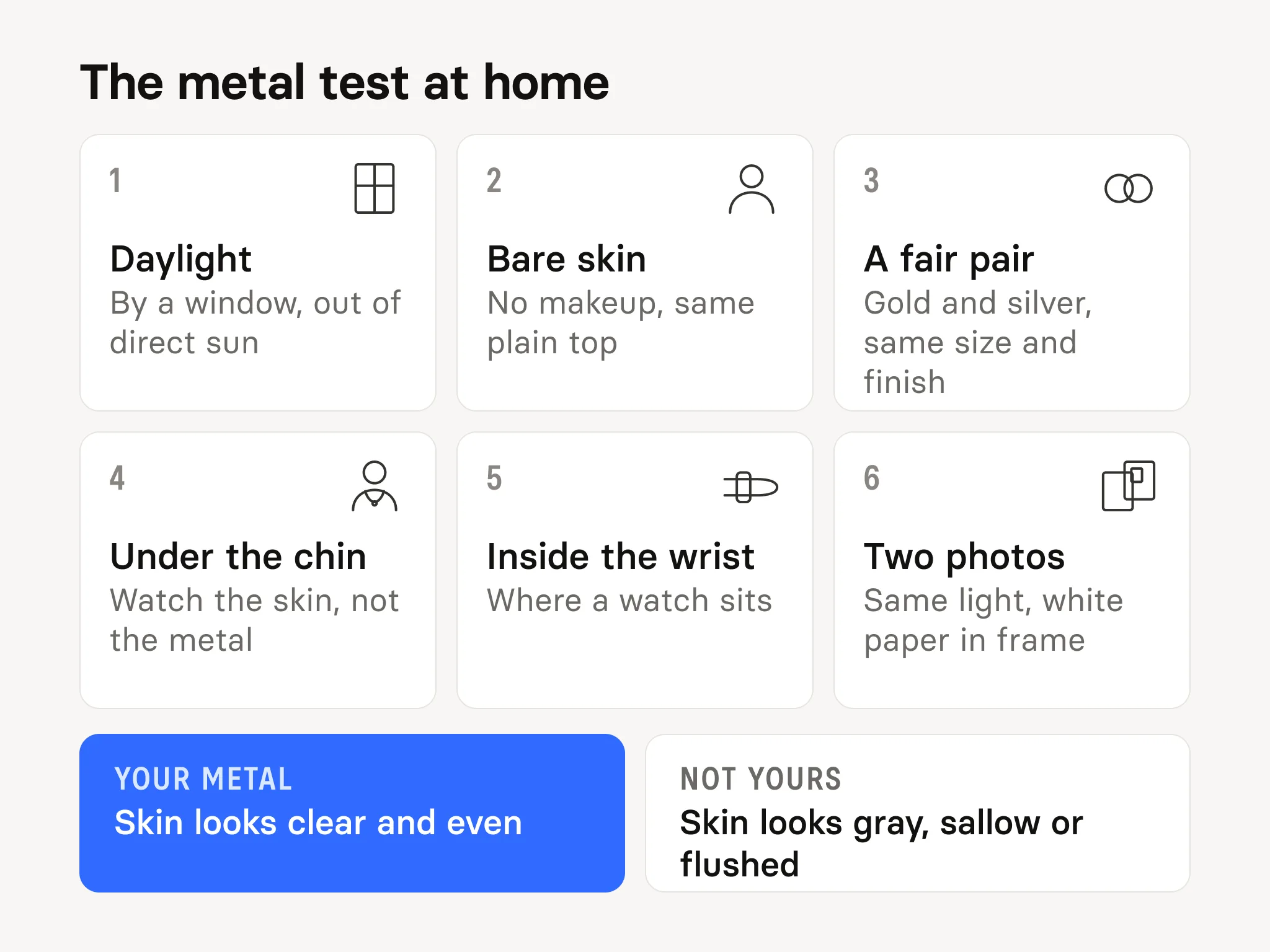
- Find daylight. Stand facing a window, out of direct sun. Bathroom bulbs add yellow and push every reading toward gold. Give your eyes a minute in the light before you judge, because they adjust to a color cast and stop seeing it.
- Clear the frame. Bare skin, no makeup or self-tanner, hair pulled back from the face. Wear a plain top and keep it on for every round, so the only thing that changes is the metal.
- Pick a fair pair. A gold piece and a silver piece of about the same size and the same finish, both polished or both brushed. A chunky gold chain against a fine silver one tests size, not color. No jewelry at home? A steel watch against a gold-tone buckle works, and so does kitchen foil against gold gift wrap.
- Test at the throat. Hold the gold under your chin, close to the skin, and look at your face, not the metal. Then the silver, in the same spot and the same light.
- Know what to watch. The shadows under your eyes, the redness around the nose and chin, and how even the skin looks overall. The right metal makes the skin look clear and rested. The wrong one makes warm skin look gray and flat, or cool skin look yellow and sallow.
- Repeat at the wrist. Lay each piece on the inside of your wrist, where a watch or bracelet sits. The wrist sees less sun than the face, so it often gives the cleaner read.
- Take two photos. Same spot, same light, phone at the same distance, with a sheet of white printer paper in the frame both times. The paper is the one thing in the picture whose color you already know, so if the camera shifts its color between the two shots, you will see it on the paper. Compare the photos side by side, faces only.
- Run the finish round. Once one metal wins, try a polished and a brushed piece of it. A clearly better polish points to clear, bright coloring. A clearly better brushed finish points to soft, muted coloring.
Read the result the way you would read the undertone tests. If one metal wins at the throat and at the wrist, that is your metal. If both look fine, you are probably neutral, and the one that looks slightly better is your lead; the undertone guide has a table of which seasons each lean points to. If the results flip between the throat and the wrist, trust the throat, because that is where people look.
One caution. Judge the metal that looks better on you, not the one you own more of. Most people have a metal habit that started with a gift or a wedding band, and habit is persuasive in a mirror.
Rose gold, white gold, platinum and steel: where the in-betweens go
Most jewelry boxes and most watch cases are not pure yellow gold or sterling silver. Here is where the common in-betweens land, by what they do at the face.
- White gold and platinum read as silver. Every Summer and Winter lists them next to silver, and no warm season leads with them.
- Stainless steel reads as silver too. A steel watch is the default silver piece for Light Summer, True Summer and Deep Winter, and a brushed steel case suits a Soft Summer better than a mirror one.
- Rose gold is a warm pink metal, and it travels further than yellow gold. It belongs to Light Spring, whose palette is pale and warm, and it passes for two cool seasons in a limited form: a small piece for Light Summer, a muted, brushed finish for Soft Summer.
- Brass, bronze and copper are the warm cousins of gold. They belong to the Autumns and to True Spring, and they are out for every Winter.
- Gunmetal and black metal are the dark end. They suit Deep Winter, pass for True Winter, and for Deep Autumn a dark gunmetal works in a single piece.
- Pewter and oxidized silver are the soft end of silver, at home on Soft Summer and True Summer.
Watches, rings, buckles and frames: the metal men wear
Men often say they wear no jewelry and still wear more metal than they think. A man in a suit can carry six metals at once: a watch case, a wedding band, a belt buckle, cufflinks, a tie bar and the frames of his glasses. Each is small. Together they set a warm or cool note right next to the shirt collar and the hands.
The rule is the same as for earrings and necklaces, and so is the season table above. What changes is how the pieces are chosen, so here they are one by one.
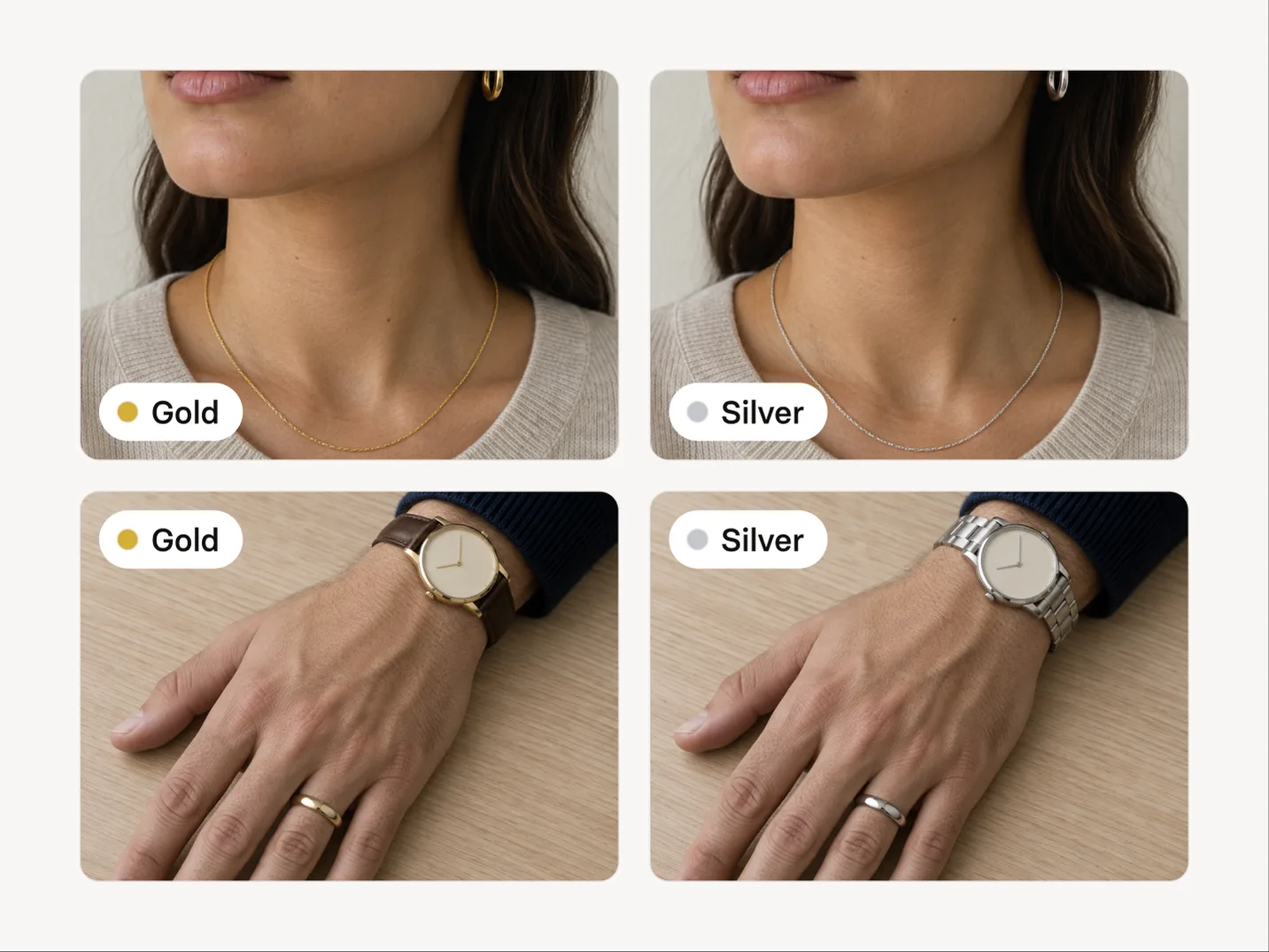
The watch. The case and the bracelet are the largest piece of metal most men wear. A steel case is a silver piece; a yellow gold or gold-tone case is a gold piece. For a cool season, a steel watch on a leather or fabric strap is the easy answer. For a warm season, a gold-tone case or a steel case on a brown leather strap keeps the metal small and lets the leather carry the warmth. A two-tone watch, steel and gold in one bracelet, is a legitimate choice for a Bright Spring and a reasonable one for a Bright Winter; for most other seasons one metal wins.
The ring. A wedding band is worn every day for decades, which makes it the one metal choice worth testing. Yellow gold for the warm seasons, white gold or platinum for the cool ones, and the finish from the table: brushed for the Soft seasons, polished for the Bright ones. A signet ring follows the same rule, and an antique gold signet is close to ideal for a Soft Autumn or a Deep Autumn.
The buckle and the hardware. A belt buckle sits at the waist, below the face, so it matters less than the watch. But it sits in line with the watch and the cufflinks, and a gold buckle with a steel watch looks assembled by accident. Pick the buckle in your metal and let shoe hardware, bag fittings and jacket zips follow where you can. Brass buttons on a navy blazer are a warm-season detail; silver-tone buttons are the cool-season version.
The frames. Glasses sit on the face itself, so metal frames are the most visible metal a man or a woman wears. Gold-tone wire frames suit warm coloring; silver and gunmetal frames suit cool coloring. Acetate frames are a color rather than a metal, and they follow your palette the same way your clothes do.
Women carry the same set and more: earrings and necklaces at the face, rings and bracelets at the hands, buckles and bag hardware lower down. The order of importance is the same for everyone. Whatever touches the face matters most, the hands second, the waist and feet last.
When mixing metals works
Mixing gold and silver is not a mistake by itself. It is a contrast, and contrast suits some colorings better than others.
The seasons built on clarity and contrast carry it best. In the season table, Bright Spring is the season whose metal rule includes mixing, and Bright Winter can wear one mixed piece. For a soft, low-contrast coloring, gold and silver side by side create a sharper break than the face does, and the eye goes to the jewelry.
Three ways to mix without it looking accidental, for anyone who wants to:
- Let one metal lead. Your metal in the larger pieces, the watch and the earrings or ring; the other in one small piece.
- Join them in one object. A two-tone watch or a ring that combines both reads as a design choice. Two separate pieces that disagree read as a coincidence.
- Keep the face in your metal. Earrings, a necklace and glasses frames in the metal that suits you, and the mix lower down, on a bracelet stack or a bag.
The mistakes that make the right metal look wrong
Testing under a warm bulb. Yellow light makes gold look right on almost everyone. Test by a window.
Comparing pieces that differ in size or shine. A large polished gold hoop against a small brushed silver stud tells you about size and finish, not about undertone.
Reading a tan as an undertone. A tan changes the surface of your skin, not the cast under it, and it can make gold look better for a few weeks. Test on skin that has not seen the sun lately.
Getting the metal right and the finish wrong. A Soft Summer in mirror-polished silver and a Bright Winter in brushed, antiqued silver are both wearing their metal, and both look slightly off. The finish row in the table is as much a part of the rule as the metal.
Letting plating fool you. Gold-tone and silver-tone plating carry the color of their surface, so judge them by what you see at your face, not by what is underneath.
Changing the metal and not the colors. A cool season in gold and camel has two warm notes at the face. Metal is part of a palette, and it works best when the clothes next to it agree.
Your metal is one line of a palette
The metal is the easiest part of your coloring to get right, and it is never decided alone. It follows from the same undertone that decides your best white, your neutral and the colors you can wear at your collar. A Deep Autumn wears gold for the same reason ivory works at the collar and black goes below the waist, and a True Winter wears silver for the same reason pure white and black work at the face.
So the metal you choose is better chosen with the rest of the palette than from a trend. Gold has its years and silver has its years, and neither changes the cast under your skin. The same goes for shape: a delicate chain and a heavy cuff are a question of scale, which belongs to your proportions and your line, sharp, medium or soft, more than to any season of fashion.
A color analysis places you in one of the 12 seasons and gives you the metal along with 50 color verdicts, each with its reason. If you want a first read without photos, the free season picker names two or three likely seasons. For how metal fits with the rest of a palette, see the best shirt colors for your skin tone and The 12 color seasons, explained for men.
Gold or silver: common questions
Gold looks better on a warm undertone, the golden or peachy cast under the skin, and silver looks better on a cool one, a pink or bluish cast. If your skin is neutral, both work and one works slightly better. Test it by a window: hold each metal under your chin and watch your skin, not the metal. The one that makes your skin look clear and even is yours.
Olive skin often tests as neutral, so both metals can work, and the finish and the depth of your coloring decide more than the metal. Run the home test with two pieces of the same size and finish, trust the result at the throat, and then run the finish round, polished against brushed, because that is often where a neutral result gets settled.
White gold reads as cool, like silver. It is gold alloyed with white metals such as palladium or silver and is usually plated with rhodium, which gives it a bright white surface. In the 12-season system it sits with silver and platinum on the Summers and Winters.
Rose gold is a warm pink metal and suits light, warm coloring best, the Light Spring palette above all. Two cool seasons can wear it in a limited form: Light Summer in a small piece and Soft Summer in a brushed, muted finish. Its color comes from the copper in the alloy.
Yes, though a steel watch is a silver piece, so it works best kept small and paired with warm materials. A steel case on a brown leather strap keeps most of what touches the wrist warm. A gold-tone case is the closer match for a warm season, and a two-tone watch suits a Bright Spring.
No. Mixing is a contrast, and it suits clear, high-contrast coloring best: Bright Spring is the season whose metal rule includes mixing, and Bright Winter can carry one mixed piece. For softer coloring, keep one metal at the face and the other in a single small piece lower down.