Soft Autumn and True Autumn are both warm, and what separates them is chroma, how strong a color is compared with gray: True Autumn carries rust, golden yellow and forest green at full strength, while Soft Autumn needs the same warmth grayed down. To tell which you are, hold a rust top at your jaw in daylight and soften your focus: on True Autumn the rust melts into your face, and on Soft Autumn it stays a separate block of color.
On this page
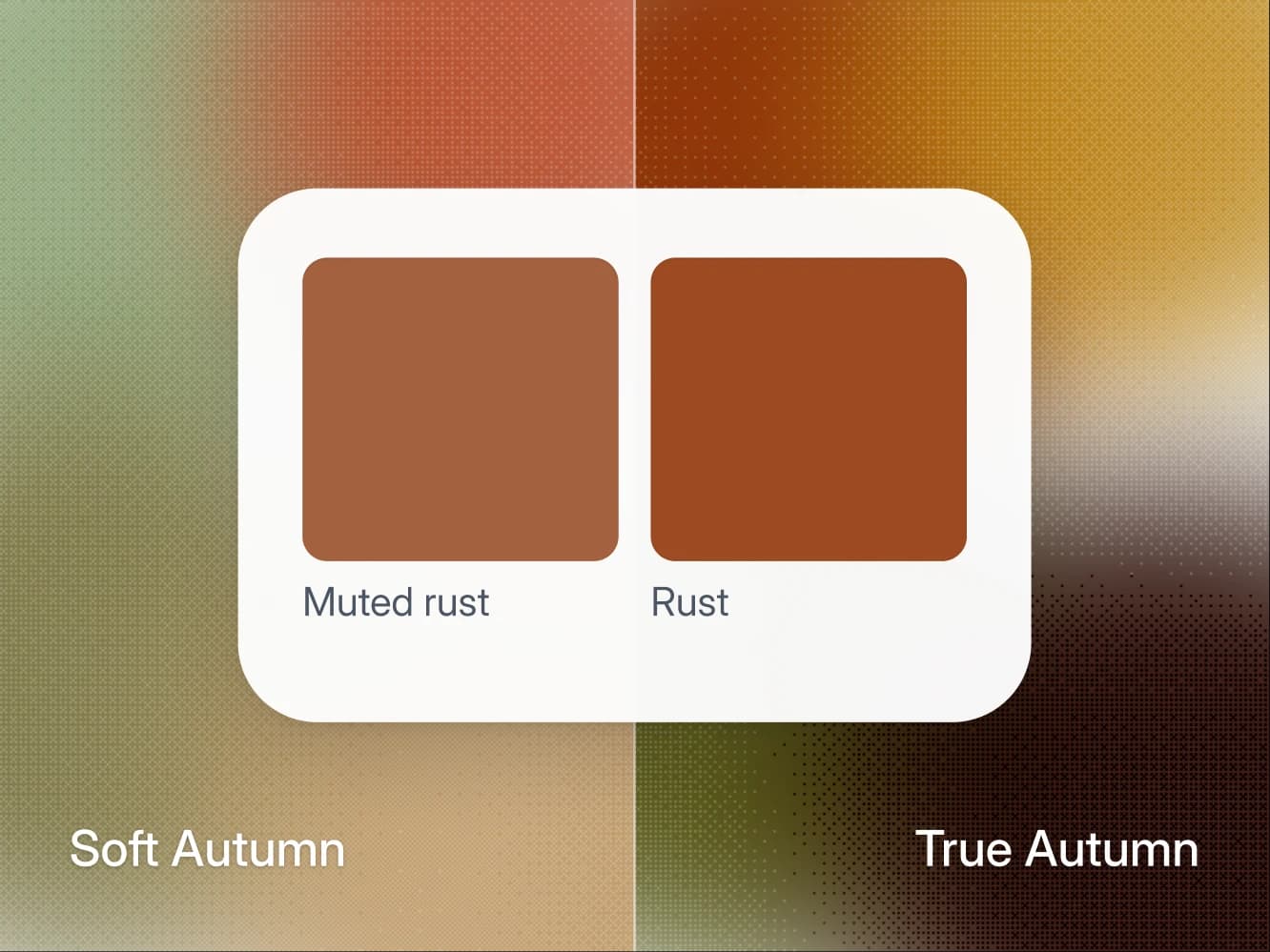
Rust comes in two strengths: grayed rust and terracotta suit Soft Autumn, and full-strength rust suits True Autumn. Each palette in full is on the Soft Autumn and True Autumn pages.
Soft Autumn vs True Autumn at a glance
- The difference: chroma. True Autumn wears strong colors, and Soft Autumn wears the same hues grayed down.
- The test: rust at your jaw with your eyes defocused. One continuous warm band means True Autumn, and a visible border at the jaw shadow means Soft Autumn.
- Shared ground: both are warm, medium in value and take ivory and gold. Ten of the 50 colors in a Wearly Labs analysis are a Wear for both.
- Different verdicts: 18 of the 50 colors change verdict between the two palettes, and 32 keep the same one.
- White and metal: ivory for both. Soft Autumn takes matte gold, and True Autumn takes polished gold.
What Soft Autumn and True Autumn share
Both seasons are warm rather than cool, so both take ivory instead of soft white and gold instead of silver. Both sit at medium value, meaning neither is especially light or deep, and both palettes have muted colors in them: Soft Autumn is built from them, and True Autumn reaches past them into rich ones.
Chroma, the axis that separates them, is how far a color sits from gray. Albert Munsell, who defined it in A Color Notation in 1905, called it "the quality by which we distinguish a strong color from a weak one."
Ten colors are a Wear for both seasons, the face included: terracotta, khaki, mustard, olive, rust, camel, chocolate, warm greige, ivory and medium denim. Rust is on that list, so the verdicts cannot settle this pair on rust. How strong the rust is can, and the test below measures exactly that.
The palettes part where they extend: Soft Autumn into sage, peach, leaf green and latte, True Autumn into golden yellow, orange, tomato red, forest green and espresso. You can go years without settling this, until one rich purchase, such as a rust knit, forces it.
Where Soft Autumn and True Autumn split
In the 12-season system each season leads with one trait. True Autumn leads with warmth. Soft Autumn leads with softness, which is low chroma, and warmth comes second. On the season wheel Soft Autumn sits between Soft Summer and True Autumn, as the Autumn nearest the Summers, and True Autumn sits in the middle of its family, between Soft Autumn and Deep Autumn, which Wearly Labs calls Dark Autumn.
| Axis | Soft Autumn | True Autumn |
|---|---|---|
| Leads with | Softness | Warmth |
| Undertone | Warm-neutral | Fully warm |
| Value | Medium | Medium |
| Chroma | Muted | Muted to rich |
| Contrast | Low | Medium |
| Best white | Ivory | Ivory |
| Metal | Matte gold | Polished gold |
| Power color | Muted terracotta | Rust |
| Black | Below the waist | Below the waist |
Value, best white and black are ties, so they cannot decide. Undertone, the warm or cool cast under your skin, and contrast, the gap between your hair, skin and eyes, each differ by a step. Chroma is the row you can see at the collar.
Colors with different verdicts for Soft Autumn and True Autumn
A Wearly Labs analysis gives each of its 50 colors a verdict, Wear, Depends or Skip, with the reason, and Depends means below the waist or as an accent only. Eighteen colors change verdict between these two seasons, and the table shows eleven.
| Color | Soft Autumn | True Autumn |
|---|---|---|
| Golden yellow | Skip | Wear |
| Orange | Skip | Wear |
| Tomato red | Skip | Wear |
| Forest green | Skip | Wear |
| Espresso | Depends, below waist | Wear |
| Peach | Wear | Depends, accent |
| Sage | Wear | Depends, accent |
| Leaf green | Wear | Depends, accent |
| Latte | Wear | Depends, below waist |
| Wine | Depends, below waist | Skip |
| Midnight blue | Depends, below waist | Skip |
Read down each column: True Autumn's extra colors are strong or deep, and Soft Autumn's are lighter and quieter. The reasons:
- Golden yellow, orange, tomato red: a Skip for Soft Autumn because they are too clean for its softness, and a Wear for True Autumn because they carry warmth at full strength.
- Forest green and espresso: deep colors that True Autumn wears at the collar. Soft Autumn keeps espresso below the waist and skips forest green, which is deeper than its medium value carries near the face.
- Peach, sage, leaf green, latte: lighter and quieter, so Soft Autumn wears them anywhere. True Autumn keeps the first three as accents and latte below the waist, because they are too light and soft for its stronger coloring.
- Wine and midnight blue: cool-leaning colors. They are a Skip for fully warm True Autumn, and a below-the-waist Depends for Soft Autumn, whose warm-neutral undertone has room for a little cool.
The other seven differences follow the same two patterns. Plum, lavender and soft pink are a Depends below the waist for Soft Autumn, and dusty pink, dusty blue and mauve work as accents, while all six are a Skip for True Autumn. Turquoise runs the other way: a Skip for Soft Autumn and an accent for True Autumn.
The defocus test: how to tell Soft Autumn from True Autumn at home
The test asks whether your face and the garment read as one object or as two, and nothing else.
- Pick the rusts. Use a rust top. If you own two, take one grayed and brownish and one at full strength, which is the pair in the picture below. With only one, test it first and then compare it with a terracotta or camel top.
- Set up the light. Stand at a north-facing window (south-facing below the equator), in daylight with no direct sun. Put a mirror far enough back to show your head and shoulders, and pull your hair off your face.
- Hold the rust at your collarbone and defocus. Let your eyes go soft until the mirror blurs, the way you would to see a hidden image in a stereogram poster. Squinting works if that does not.
- Look at the shadow under your jaw. On True Autumn it disappears, and face and rust melt into one continuous warm band. On Soft Autumn it becomes a dividing line: your face blurs into a soft, muted haze, and the rust stays a distinct block under it.
- Repeat with muted rust, terracotta or camel. A Soft Autumn watches the border dissolve, because the grayed color sits at the strength of the face.
The picture shows the pair to compare, muted rust against saturated rust on one white band. Soften your focus on it and look again.
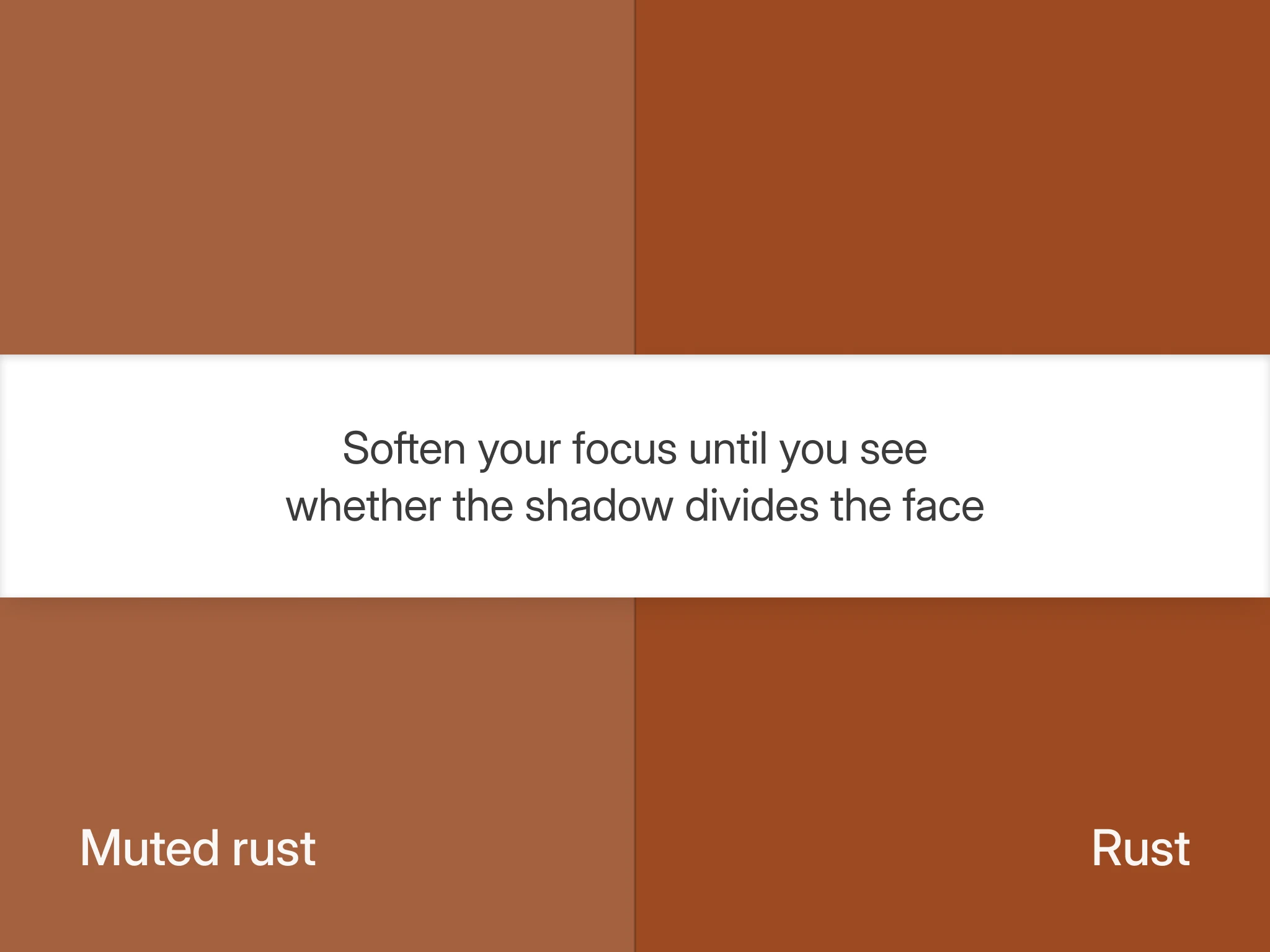
For a cross-check, use the pair the verdicts split most cleanly: golden yellow, then sage. Golden yellow is a Wear for True Autumn and a Skip for Soft Autumn. Sage runs the other way, a Wear for Soft Autumn and an accent only for True Autumn. The one your face holds without a jaw line appearing is your side.
What the wrong season looks like
- A Soft Autumn in True Autumn colors. Full-strength rust, golden yellow and forest green hold their color, and a low-contrast face with muted coloring cannot answer that, so the outfit gets noticed before you do.
- A True Autumn in Soft Autumn colors. The failure is quieter. The warmth and the white are right, and the outfit can still fall flat. You lose golden yellow, orange and forest green, the colors that give True Autumn its weight, rust drops to its grayed version, and matte gold replaces polished gold, which takes the last point of shine out of the look.
If the defocus test splits
Chroma is hard to judge by eye, because vision adjusts to the color in front of it. Color scientists Mark Fairchild and Lisa Reniff timed that adjustment in 1995 for a change in the color of the light: a first stage took a few seconds, and the whole was about 90% complete after a minute. So judge each color in the first seconds after you hold it up, and look away before the next one.
This pair is the warm counterpart of Soft Summer against True Summer, and chroma is the hard axis there too. If the test still splits:
- Shop only the overlap for a season. Terracotta, khaki, mustard, olive and camel, with ivory at the collar and brushed gold at the wrist.
- Buy one rich item and wear it for a week. A rust knit at the collar works. A week of daylight, office light and photographs gives you more to judge than seven seconds at a mirror.
The sample analysis shows how close neighbors can sit. It is the real result of co-founder Filip Poláček, a Dark Autumn, and his page names True Autumn as his sister season: True Autumn is what his photos alone suggested, his answers decided the season, and the page adds "Anything both seasons accept is a safe buy." A full analysis settles the question from your own photos: AI reads the five photos, with a white sheet of paper in frame to correct the light, fixed rules make the call, and your answers weigh the most.
FAQ
Hold full-strength rust at your jaw in daylight and defocus your eyes. If face and rust melt into one warm band, you are True Autumn, and if the jaw shadow stays as a border, you are Soft Autumn. Golden yellow and sage give a second opinion, because each is a Wear for one season and not for the other.
Yes, in the 12-season system used here: True Autumn and Warm Autumn are two names for the same season, the fully warm center of the Autumn family. The clothing brand Kettlewell, for one, runs four Autumn sub-types, Soft, Warm, True and Deep, so Warm and True are two different palettes there. Check which system a palette comes from before you compare it with this one.
Muted rust is rust with gray mixed in, so what drops is chroma, the strength of the color, and not its lightness. Muted rust sits in the Soft Autumn palette, and rust at full strength is the True Autumn power color. A Wearly Labs analysis marks rust a Wear for both seasons, which is why strength, and not the color name, decides.
Only below the waist, and the verdict is the same for both: black is a Depends, for trousers and shoes. Near the face it puts a hard cool note next to warm coloring. Chocolate is a Wear for both and takes over the anchoring job at the collar, and True Autumn can add espresso, which Soft Autumn keeps below the waist.
Ivory is the white for both. Pure white is too cold and bright for either season, and soft white is still a little cold, so both are a Depends below the waist. For metal, Soft Autumn takes matte gold, because polished shine behaves like high chroma. True Autumn has the depth and color strength to carry polished gold, brass, bronze and copper.
They point in a direction and do not settle it. A Soft Autumn iris tends to blur at conversation distance, in mixed hazel, soft green or muted brown. A True Autumn eye is more often warm brown, hazel, amber or olive green with gold around the pupil. Dyed hair, a tan and indoor light all move those cues, which is why the garment at your jaw decides. For the undertone half of the question, start with finding your undertone at home.
For a while, yes. Those three, with olive, rust, camel, chocolate, warm greige, ivory and medium denim, are a Wear for both seasons. The decision becomes unavoidable when you buy something rich, because that is the purchase the two seasons disagree about.