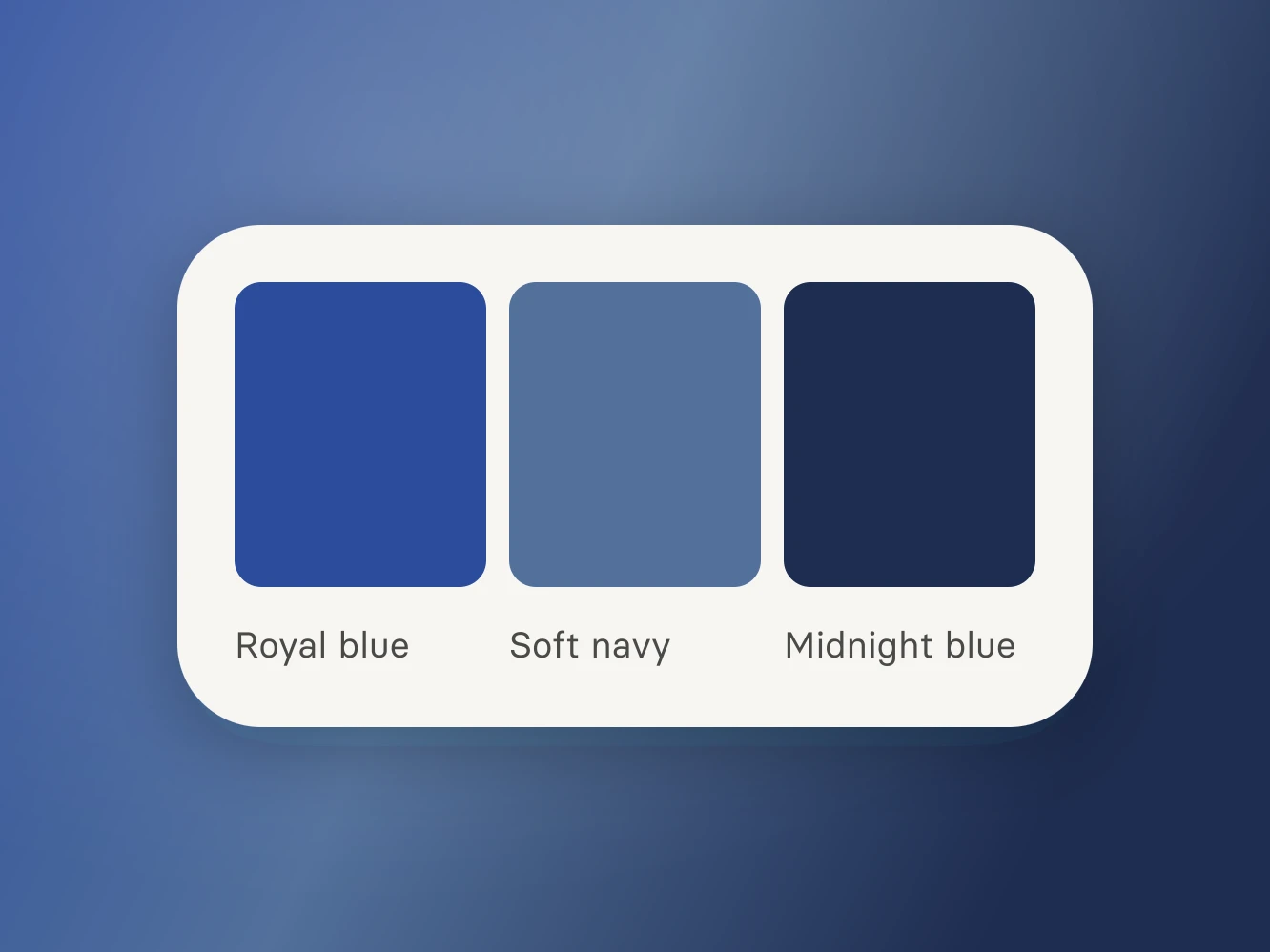
Royal blue suits the cool, clear seasons: True Summer, Deep Winter, True Winter and Bright Winter wear it at the face, Bright Spring and Light Summer keep it to an accent, and the other six skip it. Navy suits more people, as long as it is the right depth: soft navy, a grayed navy of medium depth, belongs at the face of Light Spring, Bright Spring and the three Summers, and midnight blue, the dark navy close to black, at the face of Deep Autumn and the three Winters.
On this page
Those are the verdicts a Wearly Labs analysis gives the three blues, Wear, Depends or Skip, each with its reason. The full table for all twelve seasons is below, then a mirror test you can run at home, then the question behind most navy purchases: when navy can take the place of black.
Royal blue vs navy at a glance
- Royal blue: clear, saturated, medium depth, cool. A Wear for 4 seasons, a Depends for 2, a Skip for 6.
- Soft navy: grayed, medium depth, neutral undertone. A Wear for 5 seasons, a Depends for 3, a Skip for 4.
- Midnight blue: dark, muted, cool. A Wear for 4 seasons, a Depends for 4, a Skip for 4.
- The split: no season wears both navies at the face. The light and muted seasons take soft navy, Deep Autumn and the Winters take midnight blue.
- No blue at the face: for True Spring, Soft Autumn and True Autumn, none of the three is a Wear.
What separates royal blue from navy
Two readings separate them: depth and clarity. Depth, also called value, is how light or dark a color is. Clarity, also called chroma, is how clean the pigment is, from bright and saturated to grayed and muted. A third reading, undertone, is the warm or cool cast a color carries, and it matters as much on the skin as on the fabric.
| Reading | Royal blue | Soft navy | Midnight blue |
|---|---|---|---|
| Depth | Medium | Medium | Dark |
| Clarity | Clear | Muted | Muted |
| Undertone | Cool | Neutral | Cool |
| A Wear at the face for | 4 seasons | 5 seasons | 4 seasons |
Royal blue is the blue with a strong light: saturated, with a slight violet lean, the blue of team kits and flags. In an outfit it acts as a color. Navy is the blue people treat as a neutral, and the analysis holds it at two depths. Soft navy is navy with gray worked into it, the color of a navy sweater after many washes, a few steps lighter than classic navy and close to neutral, so warm and cool skin can both sit beside it. Midnight blue is the dark one, close to black, cool and muted.
So "royal blue or navy" is really two questions. Can your coloring carry a clear, saturated blue at the face? And if you want a dark blue, how dark can it go before it takes the light out of your face?
Royal blue and navy for all 12 seasons
Each cell below is the verdict a Wearly Labs analysis gives that blue for that season, with the reason. Depends means as an accent for royal blue and soft navy, a scarf, a strap or a shoe, and below the waist for midnight blue, trousers and shoes rather than a shirt.
| Season | Your blue at the face | Royal blue | Soft navy | Midnight blue |
|---|---|---|---|---|
| Light Spring | Soft navy | Skip. Stronger and cooler than your light, warm coloring | Wear. A dark at a depth your light coloring can hold | Skip. So dark it takes the light from your face |
| True Spring | None of the three | Skip. Its violet lean turns golden skin sallow | Skip. Its gray dulls your clear warmth | Skip. Too cool beside your warmth |
| Bright Spring | Soft navy | Depends. Clear like you, but too cool for a whole shirt | Wear. A dark beside light skin that keeps warm skin bright | Skip. Too cool beside your warmth |
| Light Summer | Soft navy | Depends. Cool like you, but stronger and darker | Wear. It frames the face and stays calm | Depends. A dark for trousers, while soft navy goes higher |
| True Summer | Royal blue, soft navy | Wear. Cool like you and at your depth | Wear. Cool, softly muted and medium, like you | Depends. Darker than your coloring, so it stays below the waist |
| Soft Summer | Soft navy | Skip. Too clear for your grayed coloring | Wear. Its gray is the gray in your coloring | Depends. At the face it takes light, in trousers it does not |
| Soft Autumn | None of the three | Skip. Clear and cool against muted, warm coloring | Depends. Muted like you, but cool on warm skin | Depends. Darker than your medium depth, fine as trousers |
| True Autumn | None of the three | Skip. Its violet cast makes golden skin look yellow | Depends. Its blue base sits apart from your warmth | Skip. Too cool beside your warmth |
| Deep Autumn | Midnight blue | Skip. Its cool pigment makes warm, dark skin look ashen | Depends. Lighter and grayer than your coloring | Wear. Dark like you, the navy you share with Deep Winter |
| Deep Winter | Royal blue, midnight blue | Wear. A bright note your depth can carry | Skip. It reads faded beside your depth | Wear. Cool depth that holds your contrast |
| True Winter | Royal blue, midnight blue | Wear. Cool, clear and medium, like you | Skip. Its dusty finish looks washed out on you | Wear. A cool dark as strong as your contrast |
| Bright Winter | Royal blue, midnight blue | Wear. Your contrast takes it at full strength | Skip. It looks dull and gray at your collar | Wear. The dark that sets off your clear colors |
Read across a row for your own three blues, or down a column for who a blue is for. Each blue has a page of its own with every season's verdict: royal blue, soft navy and midnight blue.
Three things the table shows
- Royal blue is a Winter color with one Summer. All three Winters wear it at the face. True Summer joins them because it shares the blue's cool undertone and its medium depth. Soft Summer is cool enough as well, but too gentle for its intensity.
- The two navies never meet at the face. Nine seasons wear a navy at the face and each wears exactly one of the two: soft navy for Light Spring, Bright Spring and the three Summers, midnight blue for Deep Autumn and the three Winters. Royal blue pairs with soft navy at the face only for True Summer, and with midnight blue for the three Winters.
- Three seasons wear no blue at the face. For True Spring, Soft Autumn and True Autumn none of the three is a Wear. Their dark at the collar is brown instead: chocolate for True Spring and Soft Autumn, espresso or chocolate for True Autumn. When True Spring wants a blue, turquoise is a Wear.
The mirror test: royal blue against navy at your face
A royal blue top and a navy one, held one after the other, show which way your coloring leans. Three steps do it.
- Set up the light and the fabric. Stand at a north-facing window (south-facing below the equator) around midday, with every lamp off, no makeup, and your hair pulled back. Use plain, matte tops or scarves, because a sheen will fool you before the color does. If you own a grayish navy and a near-black one, bring both.
- Hold them in turn under your chin. Royal blue, then navy, then royal blue again. Do not look at the fabric. Look at the whites of your eyes, the shadow under them, and the skin around your mouth.
- Read the result. The right blue makes the face clearer: the whites of the eyes look clean and the skin looks even. A royal blue that is wrong for you either arrives before your face does, so the blue is all anyone sees, or turns the skin sallow and slightly yellow. A navy that is too dark deepens the shadow under the eyes. A navy that is too gray makes a clear face look dull.
How the results point:
- Royal blue looks clean and the near-black navy holds up too: the Winter side, where royal blue and midnight blue are both a Wear.
- Royal blue looks clean, the near-black navy looks heavy, the grayish one looks easy: True Summer, the one season that wears royal blue and soft navy at the face.
- Royal blue looks loud and the grayish navy looks calm: Light Spring, Bright Spring, Light Summer or Soft Summer.
- Royal blue turns you sallow and the near-black navy looks rich: Deep Autumn.
- Every blue makes the skin look yellow or gray: True Spring, Soft Autumn or True Autumn. Hold a chocolate brown top next, which is a Wear for all three.
If royal blue and the near-black navy both look good, the border to check is Bright Winter against Deep Winter: Bright Winter vs Deep Winter runs the same two blues side by side.
A home test narrows it to a side of the wheel, not to one season. In a Wearly Labs analysis, AI reads undertone, value, chroma and contrast together from five photos, with a white sheet of paper in frame to correct the light, and your answers about your hair, your eyes and your skin sit beside the photos. Fixed rules make the call, and when a photo contradicts a clear answer, the answer decides.
When navy instead of black
Black is a Wear for the three Winters and nobody else. For the other nine seasons it is a Depends, kept below the waist, and that is where navy earns its place in a wardrobe.
- Light Spring, Bright Spring, Light Summer, True Summer, Soft Summer: soft navy takes over black's job above the waist, in a coat, a blazer or a knit. Black stays in trousers and shoes.
- Deep Autumn: midnight blue is the dark at the face, in a coat or a suit, while black goes into boots or a skirt.
- Deep Winter, True Winter, Bright Winter: black is already a Wear, so navy is a choice rather than a fix. Midnight blue does the same job at the face. Soft navy is a Skip for all three.
- True Spring, Soft Autumn, True Autumn: neither navy goes at the face, so black's replacement is brown: chocolate for True Spring and Soft Autumn, espresso for True Autumn.
If black at the collar has always made you look tired, that is the swap to try first: the navy at your depth, or the brown, in the same coat or sweater.
Royal blue vs navy: common questions
No. They are close in hue and far apart in depth and clarity. Navy is a dark blue that many wardrobes use as a neutral. Royal blue is lighter and much more saturated, so it acts as a color in an outfit and needs a cool, clear coloring to sit at the face.
Classic navy is cool, and so is midnight blue, the dark navy. Soft navy sits closer to neutral: the gray takes the edge off the blue, which is why two warm seasons, Light Spring and Bright Spring, wear it at the face.
Yes, when your season wears both at the face. For the three Winters, a royal blue shirt under a midnight blue coat keeps both blues at their best. For True Summer the pair is royal blue with soft navy. For every other season, one of the two is an accent, kept below the waist, or a Skip.
Midnight blue, yes: it is a Wear for Deep Winter, True Winter and Bright Winter. Soft navy is a Skip for all three, because its gray reads as dust on clear, saturated coloring.
Royal blue is a Skip for all three Autumns. Navy depends on its depth: midnight blue is a Wear for Deep Autumn, and soft navy is an accent for Soft Autumn, True Autumn and Deep Autumn, a scarf, a strap or a shoe.
None of these three. Royal blue and midnight blue are too cool for its warmth, and the gray in soft navy dulls its clarity. True Spring's blue is turquoise, a Wear at the face, and its dark is chocolate.